

The F-14 Tomcat is a beloved Cold War-era fighter operated mainly by the United States Navy.
Originally designed for fleet defense, the F-14 was later upgraded into a highly capable multirole fighter. The F-14 is best known for its variable-sweep wing.
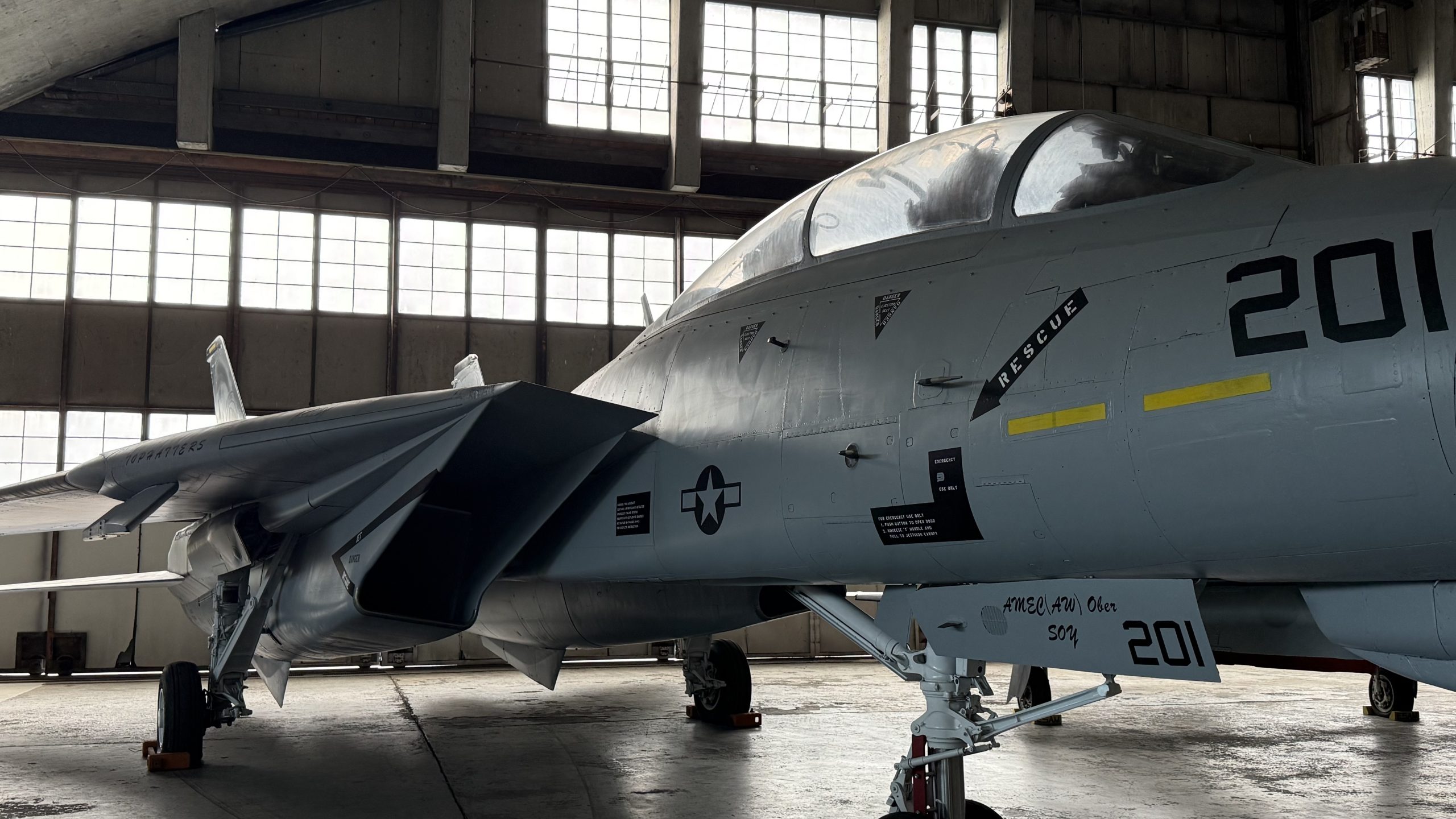
F-14 Tomcat Museum Photo 19FortyFive Photo Taken September 2026
As the aircraft accelerates, its wings automatically sweep back, making it better suited for supersonic flight.
When the aircraft needed to slow down, its wings would sweep forward again, providing better stability at slower speeds, which was excellent for carrier operations.
Although the aircraft has long since been retired from U.S. service, it retains a near-mythic status in the hearts and minds of aviation enthusiasts.
Why the Navy Wanted a Variable-Sweep Wing Fighter
The Tomcat evolved from the Naval Fighter Experimental (VFX) program. However, even before the VFX program, the Navy wanted a supersonic carrier fighter with swept-wing technology.
The Tactical Fighter Experimental (TFX) program, a joint program with the Air Force, thoroughly explored the concept of a swept-wing fighter.
The program resulted in the F-111 Aardvark, a fighter that the Navy hated (some would argue unjustly). The service feared that joint development with the Air Force would compromise the fighter’s carrier capability.
As a result, the Navy withdrew from the TFX program and launched its own VFX program.
One of the few aspects that the Navy actually appreciated about the F-111 was its sweep-wing geometry. The TFX program therefore required a fighter with variable-sweep wings.
The Navy wanted a sweep-wing fighter for a few reasons.
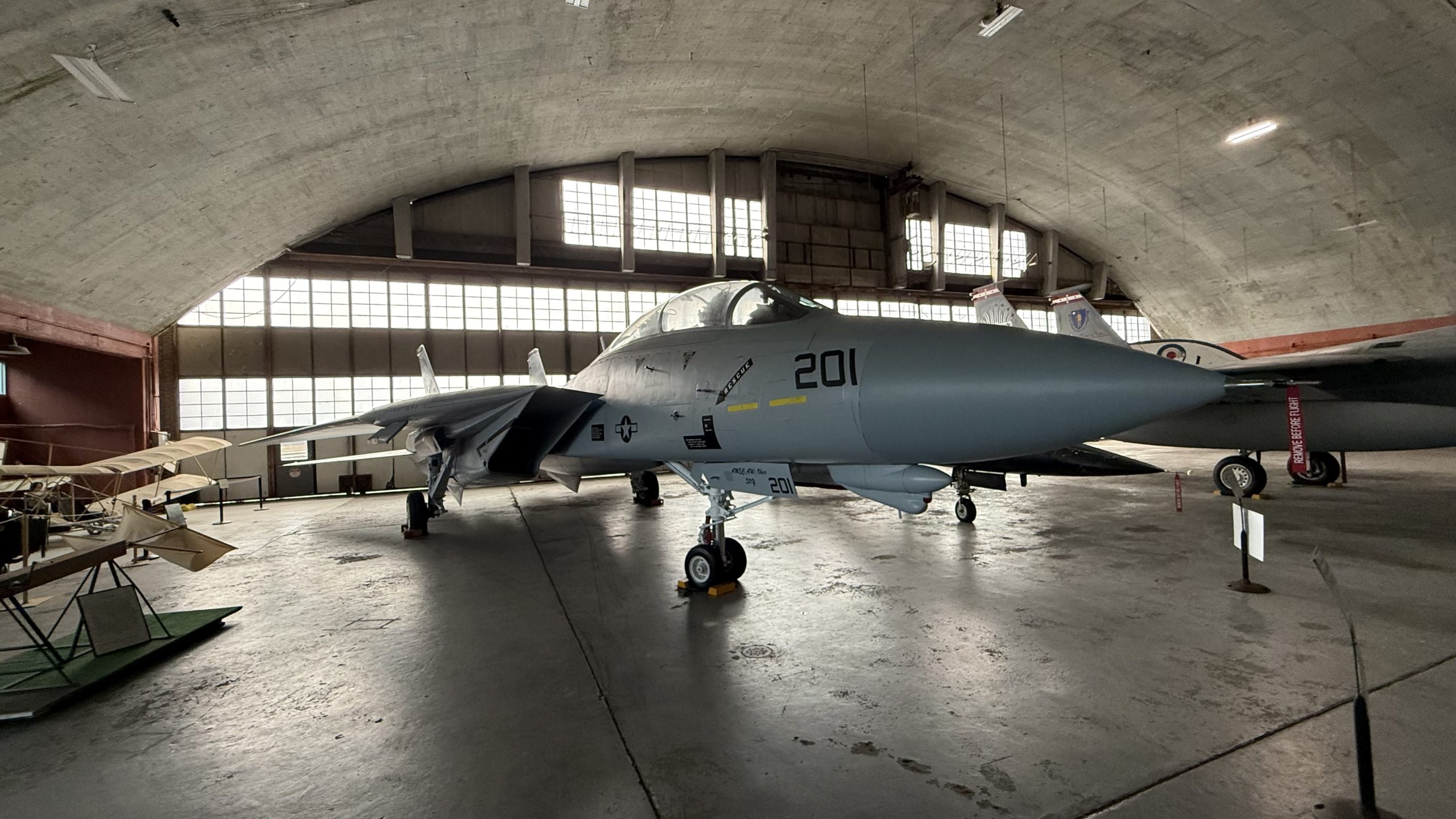
F-14 Tomcat Museum Photo 19FortyFive Photo Taken September 2026
First, supersonic speed was the rage. At the time, air defense systems had not matured to the point where they are now.
Flying fast was the surest way to ensure survival and enhance a fighter’s performance as an interceptor.
Secondly, a variable-sweep wing layout allowed excellent subsonic and supersonic performance.
For a carrier fighter in particular, the aircraft could accelerate to high speeds before sweeping its wings forward for better stability on approach to its aircraft carrier.
In other words, variable-sweep wings were seen as the best of both worlds.
How the Tomcat’s Wings Worked
The F-14 featured an automatic wing-sweep system that would reposition its wings mid-flight.
An onboard Central Air Data Computer (CADC) powered the system and continuously calculated the most efficient wing angle based on the aircraft’s speed and other flight conditions.
The system used complex hydraulic actuators connected to a transmission system that kept the wings symmetrical.
If one wing fell out of alignment, the resulting asymmetrical lift would strain the flight control systems and make the F-14 harder to control.
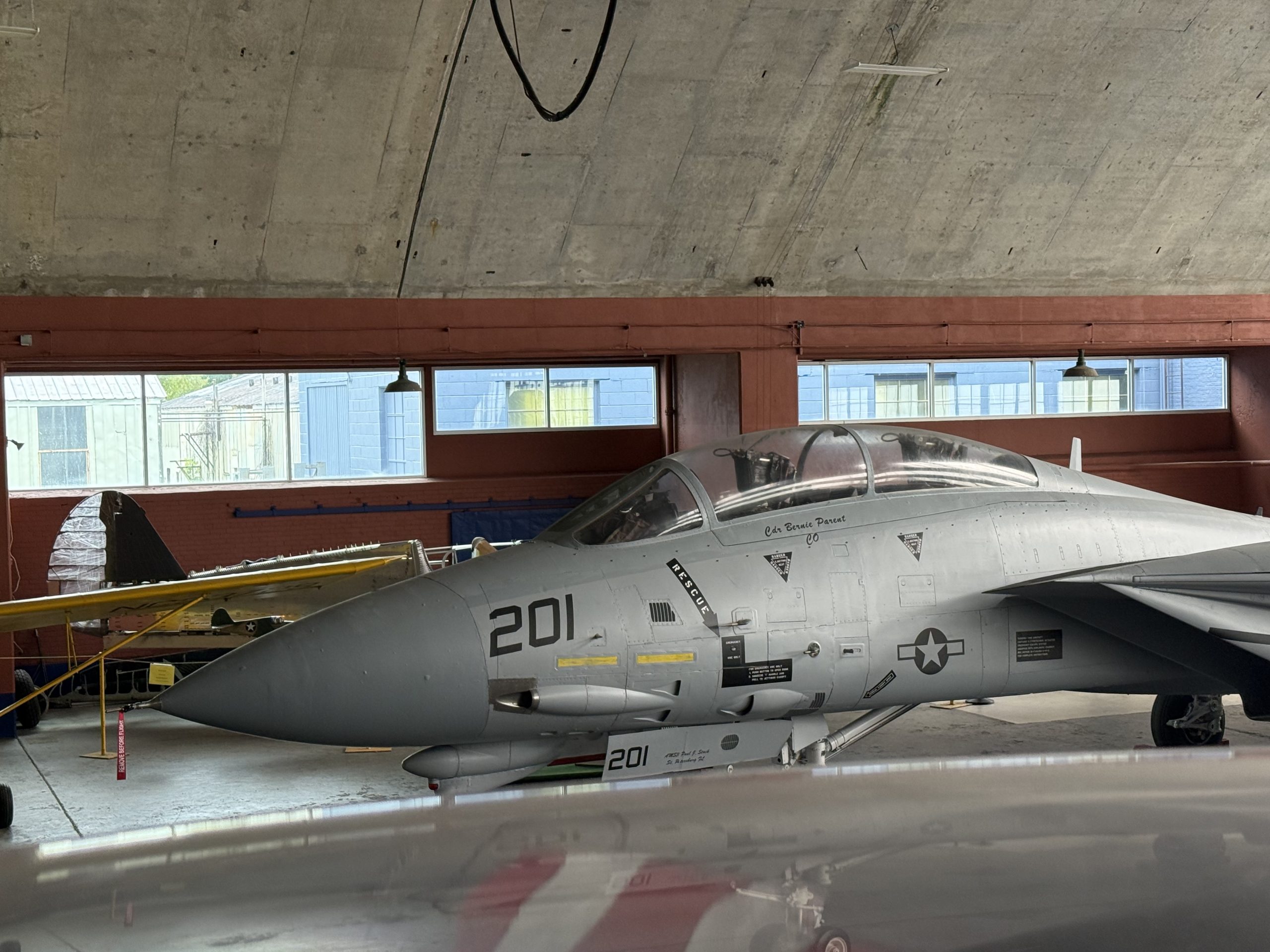
F-14 Tomcat Museum Photo 19FortyFive Photo Taken September 2026
When the wings are positioned forward, they generate much better lift, which is ideal for carrier takeoffs and landings, as mentioned before.
As the aircraft accelerated, the onboard computers automatically adjusted the wing shape, giving the Tomcat a more refined aerodynamic profile.
Although the entire system was automated, the F-14’s wings could be manually swept depending on the situation. At first glance, it may seem redundant.
However, as Dave “Bio” Baranek, a former Radar Intercept Officer (RIO) and author of the book Topgun Days: Dogfighting, Cheating Death, and Hollywood Glory as One of America’s Best Fighter Jocks, explained on The Aviationist, “the pilot could manually sweep the wings aft of the position determined by the CADC, but not forward of that position, as that could cause structural damage due to the tremendous lift it would generate.” He continues, “Manually sweeping the wings back could confuse an adversary by giving a false indicator of F-14 airspeed.
But it also provided much less lift and less maneuverability, so it was a ‘tactic’ or trick that would be used very carefully.”
Master of the Skies
While the F-14 was never designed for close air-to-air engagements, the manual sweep system meant that, in the right hands, the Tomcat was an excellent dogfighter.
Former F-14 pilot Lieutenant Larry “Music” Muczynski recalled dogfighting Libyan Su-22 fighters in 1981 during the Gulf of Sidra incident. “He fired an AIM-9L off of station 1A (left glove pylon, shoulder station),” he said, describing his wingmate’s first shot. “The missile pulled lead, then did a ninety-degree reversal and hit the aircraft in the tail.
The aircraft started to roll, the drag chute deployed, and the guy immediately ejected.” The engagement marked the first air-to-air kill achieved by American Tomcats.
The F-14’s dogfighting capabilities have been somewhat exaggerated by the film Top Gun, but the Tomcat could still perform amazing feats in the hands of the right pilot.
One area in which the F-14 truly excelled was speed.
Powered by two F110 turbofan engines, the Tomcat could reach a top speed of Mach 2.34, although some pilots recall flying as fast as Mach 2.5.
Here, the aircraft’s swept-wing geometry also helped immensely. With its swept wings, the aircraft could fly faster and more efficiently, allowing it to excel as a fleet interceptor.
Although the F-14 could dogfight, that was not its primary purpose.
Its mission was to fly at high speeds and altitudes and intercept Soviet bombers from long ranges.
The Tomcat excelled at its mission; it also excelled at a variety of other missions.
About the Author: Isaac Seitz
Isaac Seitz, a Defense Columnist, graduated from Patrick Henry College’s Strategic Intelligence and National Security program. He has also studied Russian at Middlebury Language Schools and has worked as an intelligence Analyst in the private sector.