
Anduril bets on mass-produced missile interceptors
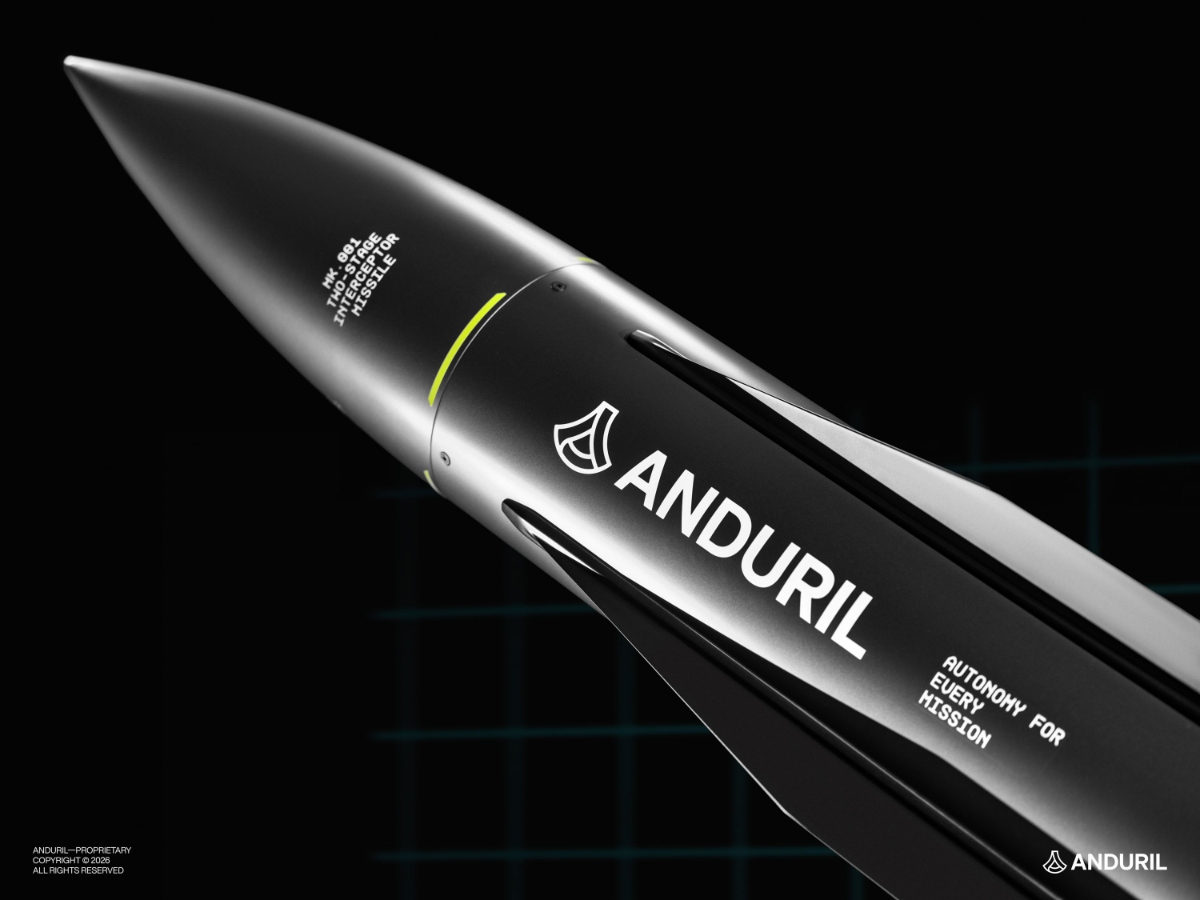
Anduril Industries has unveiled Steelfin, a family of surface-to-air interceptor missiles designed to shoot down cruise, ballistic and hypersonic missiles at a fraction of the cost of today’s interceptors, with flight tests set to begin next year.
The company announced Steelfin on Oct. 12, the first day of the Association of the U.S. Army’s annual meeting in Washington. Anduril says it plans to build on the order of several thousand Steelfin missiles a year in the short term. It did not give a unit price, name a customer or say which U.S. service is backing the program, saying only that it has been developing Steelfin for years while investing alongside multiple customers. The company has completed ballistic testing with representative air vehicles but has not yet flown a Steelfin missile.
The first stage is a solid rocket booster that can be swapped for different motors depending on how far and how fast the missile needs to fly, and how tightly it must pack into a launcher. The second stage is a common “terminal interceptor” that carries the airframe, electronics, software and flight controls shared across the family, with open interfaces so Anduril can drop in different seekers and mission systems without redesigning the missile.
Anduril says the approach lets it build versions for every layer of air and missile defense, from short-range point defense of a single site to upper-tier ballistic missile defense, while aiming for a fraction of the cost of current interceptors in each class. The company did not say what those benchmark costs are, but a single Patriot PAC-3 MSE interceptor costs about $4 million, and the Missile Defense Agency is pursuing a separate low-cost interceptor effort with a target price below $750,000 per round.
Because the variants share parts, Anduril says they can run down the same production line with the same tooling and workers, letting it shift output to whichever version is in demand. The company also says the common interfaces let it buy commercial components and use multiple suppliers.
Steelfin is designed to fire from launchers the U.S. military already fields, including the M903A2 launcher used by the Patriot air defense system, the U.S. Navy’s Mk 41 Vertical Launch System aboard cruisers and destroyers, the U.S. Army’s Typhon mid-range missile launcher, and newer containerized launchers. Anduril says it will work with existing fire control systems such as the U.S. Navy’s Aegis and the U.S. Army’s Integrated Battle Command System, known as IBCS, rather than requiring a new command network.
The launch comes as U.S. air defense stocks have been drawn down by combat in the Middle East. This month alone, Raytheon received contracts worth up to $6.3 billion for SM-3 Block IB interceptors and up to $24.4 billion for SM-6 missiles to replenish U.S. Navy inventories. Anduril already makes smaller counter-drone interceptors such as Roadrunner and Anvil, but Steelfin is its first family aimed at cruise and ballistic missiles.
Content preview only. Full article available at source. View Full Article
Anduril Industries unveiled the Steelfin family of surface-to-air interceptor missiles in Washington on October 12. The missiles are designed to target cruise, ballistic, and hypersonic threats at a lower cost than existing systems, with plans for mass production of several thousand units annually. They will utilize existing U.S. military launchers and fire control systems, enhancing the air defense capabilities of the U.S. military.
- Anduril Industries unveiled Steelfin missiles on October 12 during the Association of the U.S. Army’s annual meeting.
- Steelfin is designed to intercept cruise, ballistic, and hypersonic missiles at a lower cost than current interceptors.
- The company plans to produce several thousand Steelfin missiles annually.
- The missiles can be launched from existing U.S. military launchers and will work with current fire control systems.
- Anduril has completed ballistic testing but has not yet flown a Steelfin missile.