
Anefis 2026 — 50 Malian soldiers killed and the FLA-JNIM alliance challenges Africa Corps
 Marie Dubois
Anefis 2026 — 50 Malian soldiers killed and the FLA-JNIM alliance challenges Africa Corps
On July 18, near Anefis, on the axis connecting Gao to positions in northern Mali, a joint convoy of the Malian Armed Forces and Africa Corps fell into an ambush. Al Jazeera, citing Malian confirmations and claims from armed groups, reports at least 50 Malian soldiers killed. The exact figure on the Russian side remains less clear. However, what matters here goes beyond the toll: the attack was jointly claimed by the Azawad Liberation Front (FLA) and the Group for the Support of Islam and Muslims (JNIM).
This is not an ideological alliance. It is a ground alliance.
On a political map, the FLA and the JNIM do not tell the same war. The former carries a Tuareg autonomist or independence claim. The latter, affiliated with Al-Qaeda, seeks to impose its own religious and military governance. But on the Anefis-Gao track, these differences weigh less than a common enemy: Bamako and its Russian partners.
A road, not just an ambush
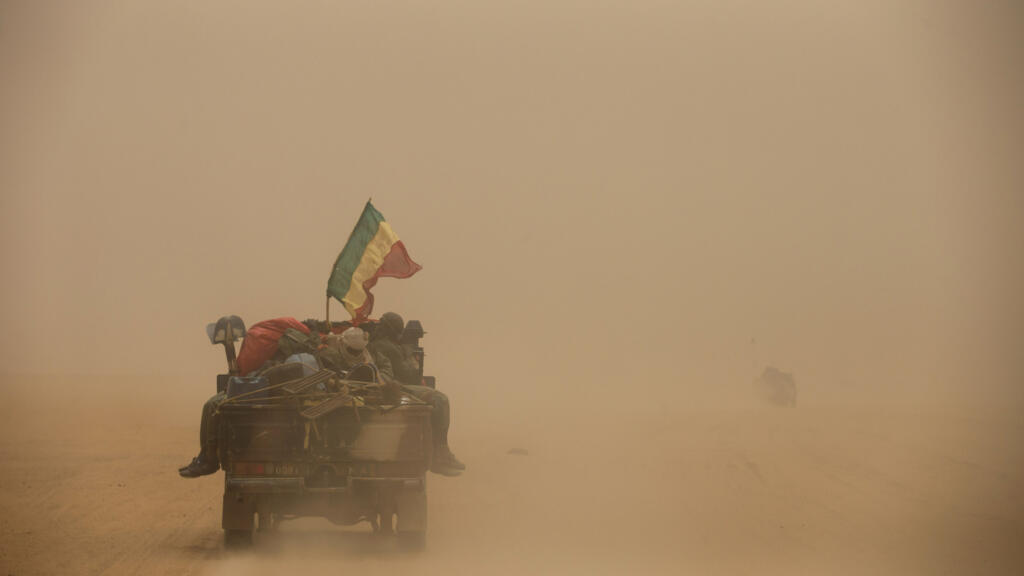
Between Gao and Anefis, there are not just kilometers of sand. There is the lifeline of a military device: fuel, food, ammunition, mechanical parts, troop rotations, and medical evacuations. When a force holds a city but loses the security of the road that supplies it, it no longer truly controls the terrain. It occupies a point.
From experience, this is often where statements become misleading. An army can announce a counter-operation, publish drone strikes, or retake a locality after the assailants have passed. But if every movement requires a reinforced convoy, aerial reconnaissance, and a correct weather window, the initiative already partly belongs to the adversary.
The attack on Anefis thus confirms a trend visible since April. Armed groups are no longer just seeking to harass isolated posts. They are attempting to cut the joints of the Malian device: roads, forward bases, power lines, supply to Bamako, and logistical depth between the north and the center.
The FLA and JNIM add their advantages
The decisive military point is complementarity. The FLA brings a fine knowledge of the north, tribal networks, secondary passages, possible retreats to desert areas, and a tactical memory of the battles around Kidal. The JNIM brings experience in mobile insurgency, cells capable of striking multiple points simultaneously, and the ability to transform a tactical success into a regional message.
Taken separately, each poses a serious problem for Bamako. Together, they create a force multiplier. Analyst Héni Nsaibia, quoted by Al Jazeera, explains that the two camps pool their efforts against a shared adversary while maintaining their own objectives. On the ground, this means that a local scout, a fire team, and a communication cell do not need to agree on Mali's constitutional future to destroy a convoy.
The duration of this cooperation remains uncertain. Ideological frictions, command rivalries, or disagreements on the treatment of civilians may resurface. But for now, the common enemy is enough. In a war of movement, a few months of coordination can change more than a political agreement signed in Bamako.
Africa Corps strengthens fire, not control
Since the transformation of Wagner into Africa Corps as a more official facade of the Russian military presence, Moscow has given Bamako what Paris no longer wanted or could provide: less politically conditioned combat aid, drones, advisors, strikes, and a narrative of sovereignty. This has made the Malian army more brutal and sometimes quicker in its response.
But firepower does not replace human intelligence or political patience. The report from the Security Council Report for July reminds us that the coordinated attacks on April 25 against Bamako, Kati, Gao, Mopti, and Sévaré marked a major escalation. It also mentions road blockages, burning trucks carrying food, and ongoing pressure on state-held areas.
In this context, Africa Corps can strike after the ambush. It cannot, alone, prevent the population around the road from warning the assailants rather than the army. This is the old lesson from Sahelian theaters. A drone sees a pickup. It does not always see why the neighboring village no longer speaks to the state.
UN alert describes a threat that administers
Leonardo Santos Simão's briefing to the Security Council adds an essential layer. According to the UN, terrorist and armed groups in West Africa are no longer just attacking. They are administering spaces, controlling trade routes, using drones, sophisticated communications, and sometimes cryptocurrencies, while linking insurgency and criminal economies.
This evolution explains why Anefis goes beyond Mali. The JNIM is already operating in Mali, Burkina Faso, and Niger. The coastal states of the Gulf of Guinea are seeing refugees, trafficking, and reconnaissance cells arrive. The same UN briefing mentions nearly 6.8 million internally displaced persons in West Africa and the Sahel, along with 1.3 million refugees and asylum seekers. These are not just humanitarian statistics. They are recruitment, taxation, and circulation maps.
The AES facing a more flexible adversary
The Alliance of Sahel States was supposed to respond to regional fragmentation. Mali, Burkina Faso, and Niger wanted to regain control of their security after breaking with ECOWAS and the departure of Western partners. On paper, the idea is not absurd. Armed groups do not respect borders, so states must coordinate intelligence, aviation, pursuit, and control of axes.
But the AES remains slower than its adversaries. A coordinated strike requires authorizations, available resources, fuel, a targeting chain, and trust between staffs. A tactical FLA-JNIM alliance sometimes only requires a shared objective and a window of opportunity.
Russia can help hold Bamako, Gao, or certain military nodes. It can make Malian operations more costly for the insurgents. It cannot alone recreate a political agreement in the north, nor replace MINUSMA in its former roles of monitoring, mediation, and diffuse logistics. The abandonment of the Algiers agreement removed a bad tool, certainly, but no better mechanism has been put in its place.
What to watch for now
The next signals will be very concrete. First, the frequency of convoys between Gao, Anefis, and Kidal: if they become rarer or heavier, Bamako absorbs the shock. Second, the propaganda of the FLA and JNIM: if joint claims multiply, cooperation will have crossed a threshold. Third, incidents on the roads to Bamako: the partial blockade of the capital remains the most dangerous strategic weapon.
Methodological caution is necessary. Casualty reports in northern Mali remain difficult to verify independently. The images published by Africa Corps show what Moscow wants to show. The claims of the FLA and JNIM show what the insurgents want to amplify. Between the two, the Anefis road tells something more reliable: armed groups can still choose the place, the pace, and sometimes the narrative of the battle.
The next vulnerability is probably not a large city taken by frontal assault. It is more mundane: a delayed convoy, a burned tanker, a mined bridge, a patrol too predictable between two points that Bamako claims to control. In the Sahel, wars are rarely won on the map. They are often lost on the track.
Main sources: Al Jazeera, July 22, 2026; UN News, UNOWAS briefing to the Security Council, July 2026; Security Council Report, monthly forecast West Africa and Sahel, July 2026.
On July 18, 2026, a joint convoy of Malian Armed Forces and Africa Corps was ambushed near Anefis, resulting in the deaths of at least 50 Malian soldiers. The attack was claimed by the Front for the Liberation of Azawad (FLA) and the Group for Support of Islam and Muslims (JNIM), indicating a tactical alliance against Malian and Russian forces. This incident underscores the logistical challenges faced by the Malian military in maintaining supply routes and security.
- 50 Malian soldiers killed in an ambush near Anefis.
- The ambush was conducted by a joint alliance of FLA and JNIM.
- The attack highlights the logistical vulnerabilities of the Malian military.
- Africa Corps is involved in supporting Malian forces against insurgents.
- The situation indicates a growing cooperation between FLA and JNIM against a common enemy.