
APKWS Missiles on British Typhoon in the Middle East Reduce Drone Interception Costs in 2026
 Ahmed Al-Rashid
APKWS Missiles on British Typhoon in the Middle East Reduce the Cost of Drone Interception in 2026
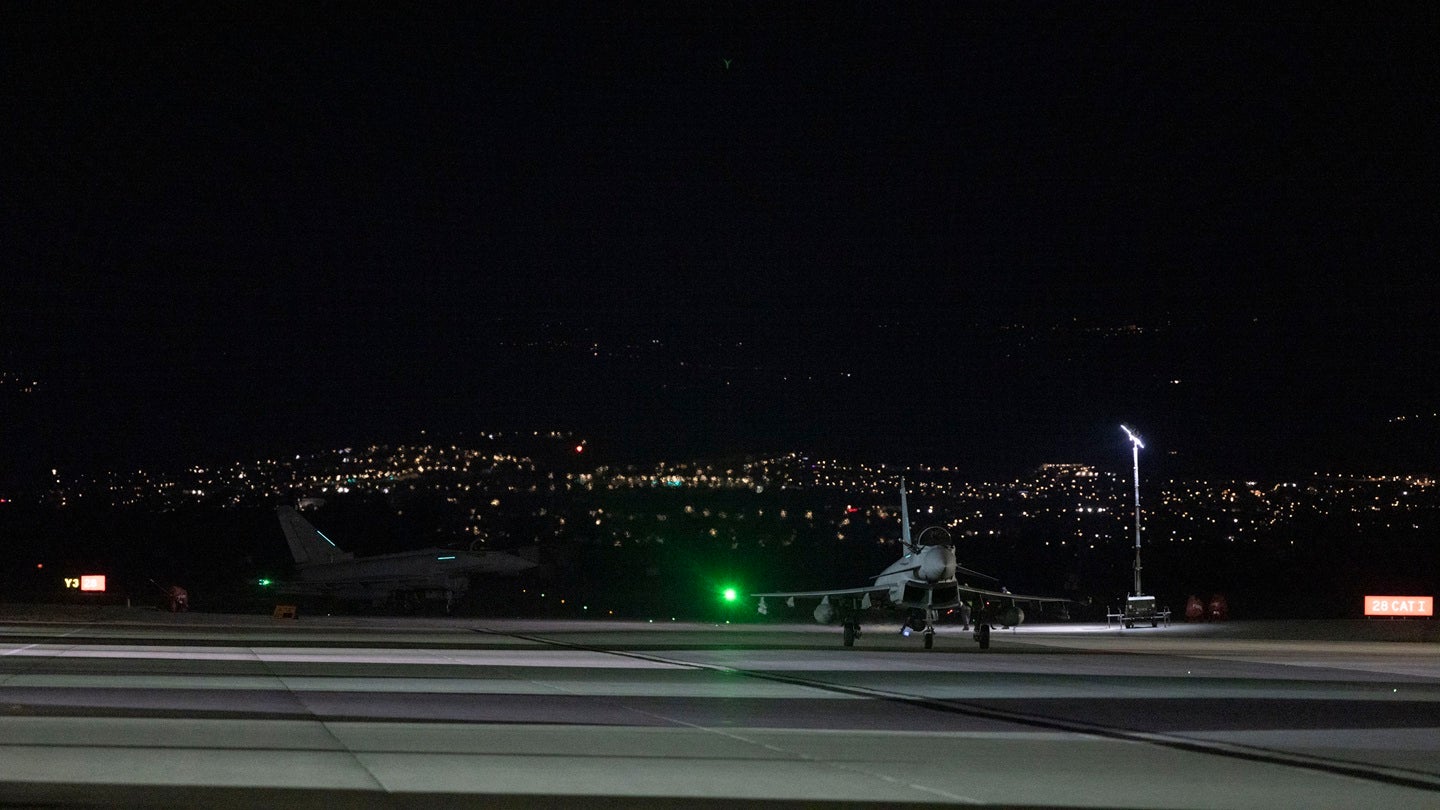
On May 17, 2026, the British news about Typhoon aircraft in the Middle East was not just an addition of a new weapon to a relatively old platform. The British Ministry of Defense, according to Army Recognition's report on the British announcement, deployed RAF 9 Squadron to operational sorties equipped with laser-guided APKWS missiles after a rapid integration that took less than two months. From a military perspective, the most important figure here is not the speed of the aircraft or the name of the squadron, but the difference between a 70 mm guided missile and the use of expensive air-to-air munitions against drones that can be produced for tens of thousands of dollars.
Why This Decision Matters in the Gulf Now
The Middle East has been under pressure for months due to a new equation: Iran and its allies are using drones, cruise missiles, and cheap systems to force the adversary to expend valuable munitions. The attack on the Barakah perimeter in the UAE, the pressure on Western bases in the Gulf, and incidents in the Red Sea all convey the same message. Air defense is no longer just a question of possessing Patriot or THAAD systems. The question has become: how many times can you fire? And how much does each shot cost? And how many days can the stockpiles withstand if the sky turns into a daily test?
Any military personnel who has served in the region knows that the Gulf has purchased the best radars and systems, but it remains vulnerable to an attrition economy. When the adversary launches a Shahed-type drone or a cheap cruise munition, responding with a Patriot, Meteor, or AMRAAM missile may be tactically successful but financially unsustainable. This is where the value of APKWS comes into play. The weapon is not a miracle, nor does it turn the Typhoon into a ground-based air defense system, but it adds a cheaper interception layer between short-range artillery and advanced missiles.
What APKWS Added to Typhoon
APKWS is essentially a laser guidance kit that transforms a 2.75-inch unguided rocket into a precision munition. According to Army Recognition's report on the April 8 test, BAE Systems discussed a range on fixed-wing platforms between 2 and 14 kilometers, a weight of approximately 35 pounds, and a declared probability of hit of 80% within two meters of the laser point in a single shot. These are figures that should be treated with caution as they come from the manufacturer, but they are sufficient to illustrate the idea: not every aerial target requires a long-range air-to-air missile.
The British integration went through three rapid phases: a ground target launch test in March, then air-to-air tests in April with 41 Test and Evaluation Squadron, and finally operational use in the Middle East with the 9th Squadron. This speed is more important than the details of the weapon itself. Western armies have been accustomed to taking years to introduce new munitions on a complex fighter. Here, however, the British institution acted with a stockpiling war mentality, not a defense exhibition mentality. The threat changed rapidly, so the decision cycle was shortened.
- Platform: RAF Eurofighter Typhoon multirole aircraft.
- New weapon: APKWS-guided 70 mm rockets.
- Operational goal: Intercept drones and slow, low-cost aerial targets.
- Core value: Protect advanced missile stockpiles for higher-value threats.
Implications for Gulf States Operating the Typhoon
This issue does not concern Britain alone. Saudi Arabia, Oman, and Qatar operate the Typhoon, and Kuwait also operates it in a Gulf defense environment close to the source of the threat. This means that the British experience will be read in Riyadh, Doha, Muscat, and Kuwait as a practical message: the platform originally purchased for air sovereignty and precision strikes can be reshaped for a less glamorous but more urgent mission, which is to kill drones at a reasonable cost.
But here begins Ahmed's old problem, and I mean the problem of capability, not the problem of procurement. It is easy to request APKWS pods and take a picture of an aircraft carrying them. The harder part is building a detection, tracking, and designation network, along with engagement rules and command and control that allow the fighter to become part of an air defense network rather than a lone hunter in the sky. The small drone does not wait for a lengthy political decision, nor does it always appear on radar in the same way that a fighter or cruise missile does.
Economics Before Technology
The real superiority in this type of defense is not in hitting a single target, but in repeating the hit dozens of times without bankrupting the stockpile. The Gulf has spent billions of dollars on high-quality interception systems, but it has not always built an economic system for munitions. In the drone war, the one who possesses the most expensive missile does not necessarily have the best defense. Sometimes the best defense is the one that puts the right weapon in front of the right target, not the most famous weapon in front of every target.
This is what makes the Typhoon loaded with APKWS newsworthy in the Gulf as much as it is in Britain. The presence of British aircraft in Cyprus, Qatar, the UAE, and Bahrain, as reported in April regarding ongoing air defense operations, means that London is not testing the concept in a vacuum. It is testing it within an operational theater that is well aware of Iranian drones, cruise munitions, and low-signature threats. If operational use is successful, the pressure on Typhoon operators in the Gulf will become clear: why are you spending millions of dollars on each interception when you can build a cheaper layer?
Limits of the British Solution
However, APKWS should not be overstated. The laser-guided missile requires detection, tracking, and designation, and it is best against slow or limited-maneuver targets. It cannot replace the Meteor against an enemy aircraft, nor can it replace the Patriot against a ballistic missile, nor can it replace electronic defense against small swarms that are difficult to distinguish. Its value lies in filling the gap between the gun and the advanced missile. In the Arab region, we sometimes tend to turn every new weapon into a political slogan. This is a mistake. The weapon here is an accountability tool, not a symbol of prestige.
Practically, Gulf states must read the British lesson this way: capability is not about purchasing a single platform, but about arranging layers. The radar detects, the operations center decides, the aircraft moves, the appropriate weapon is fired, and the stockpile is quickly replenished. If this chain is absent, APKWS becomes just a new item on the armament bill. If completed, it may help break an equation that has served Tehran and its allies: a cheap drone dragging an expensive missile.
The old adage says you do not catch a fly with a tank shell. In Gulf air defense, this is not a joke but a war budget.
Ahmed's Summary
The introduction of APKWS on the Typhoon in the Middle East reveals a quiet transition from air defense based on technical luxury to air defense based on calculation. This shift will disturb some Gulf capitals because it raises an uncomfortable question: is the problem that stockpiles do not have enough missiles, or that the doctrine does not know how to use the cheap weapon when it is the smarter choice? Britain partially answered by adding a new layer. The Gulf, however, will remain stuck between its desire to purchase at the top of the ladder and its daily need to fight in the middle of it.
Sources
- Army Recognition, May 17, 2026, report on the British Typhoon with APKWS in the Middle East.
- Army Recognition, April 8, 2026, report on BAE Systems' APKWS test on Typhoon.
- Army Recognition, April 2026, reports on ongoing British air operations in Cyprus, Qatar, the UAE, and Bahrain.
- Army Recognition technical data, Eurofighter Typhoon multirole combat aircraft.
RAF 9 Squadron conducted operational sorties with APKWS-guided rockets in the Middle East on May 17, 2026. This integration, completed in under two months, aims to provide a cost-effective solution for intercepting drones, reflecting a shift in air defense strategy. The operational use of Typhoon with APKWS is significant for Gulf states, emphasizing the need for economical defense solutions against low-cost threats.
- RAF 9 Squadron conducted operational sorties with APKWS rockets in the Middle East.
- The integration of APKWS into Typhoon took less than two months.
- APKWS rockets provide a cost-effective solution for intercepting drones.
- The operational use of Typhoon with APKWS is a shift towards economical air defense.
- The report highlights the strategic implications for Gulf states operating Typhoon.