
As US preps for more space launches, WH orders integration with air-traffic control
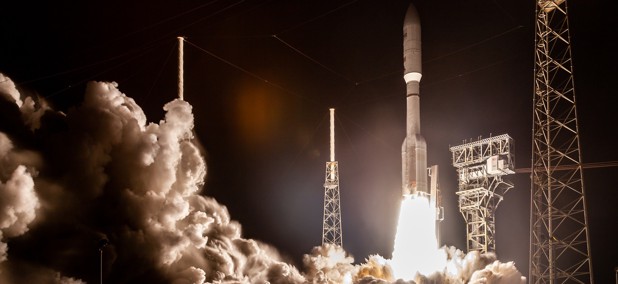
A new space-transportation policy released by the Trump administration Thursday aims to build the infrastructure needed to rapidly increase U.S.-led rocket launches in coming years, including links to the nation's modernizing air traffic control systems.
President Donald Trump’s strategy sets a goal of supporting “more than 1,000 launches and reentries” by 2030, largely through working with commercial companies to build sites across the country.
This will require the Pentagon and NASA to work together to “operate Federal launch and reentry ranges and facilities in a transparent manner that accommodates government and non government users,” Trump's memo said.
Other relevant agencies will also need to be involved in these discussions, the strategy adds, to develop and publish range schedules that can “maximize efficient use of range resources for commercial users” and “optimize launch capacity.”
To facilitate more space launches in U.S. airspace, the memo directs the Transportation Department—with the Pentagon and NASA—to “implement a plan to integrate space launch and reentry management into airspace and traffic control modernization efforts” and “designate priority airspace for critical space launch corridors” within 180 days of the policy’s release.
Under Transportation, the Federal Aviation Administration has been driving the administration’s effort to overhaul the nation’s outdated air traffic control systems.
The modernization initiative was announced by Transportation Secretary Sean Duffy in May 2025 after several high-profile airspace incidents, including the deadly collision of an Army Black Hawk helicopter and a commercial airliner near Ronald Reagan Washington National Airport that January.
While the project includes some brick-and-mortar upgrades at U.S. airports and related facilities, most of the effort is focused on updating outdated air traffic monitoring and communications systems.
The One Big Beautiful Bill, which was signed into law in July 2025, allocated $12.5 billion for the modernization effort. Five months later, Transportation officials said they would need an additional $20 billion.
It remains to be seen what steps will be needed to integrate the administration’s strategy with the air traffic control modernization effort, and whether or not this will have any impact on the project’s timeline.
The FAA announced in December that it awarded Peraton a $1.5-billion contract to serve as the project’s prime integrator, although Politico reported on Thursday that officials within the agency were growing frustrated by the company’s management of the massive systems overhaul.
In April, Duffy said, “We’re on track to have this project completed before President Trump leaves office.”
Asked for comment, Transportation directed Nextgov/FCW to a Friday press release that announced the agency’s request for public comment on where new space launch facilities should be built, as well as how it should go about setting aside “priority airspace” for future launches.
Neither Transportation’s request for information nor its press release includes details about how the space transportation policy would be integrated with the agency’s air traffic control modernization project.
An FAA spokesperson similarly pointed to Transportation's release and said the agency is "seeking input on how increased launch cadence can be integrated into the U.S. airspace system."
The Trump administration released a new space-transportation policy to increase U.S.-led rocket launches, aiming for over 1,000 launches by 2030. The policy mandates collaboration between the Pentagon, NASA, and the Transportation Department to integrate space launch management with air traffic control modernization. A $12.5 billion initiative for air traffic control upgrades was announced, with a $1.5 billion contract awarded to Peraton for project integration.
- The Trump administration aims for over 1,000 rocket launches by 2030.
- The policy requires collaboration between the Pentagon, NASA, and the Transportation Department.
- A $12.5 billion modernization effort for air traffic control was announced.
- The FAA awarded a $1.5 billion contract to Peraton for project integration.
- Public comments are being sought on new space launch facilities and priority airspace.