
Australia's MQ-28 Ghost Bat Exposes America's 2026 Pacific CCA Gap
 Marcus Chen
Australia's MQ-28 Ghost Bat Exposes America's 2026 Pacific CCA Gap
The first collaborative combat aircraft to fly with U.S. aircraft in a major Pacific exercise was not American.
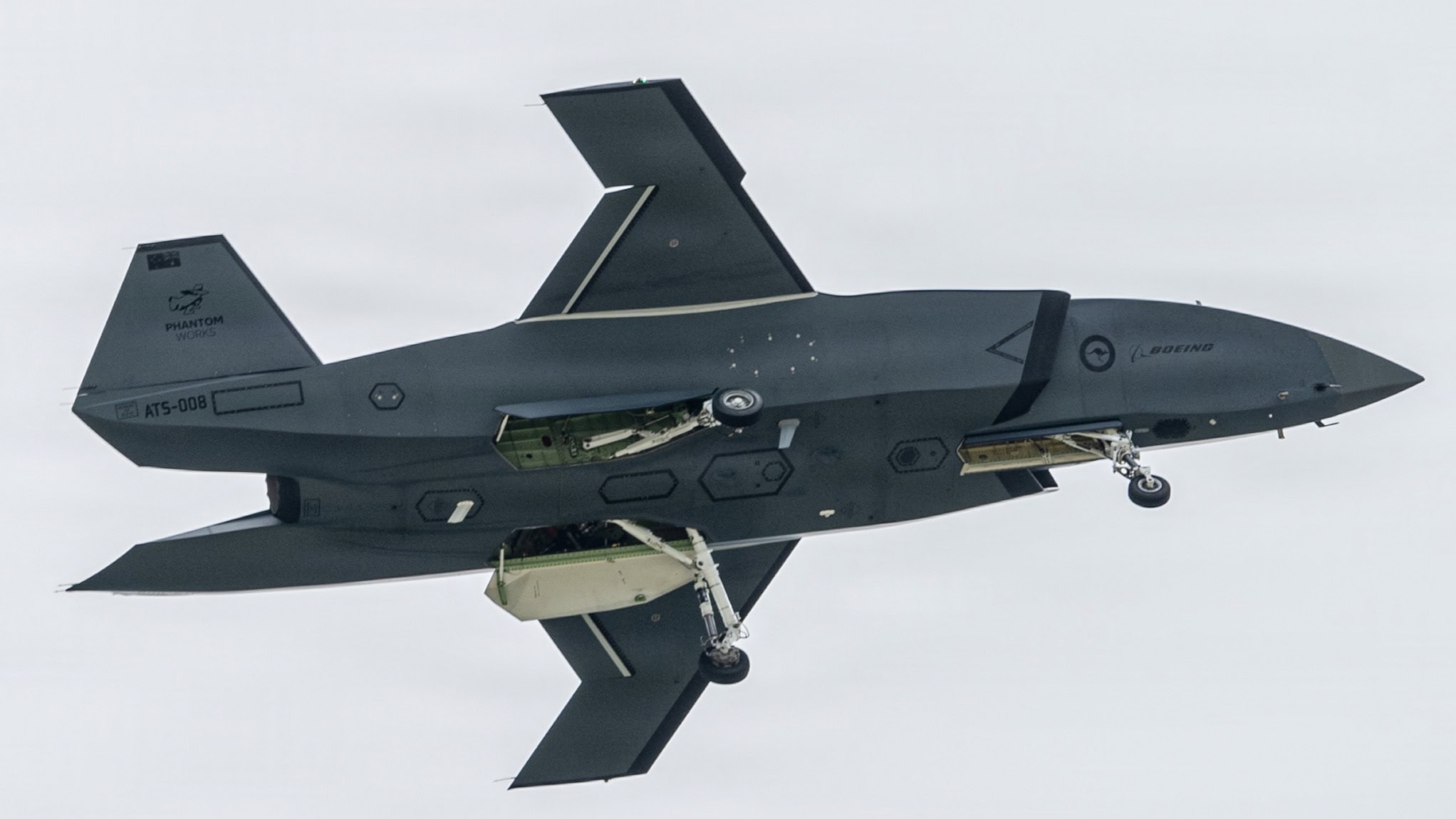
That is the uncomfortable fact behind Boeing Defence Australia's MQ-28 Ghost Bat appearance at Exercise Valiant Shield 2026 in the Northern Mariana Islands. According to Defense One, the Australian-developed drone operated alongside U.S. and allied forces last month, while Boeing publicly described it as the first and only collaborative combat aircraft deployed to a multinational joint operational exercise. For a program category Washington has talked about as central to Pacific airpower, that order of events matters.
The MQ-28 did not arrive as a slide deck. Boeing lists the aircraft at more than 2,000 nautical miles of range, up to Mach 0.9, a ceiling above 40,000 feet, and a maximum takeoff weight of up to 12,000 pounds. Those numbers put it in the range band that actually matters west of Guam. A short-legged robot wingman is a local training tool. A 2,000-nautical-mile class platform begins to change how F-35s, F-15EXs, E-7s, tankers, and electronic attack aircraft can distribute sensors and decoys across the Philippine Sea.
The Exercise Was the Signal
Valiant Shield is not a boutique technology demonstration. It is one of the U.S. military's recurring Pacific exercises designed to stitch together air, maritime, and joint fires across the geography that would define a Taiwan or South China Sea contingency. Putting Ghost Bat into that environment, even in a limited role, is more meaningful than flying a pristine test profile at a contractor range.
Defense One reported that the aircraft flew alongside F-35s, F-15EXs, HC-130, E-3, E-2D, EA-18G, and RC-135 aircraft. That list is useful because it shows what the MQ-28 is being asked to complement. It is not just a disposable missile truck. It is being tested around airborne early warning, electronic attack, reconnaissance, rescue support, and high-end fighters. Anyone who has served on a destroyer knows the hard part is not getting one sensor or shooter into the fight. It is keeping the network useful when the sky is crowded, jamming is heavy, and commanders want tracks they can trust.
Boeing's own description of the aircraft emphasizes open-system architecture, a modular missionized nose, and the ability to fuse sensor and payload information from multiple aircraft. Strip away the marketing language and the operational claim is straightforward. The MQ-28 is meant to put more apertures and payloads forward without putting another pilot inside the weapons engagement zone.
America Is Still Buying Its First Batch
The awkward part is timing. The U.S. Air Force has now moved its first CCA increment into production with Anduril and General Atomics, but Boeing was not selected for that first increment. Defense One reported in June that the service awarded initial production contracts for three lots, while keeping numbers and unit costs undisclosed. The same report said the Defense Department is seeking nearly $1 billion for CCA procurement in fiscal 2027 and that the Air Force now expects more than 150 combat-capable CCAs by the end of the decade.
That sounds substantial until it is put against the Pacific map. Andersen Air Force Base to the Luzon Strait is roughly 1,500 nautical miles. Guam to Taiwan is farther. Northern Australia to the South China Sea is also a long haul. A force of 150 CCAs, spread across training, testing, attrition reserves, maintenance, software updates, and multiple theaters, does not produce a dense combat cloud. It produces a starter fleet.
Former Air Force Secretary Frank Kendall previously told lawmakers the service expected over 100 CCAs on order or delivered by fiscal 2029, while describing a possible long-term planning figure of 1,000 and earlier discussion of as many as 2,000. The useful number is not the ambition. It is the 2029 delivery band. If a Taiwan crisis arrives before then, U.S. commanders will not be fighting with the mature CCA force described in congressional testimony. They will be fighting with prototypes, early production lots, and whatever allied systems can be integrated fast enough.
That is why the Australian drone matters. It is not proof that Canberra has solved autonomous air combat. It is proof that the allied side may need several parallel CCA pipelines because the American one will not scale quickly enough by itself.
Australia Is Building More Than a Niche Drone
The MQ-28 is often treated as an Australian technology story. That is too narrow. Australia is building a piece of the allied air order of battle that can operate from the southern arc of the Indo-Pacific and potentially support U.S. aircraft without requiring the United States to own every airframe, every software line, and every maintenance burden.
This is the part of AUKUS-style defense cooperation that gets less attention than submarines but may prove easier to field. Nuclear-powered submarines require shipyards, nuclear stewardship, a deep crew pipeline, and years of industrial repair before the promise becomes combat power. A modular uncrewed aircraft is not easy, but it is a smaller bite. It can be tested in exercises, iterated in software, exported to partners, and produced in quantities that do not require a generational shipbuilding rescue plan.
The next venue to watch is Talisman Sabre. Australia's Defence Department describes that exercise as a combined and joint event involving live fire, amphibious operations, air combat, maritime operations, and multinational interoperability. Boeing's MQ-28 program director pointed to future exercises of that type as opportunities to apply the aircraft as an operational capability rather than a display item. That is exactly where the hard questions should be asked.
- Can the MQ-28 pass useful sensor data into U.S. and Australian command-and-control systems under degraded communications?
- Can it operate from austere bases without contractor-heavy support?
- Can its autonomy reduce pilot workload instead of creating another screen to manage?
- Can Australia and the United States agree on mission software control before a crisis forces the issue?
Those questions are less glamorous than a flyover, but they decide whether Ghost Bat becomes combat mass or another exquisite aircraft with a narrow test envelope.
The Pacific Math Is Unforgiving
China does not need to match every allied aircraft one for one. In a Taiwan or South China Sea fight, Beijing's advantage is geography. The People's Liberation Army can concentrate land-based missiles, aircraft, sensors, and maritime militia pressure close to home. The United States and its allies have to move combat power across water, defend bases, keep tankers alive, and maintain networks across enormous distances.
That geography is why CCAs are not optional decoration. They are one answer to a basic capacity problem. Crewed fifth-generation fighters are too expensive, too few, and too politically sensitive to risk casually. Tankers and airborne early warning aircraft are precious. A useful CCA can push sensors forward, absorb risk, complicate Chinese targeting, and let manned aircraft stand off a little farther. A bad CCA just adds maintenance load and bandwidth demand.
Ghost Bat's Valiant Shield appearance does not close the gap. It identifies it. The United States has chosen its first domestic CCA builders, but the first allied robot wingman to show up in a major Pacific exercise came from Australia. That should make Washington uncomfortable in a productive way.
The Pacific will not wait for the perfect American program. If allied airpower is going to have enough mass before 2029, the answer will have to be messier: U.S. CCAs, Australian MQ-28s, shared autonomy standards, and exercises that punish bad assumptions before China gets a vote.
That is the real lesson from Valiant Shield. The drone flew. The production math still has not caught up.
Australia's MQ-28 Ghost Bat participated in Exercise Valiant Shield 2026 in the Northern Mariana Islands, operating alongside U.S. and allied forces. The drone, developed by Boeing Defence Australia, is designed to enhance airpower capabilities with a range of over 2,000 nautical miles. The U.S. Air Force is progressing towards producing combat-capable CCAs, with expectations of 150 units by 2029, highlighting the importance of allied systems like the MQ-28 in addressing potential operational gaps before then.
- MQ-28 Ghost Bat participated in Exercise Valiant Shield 2026 with U.S. forces.
- The drone has a range of over 2,000 nautical miles and can operate at Mach 0.9.
- The U.S. Air Force is moving towards producing combat-capable CCAs, with 150 expected by 2029.
- The MQ-28 is designed to complement various U.S. aircraft in joint operations.
- The report emphasizes the need for allied CCA capabilities due to U.S. production timelines.