
BAE delivers final ACV-P amphibious vehicle to U.S. Marines
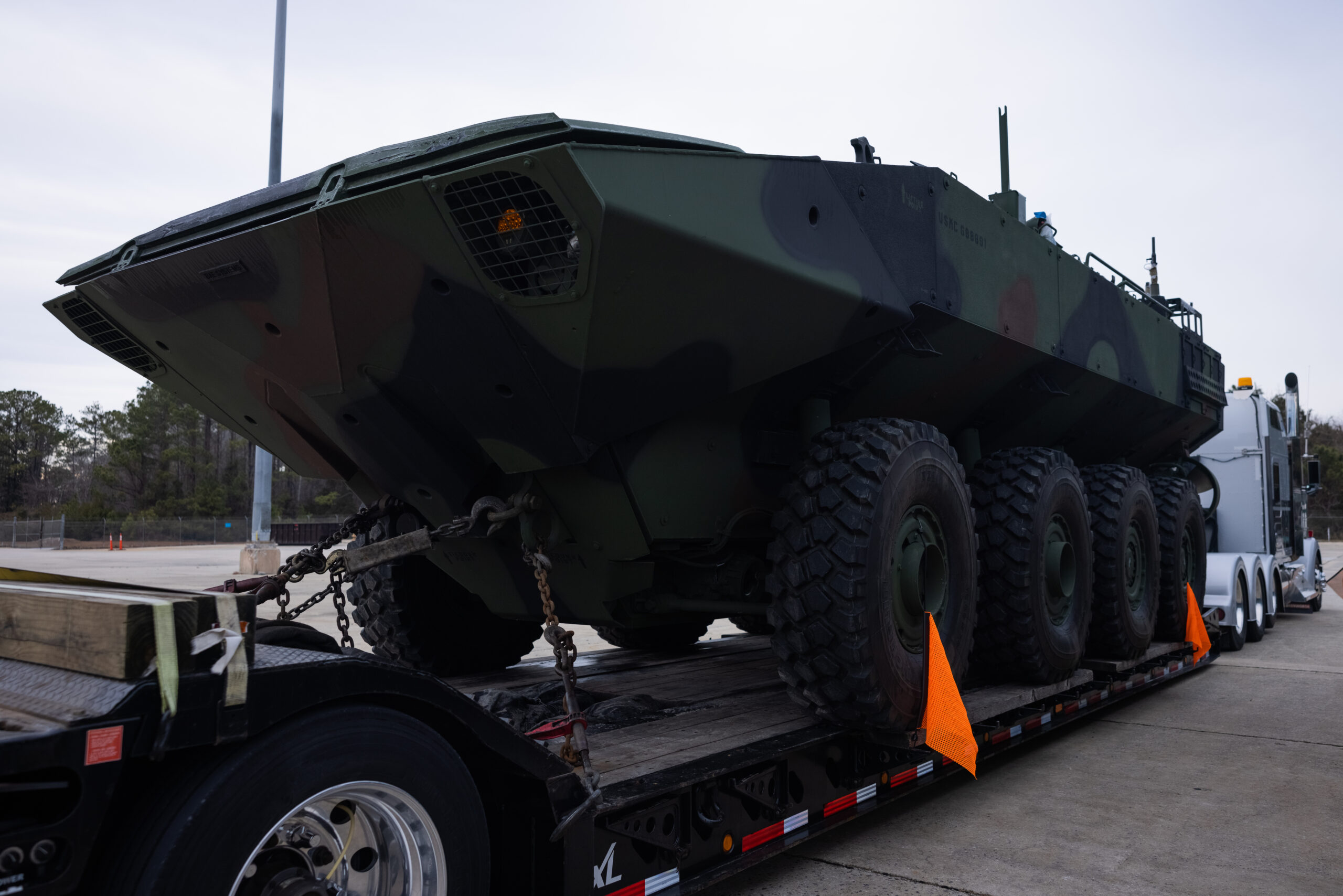
BAE Systems said Thursday it has delivered the final ACV-Personnel, or ACV-P, vehicle to the United States Marine Corps.
The handover closes out deliveries of the troop-carrying version of the Amphibious Combat Vehicle, the platform intended to replace the Marine Corps’ aging Assault Amphibious Vehicle fleet. The ACV-P serves as the primary carrier for Marine infantry units during ship-to-shore operations and is built to move troops from amphibious ships directly to inland objectives.
Unlike older platforms, the ACV is built as a true 8×8 amphibious vehicle capable of operating both in open water and on land without compromise. BAE Systems says the platform can be launched and recovered from ships in the open ocean and then transition through the surf zone onto land, where it uses full-time all-wheel traction to maneuver across rough terrain.
Protection has also been a major focus of the program. The vehicle uses a blast-resistant hull and energy-absorbing seats intended to improve crew and troop survivability against mines, improvised explosive devices, kinetic threats, and overhead attacks. It also includes an automatic fire suppression system.
That added protection has become increasingly important as modern amphibious operations are expected to face a wider range of threats, from mines and anti-armor weapons to drones and precision-guided strikes.
The ACV-P can carry 13 Marines in addition to a crew of three. Company specifications list the vehicle at about 35 tons, with road speeds above 65 miles per hour and water speeds exceeding 6 knots. It is rated for operations in Sea State 3 conditions and through nine-foot plunging surf, giving the Marine Corps the ability to launch forces from ships positioned offshore.
Range is another key feature. BAE Systems lists the vehicle’s road range at up to 325 miles, while its amphibious mission profile allows for up to 12 nautical miles at sea followed by more than 250 miles of land movement. That combination is aimed at supporting long-range expeditionary operations from ship to objective without the need for separate transport platforms.
The ACV program extends beyond the personnel carrier variant. The same vehicle family includes a command-and-control version, a 30mm cannon-equipped fire support variant, and a recovery vehicle, all built on the same chassis.
That shared design gives the Marine Corps more flexibility while simplifying maintenance and logistics across units operating different mission variants. It also leaves room for future upgrades as the service continues adapting its amphibious doctrine.
Content preview only. Full article available at source. View Full Article
BAE Systems delivered the final ACV-P amphibious vehicle to the United States Marine Corps. This vehicle is intended to replace the aging Assault Amphibious Vehicle fleet and serves as a primary carrier for Marine infantry during ship-to-shore operations. The ACV-P can carry 13 Marines and is designed for operations in various environments, enhancing the Marine Corps' capabilities for long-range expeditionary operations.
- BAE Systems delivered the final ACV-P vehicle to the U.S. Marine Corps.
- The ACV-P is designed to replace the aging Assault Amphibious Vehicle fleet.
- It can carry 13 Marines and a crew of 3, totaling 16 personnel.
- The vehicle is capable of operating in both water and land environments.
- It features a blast-resistant hull and energy-absorbing seats for improved survivability.