
BAE releases first live-fire footage of its new artillery system

A wheeled cannon that looks nothing like traditional artillery has fired live rounds on camera for the first time, and the footage shows exactly why the U.S. Army is betting on it to solve one of modern warfare’s most expensive problems.
BAE Systems released new test footage on July 2, 2026, showing its Multi-Domain Artillery Cannon System, known as MDACS, firing a large-caliber gun mounted on a mobile wheeled platform, describing the weapon on social media as fully air transportable and capable of firing Hypervelocity Projectiles at high speeds. The clips mark a visible step forward from images BAE Systems first released in mid-May 2026 at the LANPAC defense conference, which showed the odd, upward-angled cannon being unloaded from a C-130 Hercules transport aircraft but did not include any footage of the weapon actually firing.
MDACS exists to solve what defense planners call the cost-exchange problem, a mismatch that has plagued military forces defending fixed positions in Ukraine, the Red Sea, and other recent conflict zones, where a drone or missile costing a few hundred to a few thousand dollars can force a defender to fire a surface-to-air missile worth hundreds of thousands or even millions of dollars just to stop it. The U.S. Army’s Rapid Capabilities and Critical Technologies Office selected BAE Systems in a sole-source award announced December 20, 2024, determining that BAE Systems Land and Armaments was the only company capable of developing both the cannon and its ammunition on the required timeline, bypassing the competitive bidding process the Pentagon typically uses for major weapons programs. The Army has budgeted roughly $646 million for the project across fiscal years 2025 through 2027, with an initial $67 million allocated to get development underway.
The weapon at the heart of MDACS is the Hypervelocity Projectile, commonly called HVP, a gun-launched round originally developed under a joint Army and Navy program that traces its roots to research intended for the Navy’s electromagnetic railgun effort. According to BAE Systems’ own technical specifications, the projectile measures 26 inches (66 centimeters) as a complete launch package and weighs 40 pounds (18 kilograms), carrying a 15-pound (6.8-kilogram) payload designed with a low-drag aerodynamic shape that lets it achieve high velocity and maneuverability without needing a rocket motor to extend its range, unlike many guided munitions that rely on separate propulsion after leaving the barrel. Depending on which gun system fires it, BAE Systems states the HVP can reach targets more than 40 nautical miles (74 kilometers) away from a Navy 5-inch gun, more than 70 nautical miles (130 kilometers) from the Navy’s Advanced Gun System, more than 43 nautical miles (80 kilometers) from standard 155mm tube artillery, and more than 100 nautical miles (185 kilometers) if fired from a future electromagnetic railgun, giving military planners a single common round compatible with multiple existing and future weapon platforms rather than a separate munition for each.
A complete MDACS battery, the operational unit the Army plans to field rather than a single gun, consists of eight Multi-Domain Artillery Cannons, four Multi-Function Precision Radars to detect and track incoming threats, two Multi-Domain Battle Managers to coordinate targeting and engagement decisions, and a minimum of 144 Hypervelocity Projectiles ready to fire. That structure reflects a deliberate design choice to build MDACS as a networked air defense system rather than a standalone weapon, since detecting a fast-moving drone or cruise missile early enough to intercept it requires radar coverage and automated battle management working in coordination with the guns themselves, not just a cannon capable of firing quickly. The Army has also required that the system be transportable by C-130 cargo aircraft, a specification meant to let commanders rapidly deploy MDACS batteries to forward or contested locations rather than relying solely on ground transport that could take days or weeks to position defenses where they are needed.
In September 2020, the Army’s experimental XM1299 self-propelled howitzer successfully struck a subsonic aerial target simulating a BQM-167 Skeeter cruise missile using an early hypervelocity projectile, a demonstration that gave the broader concept real credibility years before MDACS existed as a named program. The Defence Blog reported in May 2026 that MDACS represents a serious reinvestment in cannon-based air defense, a category of weapon many in the defense industry had considered a legacy concept largely superseded by guided missiles, now being revived specifically because artillery rounds cost dramatically less per shot than missile interceptors while still offering the rapid rate of fire needed against a swarm of incoming drones.
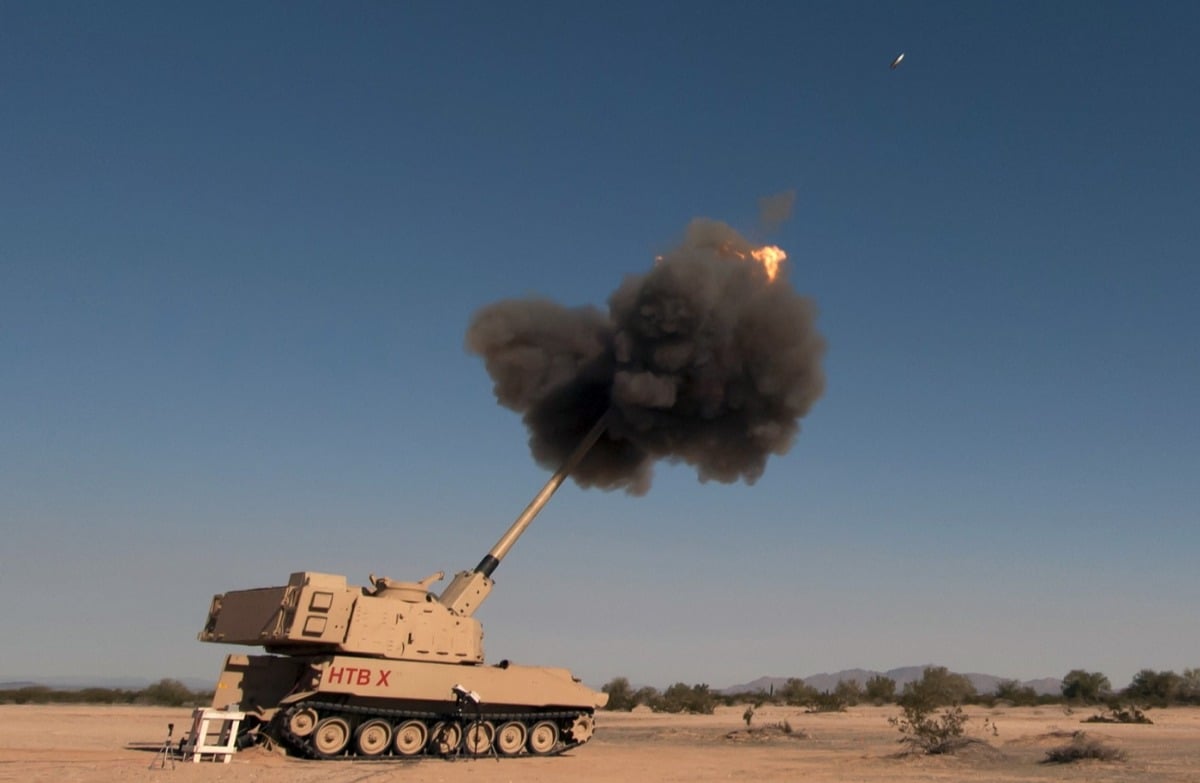 XM1299. Photos courtesy of U.S. Army Yuma Proving Ground
The program’s real test comes later, when the Army plans to deliver a complete prototype battery by the fourth quarter of fiscal year 2027 and put it through an operational demonstration in fiscal year 2028, evaluating whether a wheeled cannon system can genuinely hold its own against the kind of massed drone and missile attacks that have already overwhelmed less mobile, more expensive air defenses elsewhere in the world.
Content preview only. Full article available at source. View Full Article
BAE Systems released live-fire footage of its Multi-Domain Artillery Cannon System (MDACS) on July 2, 2026, showcasing its capabilities in modern warfare. The U.S. Army has allocated approximately $646 million for the development of MDACS, which aims to solve the cost-exchange problem in air defense. The system includes advanced features such as the Hypervelocity Projectile, capable of reaching targets over 100 nautical miles away, and is designed for rapid deployment via C-130 aircraft.
- BAE Systems released live-fire footage of the MDACS on July 2, 2026.
- MDACS is designed to address the cost-exchange problem in modern warfare.
- The U.S. Army has budgeted approximately $646 million for the MDACS project from 2025 to 2027.
- The Hypervelocity Projectile can reach targets over 100 nautical miles away depending on the firing system.
- MDACS is intended to be a networked air defense system, not just a standalone weapon.