
BAE to add jam-resistant GPS to carrier landing system
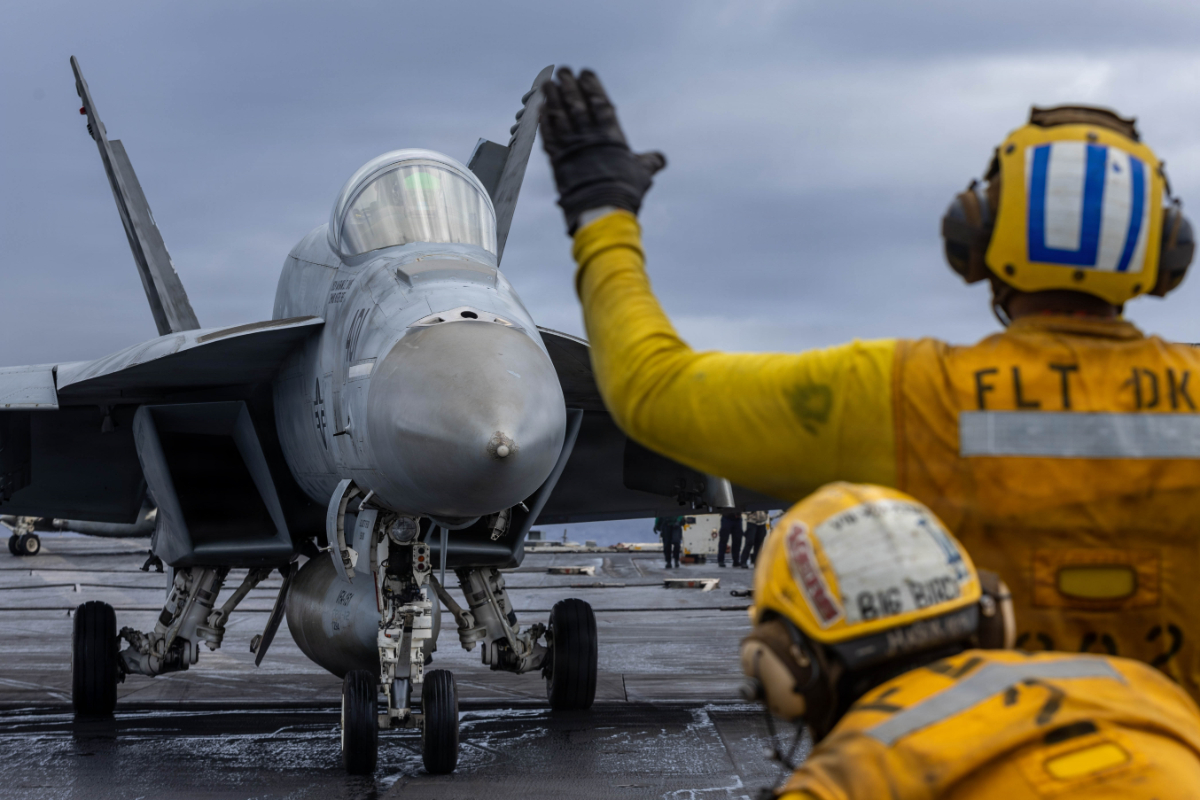
BAE Systems will upgrade the GPS inside the U.S. Navy’s carrier landing system to the military’s encrypted, jam-resistant M-code signal under a $16 million contract from Collins Aerospace.
The company will design and develop the M-code GPS solution for the Joint Precision Approach and Landing System, known as JPALS, BAE Systems said on Oct. 1. It will supply its DIGAR-500M anti-jam receiver for the job. The company did not say when development will finish, how many receivers the work covers, or when upgraded systems could reach the fleet.
JPALS guides aircraft onto the decks of aircraft carriers and amphibious assault ships using GPS, in fog, heavy rain and rough seas, without relying on landing radar. All three versions of the F-35 carry it, as do the CMV-22B Osprey and the MQ-25 Stingray unmanned tanker. The system reached initial operational capability with U.S. Marine Corps F-35Bs on amphibious ships in 2018 and with the U.S. Navy on nuclear-powered carriers in 2021.
Raytheon, now part of RTX, built JPALS and delivered all 23 low-rate production units to the U.S. Navy under a $234 million contract awarded in 2019. The system is also installed on Britain’s HMS Queen Elizabeth, Italy’s ITS Cavour and Japan’s JS Izumo. Collins Aerospace, which awarded the BAE Systems contract, is also an RTX business.
BAE Systems already provides the GPS receivers in today’s JPALS. They use an older protected technology called SAASM, short for Selective Availability Anti-Spoofing Module. The new DIGAR-500M will run SAASM and M-code at the same time, so the system can work with aircraft that have and have not yet been upgraded, the company said.
M-code is a military-only GPS signal that is encrypted and built to hold up better against jamming and spoofing, where an enemy broadcasts false signals to throw off navigation. For a carrier landing, where an aircraft depends on precise position data in the final seconds before touchdown, a corrupted signal is a safety problem as much as a combat one.
The DIGAR receiver uses digital beamforming, which lets its antenna electronics focus on satellite signals while tuning out interference. It can track up to 24 steered beams at once, BAE Systems said.
“Integrating M‑Code strengthens JPALS against evolving threats and ensures our warfighters maintain a decisive operational advantage,” said Molly O’Brien, program manager for Airborne GPS at BAE Systems.
The upgrade is a small piece of a much larger and slower effort. The Government Accountability Office has estimated that up to 1 million M-code receivers could be needed across some 700 types of weapon systems, from ground vehicles to destroyers and fighter jets. U.S. Air Force officials now expect operational testing of the chip cards that let ships and aircraft receive M-code to wrap up in fiscal 2027, two decades after the first satellite broadcasting the signal went into orbit, Breaking Defense reported in July.
BAE Systems bought Collins Aerospace’s military GPS business in 2020.
Content preview only. Full article available at source. View Full Article
BAE Systems is upgrading the GPS in the U.S. Navy’s carrier landing system to the military’s encrypted, jam-resistant M-code signal under a $16 million contract. This upgrade will utilize the DIGAR-500M anti-jam receiver and enhance the Joint Precision Approach and Landing System (JPALS), which guides aircraft during landings in challenging conditions. The integration of M-code technology aims to improve operational safety and effectiveness for naval aviation.
- BAE Systems received a $16 million contract to upgrade the GPS in the U.S. Navy’s carrier landing system.
- The upgrade involves the integration of M-code GPS technology.
- The DIGAR-500M anti-jam receiver will be used in the upgrade.
- JPALS is used for landing aircraft on carriers and amphibious ships under adverse conditions.
- The system has been operational with U.S. Marine Corps F-35Bs since 2018.