
Baltic Presidents Demand 2026 NATO Air Defense with Rafale and F-16 Instead of Air Policing
 Dr. Klaus Weber
Baltic Presidents Demand 2026 NATO Air Defense with Rafale and F-16 Instead of Air Policing
A single drone shootdown on May 19 revealed more about the weakness of NATO air defense in the Baltics than many budget speeches in Brussels. A Romanian F-16, operating from Šiauliai in Lithuania as part of the Baltic Air Policing Mission, shot down a drone over Estonia. According to reports from Tallinn, it was likely a Ukrainian drone that had been diverted from its course by Russian electronic warfare. Two days later, the presidents of Estonia, Latvia, and Lithuania jointly demanded that NATO strengthen its air defense and counter-drone capabilities on the eastern flank. This sounds technical. In fact, it is an institutional demand on an alliance that has primarily organized presence in the Baltics for two decades but still has not established a robust regional air defense.
The Incident Was Small, the Institutional Statement Was Large
The facts are now relatively clear. LRT reported on May 19 that Estonian Defense Minister Hanno Pevkur confirmed that a NATO fighter jet had shot down a drone in Estonian airspace. The jet was a Romanian F-16, stationed in Šiauliai, thus not in Estonia itself. Pevkur explicitly referred to the joint airspace monitoring with Latvia and Lithuania. Marko Mihkelson, the chairman of the Foreign Affairs Committee in the Estonian Parliament, identified the target as a Ukrainian drone that had drifted into Estonia; Ukrainian Defense Minister Mykhailo Fedorov had apologized.
These details are politically more important than the origin of the drone. A small, presumably not intentionally deployed projectile against NATO territory forced the alliance to activate the entire chain of detection, identification, political assessment, and kinetic effect. On May 20, residents in Vilnius had to seek shelter; President Gitanas Nausėda and Prime Minister Inga Ruginienė were reportedly taken to safe locations. For the Baltic capitals, this was not an abstract scenario from a NATO exercise, but a reality on a Wednesday morning.
Baltic Air Policing Is Not Air Defense
Since 2004, NATO has operated Baltic Air Policing in the Baltics. The program was designed for a different strategic moment: small alliance partners without their own combat aircraft should be able to demonstrate airspace sovereignty in peacetime. Rotating contingents, currently including French Rafale in Lithuania and Romanian F-16, reliably fulfill this task. But air policing is not an air defense system. It identifies, escorts, and if necessary, forces aircraft to land. Against mass-deployed Shahed drones, small reconnaissance UAVs, GPS-jammed cluster munitions, or ballistic missiles, this model is structurally inadequate.
The Presidential Chancellery of Latvia therefore formulated quite precisely on May 21. The three Baltic presidents thanked NATO allies for Baltic Air Policing, Baltic Sentry, and Eastern Sentry, but simultaneously called for investments in air defense and counter-drone capabilities as well as a review of the alliance's capability goals. This is diplomatic language for an uncomfortable fact: the existing mission fulfills its mandate, but the mandate is outdated.
The Drone Question Disassembles the Old Division of Labor
European defense policy likes to separate police, defense, deterrence, and warfare. Drones do not adhere to these categories. A UAV that launches from Ukraine, is diverted by Russian electronic warfare, and then appears over Estonia is simultaneously an accident, a news test, an escalation risk, and an air defense problem. This is precisely where the institutional weakness lies: Who decides in seconds whether an object is shot down? Who is liable if debris falls in a village? What national law allows a rotating NATO pilot to engage an unclear track over the territory of a third alliance state?
These questions sound bureaucratic, but they determine military effectiveness. Brigadier Chris Gent described the new Eastern Flank Deterrence Initiative to Defense News as a network of sensors, unmanned systems, and offensive as well as defensive effectors. The core term is "autonomous zone": a space where primarily unmanned systems operate and sensors can trigger effectors across borders. Technically, this is plausible. Politically, it is delicate. Because a sensor in Latvia, an effector in Lithuania, and a target over Estonia do not automatically result in a common engagement rule.
Patriot, IRIS-T, and Skyranger Only Solve Part of the Problem
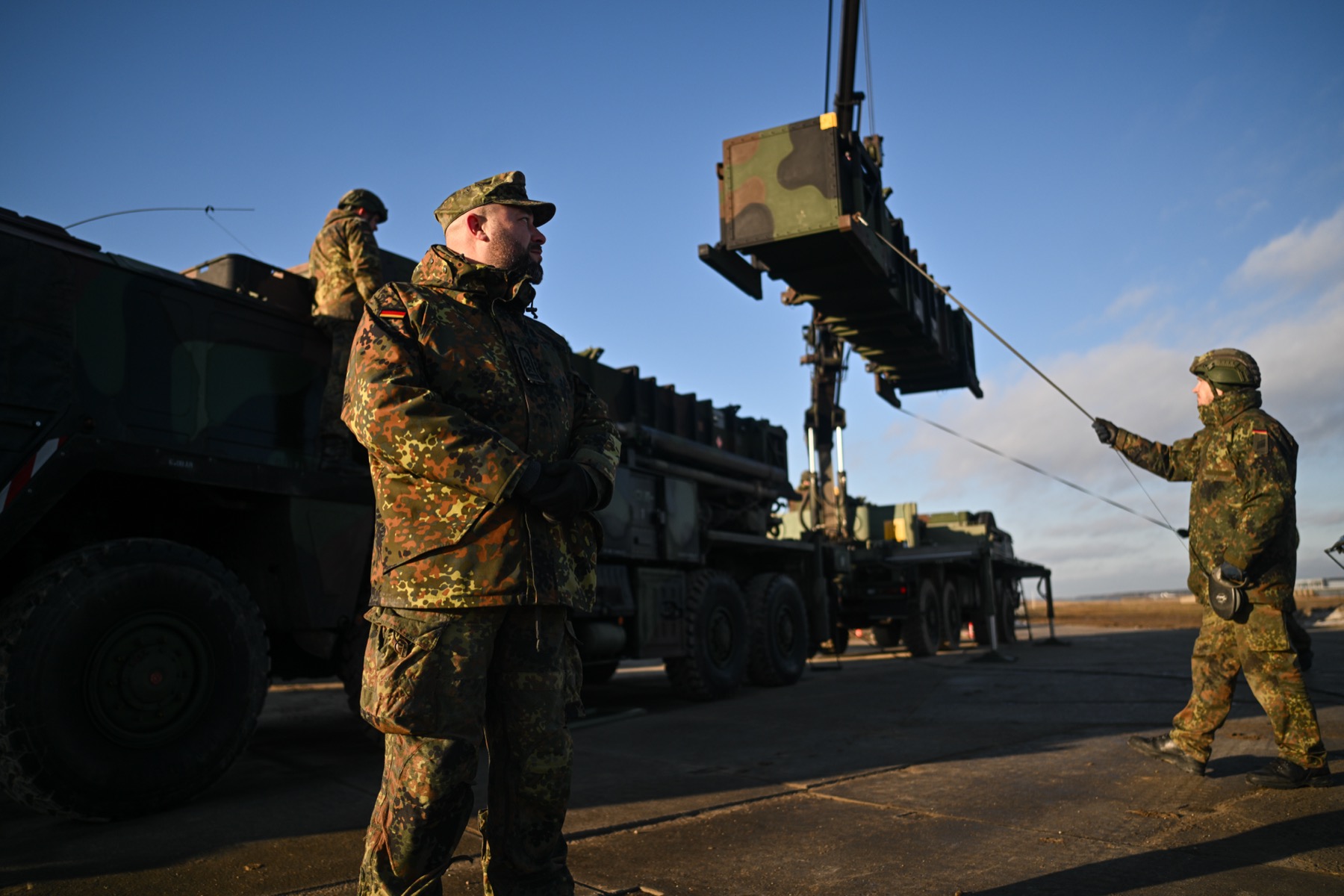
The Baltic demand for stronger air defense is immediately read as a procurement issue in many capitals: more Patriot, more IRIS-T SLM, more NASAMS, more Skyranger 30, more radars. This is not wrong. Estonia and Latvia have already procured IRIS-T SLM; NATO refers to integrated air and missile defense as the core of its deterrence and defense structure. But the critical gap lies not only in the number of batteries. It lies in the layering.
A Patriot interceptor missile is designed for ballistic missiles and high-value air targets, not for cheap drones that enter NATO airspace through electronic disruption. A Rafale or F-16 can shoot down a drone, but that is an economically absurd and operationally scarce resource. A Skyranger can engage small targets more cheaply, but it only protects a limited area. IRIS-T SLM fills the medium layer but requires sensor integration and ammunition. Without a regional data backbone, common engagement rules, and predefined responsibilities, each individual system remains a national island.
The Eastern Flank Demands Not More Symbolism, but Delegation
The Baltic states therefore do not simply demand "more NATO." They demand a different NATO. The alliance should transition from the symbol of rotating presence to a permanently combat-capable, automated, and legally actionable air defense network. This is particularly uncomfortable for Germany. Berlin likes to speak of leadership responsibility on the eastern flank, leads a brigade in Lithuania, and finances large parts of European support for Ukraine. But in air defense, Germany must decide whether to primarily protect Patriot and IRIS-T capabilities nationally, deliver them to Ukraine, or integrate them into a permanent Baltic network. Achieving all three goals simultaneously is not possible with the current stock.
France faces a similar dilemma. The Rafale presence in Šiauliai is visible and politically useful. However, if Baltic Air Policing is to become Baltic Air Defense, a rotating fighter jet contingent is not enough. Then it is about ground-based systems, ammunition, command infrastructure, constant alert chains, and the willingness to act early in gray zones. European strategic autonomy does not begin with grand speeches about sovereignty. It begins with the banal question of whether a radar track over Daugavpils, Tartu, or Vilnius can be assigned to a legally permissible effector within seconds.
The Real Test Comes Before the NATO Summit
By the next NATO summit, the Baltic demand will likely be translated into familiar formulaic compromises: stronger Integrated Air and Missile Defense, better Counter-UAS capabilities, more exercises, more forward presence. These formulas are not worthless. However, they will not be sufficient if they circumvent the decision-making question. The eastern flank does not need another political assurance that Article 5 applies. It needs a technical and legal architecture that intercepts small air threats before they become political crises.
The shootdown on May 19 was militarily limited. Institutionally, it was a warning. NATO can continue to pretend in the Baltics that air policing is a sufficient peace mission. Or it can acknowledge that the war in Ukraine has already changed the peace mission. More aircraft demonstrate alliance solidarity. More air defense creates operational capability. Between these two concepts lies exactly the gap in which Europe's security policy has been stuck for years.
Source Situation
- LRT, May 19, 2026, report on the shootdown of a drone over Estonia by a Romanian F-16 as part of the NATO Baltic Air Policing Mission.
- Presidential Chancellery of Latvia, May 21, 2026, statement on the demand for stronger NATO air defense and counter-drone capabilities.
- Associated Press, May 20, 2026, report on air alarm and protective measures in Vilnius.
- NATO, background documents on Air Policing, Integrated Air and Missile Defense, Baltic Sentry, and Eastern Sentry.
- Defense News, May 20, 2026, report on the Eastern Flank Deterrence Initiative and the planned "autonomous zone."
- IISS Military Balance 2026, analysis of the fortification and air defense of NATO's eastern flank.
On May 19, 2026, a Romanian F-16 shot down a drone over Estonia, likely a Ukrainian UAV disrupted by Russian electronic warfare. This incident prompted the presidents of Estonia, Latvia, and Lithuania to demand stronger NATO air defense and counter-drone capabilities. The event underscored the inadequacies of NATO's Baltic Air Policing mission and the need for a more robust air defense system in the region.
- A Romanian F-16 shot down a drone over Estonia on May 19, 2026.
- The drone was likely a Ukrainian UAV affected by Russian electronic warfare.
- Baltic presidents called for enhanced NATO air defense and counter-drone capabilities.
- The incident highlighted weaknesses in NATO's Baltic air defense.
- Residents in Vilnius were ordered to seek shelter following the incident.