
Beware! Japan Develops Laser Weapons Using Anti-Drone Technology
[Global Times Comprehensive Report] According to a report by Kyodo News on the 22nd, the Japanese government plans to revise three security-related documents within the year, which will include measures to strengthen the air defense network in response to a large number of drone attacks, and discussions on this have already begun. The tactics involving a large number of drones used in the Russia-Ukraine conflict have attracted widespread attention. To prepare for "emergency situations," Japan will also accelerate the construction of interception measures. Japan is utilizing air defense missiles, high-power lasers, and microwave weapons to counter these new threats.
It is reported that the Self-Defense Forces currently rely mainly on the domestically produced "Type 03 Medium-Range Air Defense Missile," which can shoot down aircraft and cruise missiles, to intercept drones. However, when faced with a large number of suicide drones, this system not only has a limited number of targets it can engage simultaneously, but using expensive missiles against cheap drones is also "very uneconomical." Therefore, the Self-Defense Forces are requesting the introduction of new air defense missiles and high-power laser weapons, as well as adjustments to their interception strategies for drones.
The Japanese Ministry of Defense is developing a high-power laser system capable of shooting down small drones. Recent defense budgets in Japan have explicitly included special funds for the research and testing of laser weapons. Additionally, in the fiscal year 2026 budget proposal, Japan has allocated 1.3 billion yen (approximately 58 million yuan) for the development of high-power microwave weapons that can intercept a large number of drones simultaneously.
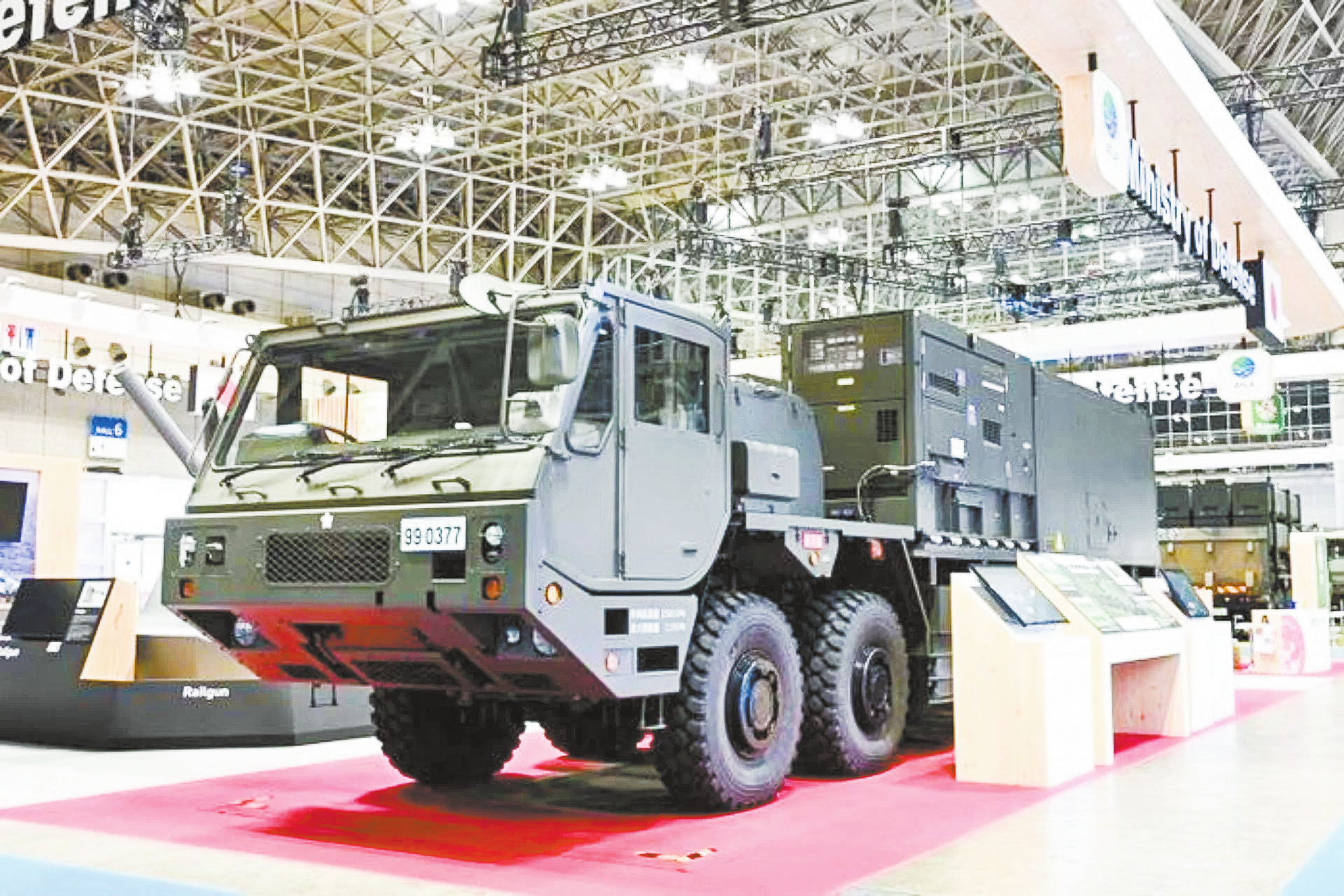
It is noteworthy that under the guise of addressing drone threats, Japan is continuously accelerating the development of laser weapons. At the 2025 Japan Defense Expo, the Acquisition Technology and Logistics Agency (ATLA) of the Ministry of Defense unveiled the "Vehicle-Mounted High-Power Laser Demonstration System." An official from the Ministry of Defense involved in the project confirmed that the system successfully shot down small drones during tests conducted in February and March of that year, demonstrating its effectiveness in counter-drone operations. The system uses a 10-kilowatt laser that can continuously fire in a 360-degree range.
In December of last year, the U.S. Navy News website revealed that, in addition to land-based vehicle-mounted laser weapons, larger power laser weapons planned to be mounted on Japan's Maritime Self-Defense Force vessels have also entered the prototype testing phase. Unlike the vehicle-mounted laser weapon system that integrates all functions into a single truck, the shipborne laser weapon system is much larger, consisting of two containers, designed to combine multiple 10-kilowatt fiber lasers into a 100-kilowatt laser weapon, providing sufficient power to burn through metal surfaces. Japanese engineers specifically designed this system to shoot down drones, mortar shells, and other light aerial threats. The prototype of this system has already been installed on the Maritime Self-Defense Force's "Asuka" test ship and may go to sea for testing in the first half of this year to verify its destructive effects on small drones and mortar shells, sustained combat capability, target acquisition and precise tracking performance, integration with target search sensors, and operational performance under various environmental conditions. The Maritime Self-Defense Force is advancing the construction of two new Aegis-equipped ships, which will also be equipped with high-power laser weapon systems in the future.
The Japanese Ministry of Defense believes that high-power laser weapons are expected to become "game changers" on the battlefield, especially since the cost of using laser weapons is low, they can provide immediate response, and under sufficient power supply, the ammunition capacity is virtually unlimited. They can also precisely strike high-speed moving targets without physical interception. This makes the technology particularly suitable for urban or sensitive environments, where the use of missiles or artillery poses risks to nearby civilians and infrastructure. The Navy News website states that integrating such laser weapon systems into the operational framework of the Japanese Self-Defense Forces indicates that the Self-Defense Forces are moving towards more diversified and adaptable response capabilities. (Wei Yunfeng)
Japan is enhancing its air defense strategy by modifying security documents to address drone threats and is developing high-power laser and microwave weapons for interception. The Japan Self-Defense Forces are focusing on new technologies to improve their capabilities against drone attacks, with successful tests of laser systems already conducted. Funding for these developments is included in the upcoming defense budget, indicating a significant shift in Japan's military approach.
- Japan is modifying security documents to enhance air defense against drone attacks.
- The Japan Self-Defense Forces are developing high-power laser systems and microwave weapons.
- The budget for 2026 includes funding for high-power microwave weapons development.
- Japan's high-power laser systems have successfully intercepted small drones during tests.
- The integration of laser weapons into Japan's Self-Defense Forces indicates a shift towards more adaptive defense capabilities.