
British Army approves hinged mortar fleet integration
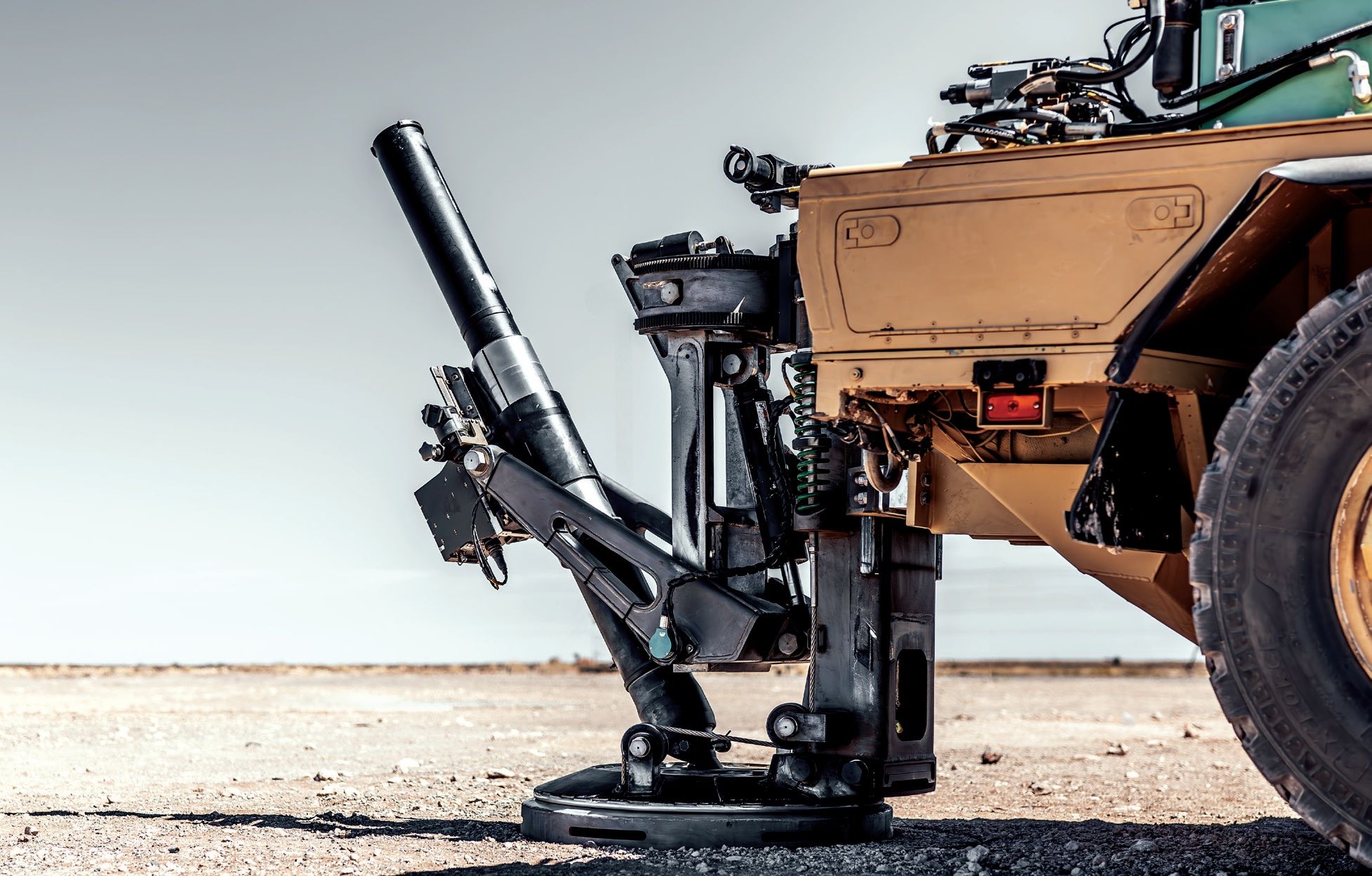
The British Army and UK Defence Innovation have issued a Request for Information for a vehicle-mounted 120mm hinged mortar system under Project STOKES, opening a formal procurement process aimed at fielding approximately 60 systems integrated onto light tactical vehicles, with the Jackal 3 Extenda identified as the assumed platform.
The RFI, published under project code 715605452, marks the opening phase of what UKDI describes as a concept and assessment process intended to inform a full procurement decision. The authority is seeking information on system costs, integration feasibility, munitions availability, and through-life support before advancing to more formal commercial engagement. Indicative timelines point to a Pre-Qualification Questionnaire in December 2025, an Invitation to Tender in January 2026, and a test and evaluation phase in the third quarter of 2026, subject to approvals.
The choice of a hinged rather than recoil-absorbing mounted system is deliberate. According to the project documentation, a hinged mortar configuration offers the best balance of performance, integration speed, and cost compared to recoilless alternatives. It is easier to fit onto an existing vehicle at pace, less expensive to integrate and support over its service life, and adequate to the lethality requirements the British Army has set out. Only hinged-mounted systems will be considered under this competition.
The Jackal 3 Extenda, a high-mobility medium-support vehicle already in British Army service, is the assumed host platform. Under the competitive process UKDI has outlined, down-selected suppliers will be provided a government-furnished vehicle for integration work, after which the complete system will be run through assessed trials covering vehicle performance, maneuverability, and human factors. Live firing trials are expected to be conducted in the United Kingdom due to export restrictions the project will not be resourced to manage abroad.
UKDI has designed the competition around what it calls a 3-2-1 down-select model, progressing suppliers through a Pre-Qualification Questionnaire, a technical ITT, a strategic ITT covering factors such as supply chain resilience and onshoring, a potential presentation stage, and finally a trials and demonstration phase. The scoring framework is structured to reward proximity to desired rather than minimum acceptable performance — digital fire control integration, for example, would score significantly higher than a basic laptop-and-cable solution. The aim, officials said, is to deliver a Minimum Deployable Capability quickly, followed by spiral development as the programme matures.
Munitions are a notable element of the requirement. The authority expects suppliers to provide their own ammunition for live firing trials, and for the initial procurement, munitions will be included as part of the purchased capability until the UK Ministry of Defence establishes its own 120mm procurement programme. Officials acknowledged the current global demand signal for artillery ammunition and indicated openness to discussion on how supply constraints could be managed contractually.
A 120mm mortar mounted on a light vehicle gives infantry units substantially greater organic fire support than smaller-calibre systems allow, with effective ranges and warhead effects that can substitute for artillery in rapid, distributed operations. The ability to fire from a mobile platform, then displace quickly before counter-battery radar can respond, is precisely the operational pattern modern ground forces have sought to refine following extensive observation of the war in Ukraine.
An update to the project notice in November 2025 noted that formal direction to industry was being held pending publication of the UK government’s Defence Investment Plan, underscoring that Project STOKES sits within a broader strategic review of British defence spending. The listing deadline runs to March 2027, giving the programme room to absorb the policy timeline without collapsing the competitive schedule.
For industry, the competition represents a concrete near-term opportunity in a market segment that has attracted renewed investment across NATO. For the British Army, fielding a vehicle-mounted 120mm mortar on the Jackal platform would extend the reach and lethality of its light forces at a time when the service is restructuring around Mobile Brigade Combat Teams designed to operate faster and with a smaller logistical footprint than traditional armoured formations.
Content preview only. Full article available at source. View Full Article
The British Army is initiating a procurement process for approximately 60 vehicle-mounted 120mm hinged mortar systems under Project STOKES, with the Jackal 3 Extenda as the assumed platform. The Request for Information outlines timelines for supplier engagement, including a Pre-Qualification Questionnaire in December 2025 and an Invitation to Tender in January 2026. This project aims to enhance the fire support capabilities of infantry units in the UK.
- The British Army is seeking to procure approximately 60 vehicle-mounted 120mm hinged mortar systems.
- The Jackal 3 Extenda is identified as the assumed platform for the mortar system.
- The procurement process includes a Pre-Qualification Questionnaire in December 2025 and an Invitation to Tender in January 2026.
- Suppliers are expected to provide their own ammunition for live firing trials.
- The project aims to enhance the fire support capabilities of infantry units.