
Can new drones, 3D printers defeat distance’s tyranny? RIMPAC aims to find out
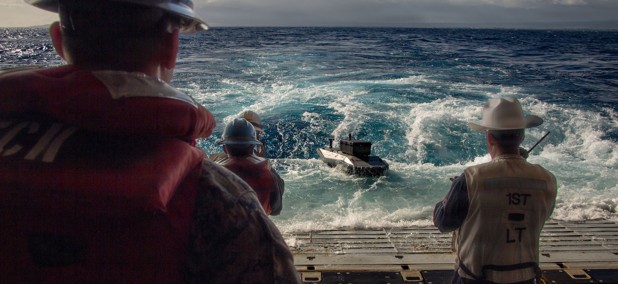
SCHOFIELD BARRACKS, Hawaii—Replacing broken parts and resupplying ships at sea is a challenge anywhere, but in the Pacific theater, that problem is magnified by thousands of miles of sea water. Now, as part of the sprawling Rim of the Pacific, the U.S. military is practicing how it might use tech like self-driving boats and 3D printers that can be thrown out of airplanes to overcome the region’s oft-lamented tyranny of distance.
“We are piloting this program during RIMPAC to experiment with the idea of what theater-wide advanced manufacturing is going to look like for the joint force,” Rear Adm. Michael Mattis told reporters during a media day at the U.S. Pacific Command Joint Advanced Manufacturing Center, calling it the U.S. military’s largest advanced manufacturing demonstration so far.
This year’s RIMPAC features “38 countries, 31 surface vessels, five submarines, over 30,000 personnel, almost 180 aircraft, and over 1,100 personnel that are going to be doing our landings,” Mattis said. “In that process, it’s an enormous experiment for us to figure out how to sustain the joint force.”
Marine Lt. Col. Michael Radigan said the experiment—coordinated by Fleetwerx and the Naval Postgraduate School’s Consortium for Advanced Manufacturing Research and Education—is bringing together a “trifecta of advanced manufacturing, autonomous systems, and artificial intelligence… to deliver true parts that the joint force needs.”
“What are we trying to do? Very simply, this is Uber for manufacturing delivered at the speed of Amazon, for the highest quality of parts, and we have the opportunity to do it in the most contested of environments. And that’s extremely challenging,” Radigan said.
Some of the experiment’s technology was put on display in a sun-scorched field at this Army base near Oahu’s North Shore. San Diego-based Firestorm gave a tour of its expeditionary advanced manufacturing cell, which comprises two shipping containers that can be set up by two people in a few hours. Norway-based Fieldmade displayed what it calls an “additive manufacturing micro factory”—a rugged 3D printer that can be parachuted from a plane and set up in minutes.
Florida-based Snowbird Technologies showed off its own 3D printer, housed in a compact shipping container, that works on land and aboard a ship at sea.
Rhode Island-based Havoc exhibited a 14-foot autonomous boat it printed for the exercise. The solar-rechargeable unmanned surface vessel is built to operate in moderate seas—and to right itself if it capsizes in heavier weather, said Sea Thomas, Indo-Pacific director for the company.
And Los Angeles-based Splash Industries displayed a 10-foot Typhoon, an autonomous drone boat with a Pelican case attached to the top. CEO Ivan Avanesov told reporters that the USV had recently executed the first autonomous resupply of a warship at sea when it drove straight onto the well deck of the USS Essex amphibious assault ship underway during RIMPAC. The Typhoon USV later drove itself through rough waters to an aircraft carrier 100 miles from shore, Avanesov said.
But the gear is just part of the puzzle. “I think we’ve actually got the technology pretty good,” Radigan said. “It’s all the other things that have to happen throughout the theater in order to be able to deliver those [high-quality parts], the logistics, and creating this into the scale that you’re going to see today. So it’s all about operationalizing advanced manufacturing.”
The U.S. military is conducting experiments with advanced manufacturing technologies, including self-driving boats and 3D printers, at Schofield Barracks, Hawaii, during RIMPAC 2023. This initiative involves 38 countries and aims to enhance logistical capabilities in the Pacific theater. Technologies demonstrated include autonomous vessels capable of resupplying warships at sea, addressing the challenges posed by vast distances in the region.
- The U.S. military is piloting advanced manufacturing technologies during RIMPAC.
- 38 countries and over 30,000 personnel are participating in RIMPAC 2023.
- Technologies include self-driving boats and 3D printers for logistical support.
- The exercise aims to address the challenges of distance in the Pacific theater.
- Autonomous vessels have successfully conducted resupply missions at sea.