

Summary and Key Points: Christian D. Orr, a defense expert and former Air Force officer, evaluates the U.S. threat to use “hardball” diplomacy against Prime Minister Mark Carney’s government regarding the F-35 Lightning II order.
-As Canada weighs reducing its F-35 order in favor of the Saab JAS 39 Gripen, Washington holds a “red card” via the MIDS-LVT (1) terminal.
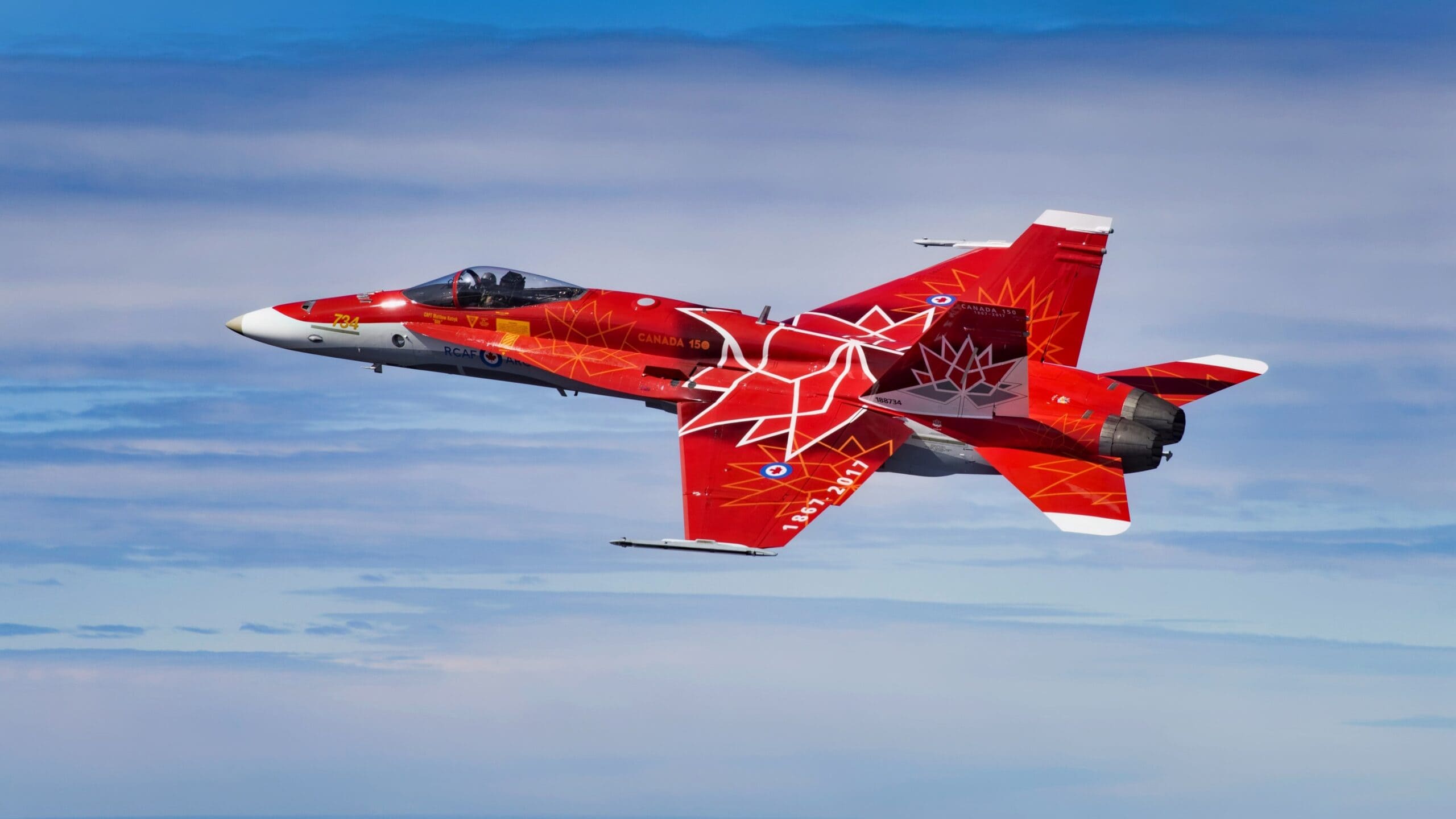
CF-18 Fighter from Canada. Image Credit: Creative Commons.
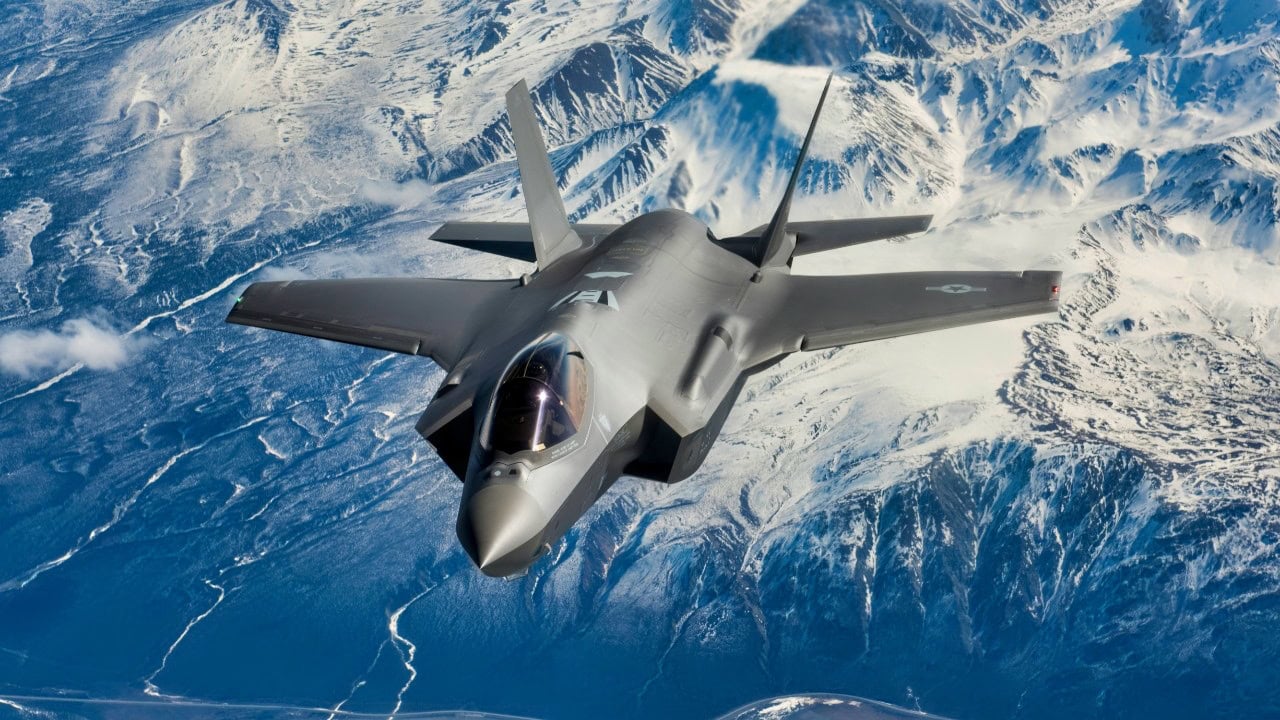
A new F-35A Lightning II fifth-generation fighter aircraft flies over the Alaska Canada Highway en route to its new home at the 354th Fighter Wing, Eielson Air Force Base, Alaska, April 21, 2020. The F-35 represents a new model of international cooperation, ensuring U.S. and Coalition partner security well into the 21st Century. (U.S. Air National Guard photo by Tech. Sgt. Adam Keele)
-This Link 16 hardware is the backbone of NORAD interoperability.
-This 19FortyFive report analyzes how the Trump administration, already pressuring allies to increase defense spending to 5% of GDP, could restrict the encryption keys needed for Gripen to “speak” to U.S. forces, effectively isolating the RCAF from its closest allies.
The “Red Card” Lever: How the U.S. Could Use Link 16 Encryption to Force Canada’s F-35 Purchase
Back in the day, MAD Magazine referred to the enduringly popular 1960s TV sitcom “Gilligan’s Island” as “the show that refuses to die” thanks to the show’s persistence and endurance via reruns Speaking of “Gilligan’s Island,” did you know that Alan Hale, Jr. (“The Skipper”) and Russell Johnson (“The Professor”) were both were World War II veterans? Hale served in the U.S. Coast Guard, and Johnson was a bombardier with the U.S. Army Air Forces.
If there is current international security affairs equivalent of “Gilligan’s Island,” it would be the undying debate and drama involving the Royal Canadian Air Force (RCAF)’s choice between a continued purchase of the fifth-generation Lockheed Martin F-35 Lightning II stealth fighter, and the 4.5-generation Swedish-made Saab JAS 39 Gripen non-stealth fighter.
This story has taken multiple twists and turns, not entirely unlike two fighter planes in a dogfight. The latest twist is that the U.S. plane may hold a proverbial red card over the Swedish one.
The Scoop
The latest development comes to us courtesy of CBC News reporter Murray Brewster:
“There is a way the U.S. could play hardball with Canada, if the Liberal government of Prime Minister Mark Carney decides it wants to limit its purchase of F-35s in favour of the Gripen. … The two fighters from different generations speak to each other and share data over a highly sophisticated U.S.-owned system known as Link 16, which contains a cutting-edge anti-jamming and encryption device called a multifunctional information distribution system (MIDS)…It is the key for NATO and NORAD interoperability.
“And countries wanting to integrate—or stay integrated—with American forces must get permission from the United States to acquire the system.”
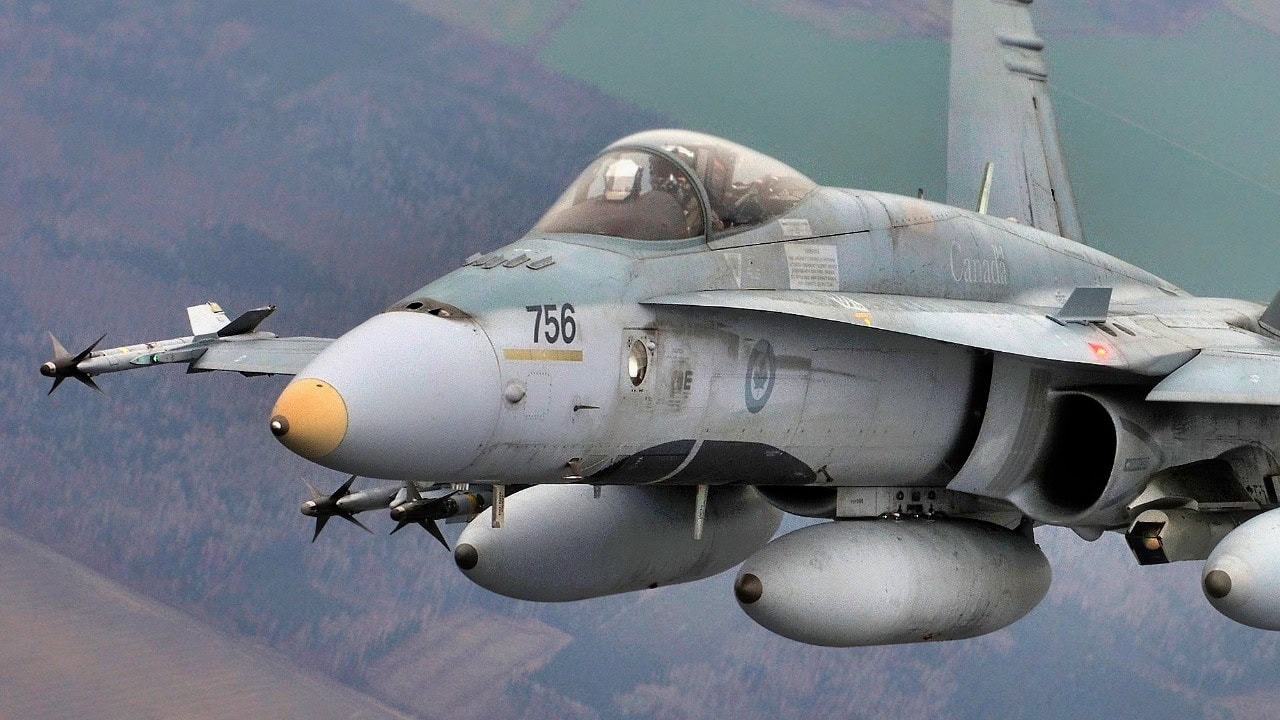
A CF-188 Hornet from the Canadian Air Task Force Lithuania flies over Lithuania on November 20, 2014 for the NATO Baltic Air Policing Block 36 during Operation REASSURANCE.
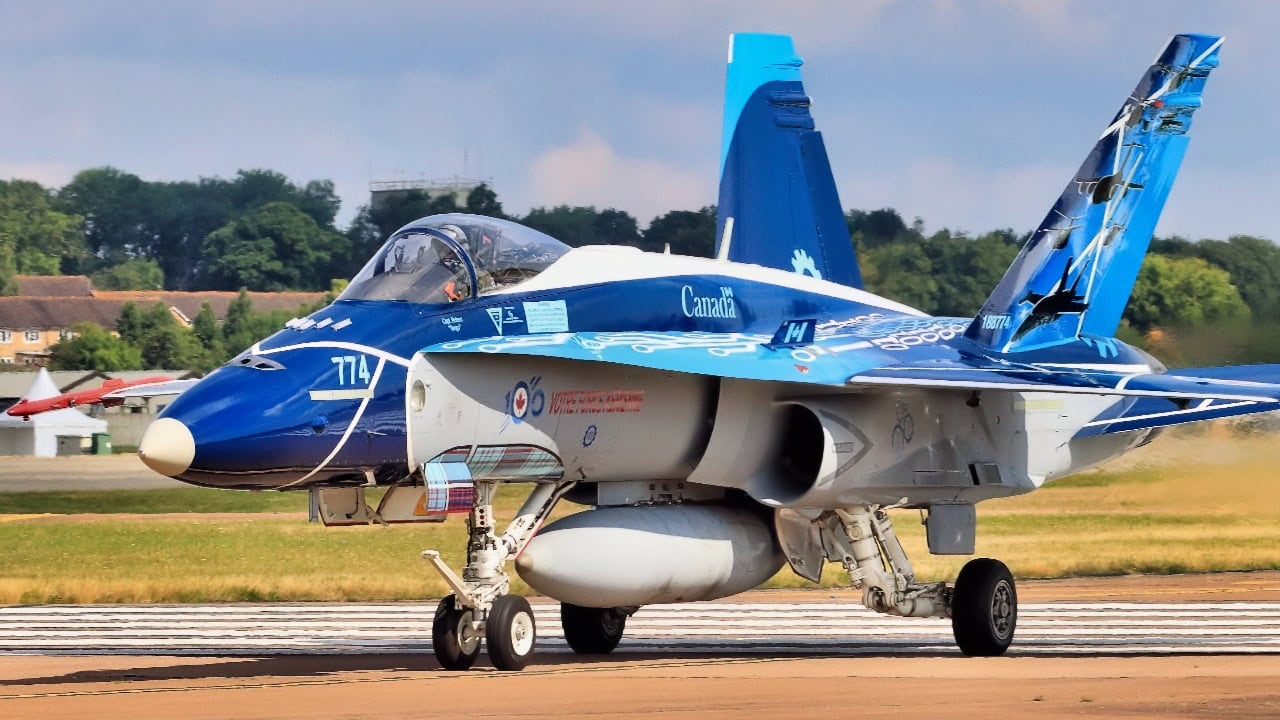
CF-18 Canada Air Force.
Brewster adds that “concerns the Trump administration is prepared to pull this lever,” and given that Trump has already shown he’s not willing to take any guff from fellow NATO member Spain when it comes to support for Operation Epic Fury and meeting the threshold of 5 percent GDP expenditure on defense, Prime Minister Carney—and other NATO heads of state—might take note.
About MIDS
Okay, so what exactly is MIDS, and why is it such a big deal?
It’s co-developed by Collins Aerospace (an RTX subsidiary) in partnership with BAE Systems, and it offer high-speed, secure sharing of military tactical data links through the Link 16 network. It comes in six different variants:
-Multifunctional Information Distribution System – Fighter Data Link – (MIDS-FDL)
-Multifunctional Information Distribution Systems-Low Volume Terminal – MIDS-LVT [1])
-Multifunctional Information Distribution System Joint Tactical Radio System (MIDS-J)
-Multifunctional Information Distribution System -Low Volume Terminal 2-11 (MIDS-LVT 2-11)
-Mobile Integration and Test Environment (MITE)
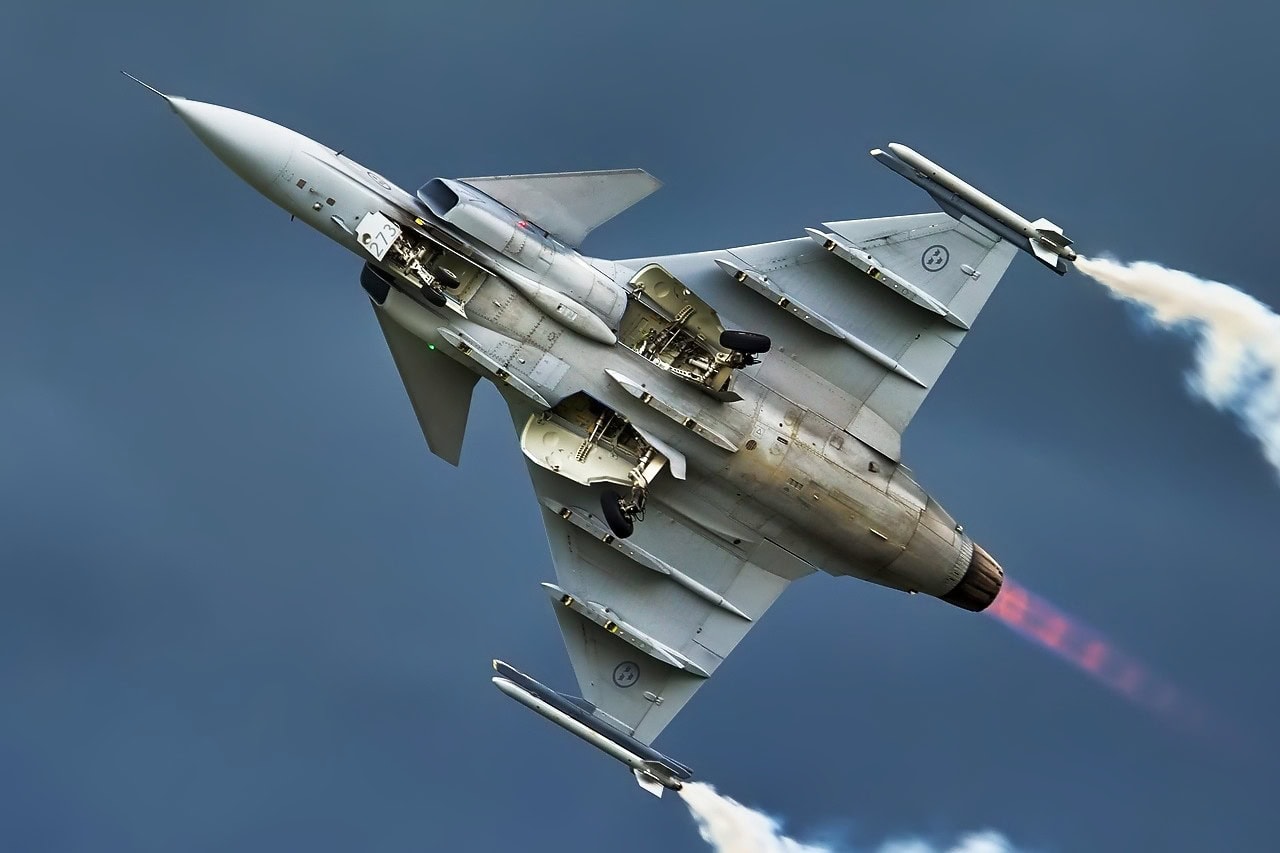
JAS 39 Gripen Fighter from Sweden.
Of these half-dozen options, the second one from the top, MIDS-LVT (1), is presumably the version most germane to this discussion. It is described as “the optimum solution for all your Link 16 applications and capable for space and weight constrained platforms, for example; U.S. Navy (USN) F/A-18, U.S. Air Force (USAF) F-16, Rafale and Eurofighter.”
Though the Gripen isn’t specifically listed by name, the data sheet specific to MIDS-LTV (1) does list “NATO interoperability” under its “Functional capabilities.”
Meanwhile…
Danish-owned F-35s have been training and operating alongside Swedish Gripens-Cs during the NATO Iceland air policing mission. The commanders of both nations’ contingents said that the two platforms have been integrating together quite well. However, that’s not to say that these commanders aren’t feeling a tad “nervous in the service.”
As the Swedish component commander, Lt.-Col. Johan Legardt, stated during an interview at Keflavik Air Base, “If Canada is the first country where the U.S. draws the red card then we have a problem;” however, he hastened to add that such a drastic step has never happened in any country to whom Sweden had sold Gripens in the past.
Meanwhile, the chief of the Royal Danish Air Force, Maj.-Gen. Jan Dam, is maintaining a positive note on the current mission, stating that, “We’ve made each other better and I think that’s what we’re gaining.”
About the Author: Christian D. Orr, Defense Expert
Christian D. Orr is a Senior Defense Editor. He is a former Air Force Security Forces officer, Federal law enforcement officer, and private military contractor (with assignments worked in Iraq, the United Arab Emirates, Kosovo, Japan, Germany, and the Pentagon). Chris holds a B.A. in International Relations from the University of Southern California (USC) and an M.A. in Intelligence Studies (concentration in Terrorism Studies) from American Military University (AMU). He is also the author of the newly published book “Five Decades of a Fabulous Firearm: Celebrating the 50th Anniversary of the Beretta 92 Pistol Series.”