
Canadian armored vehicle maker showcases Senator APC in Brazil
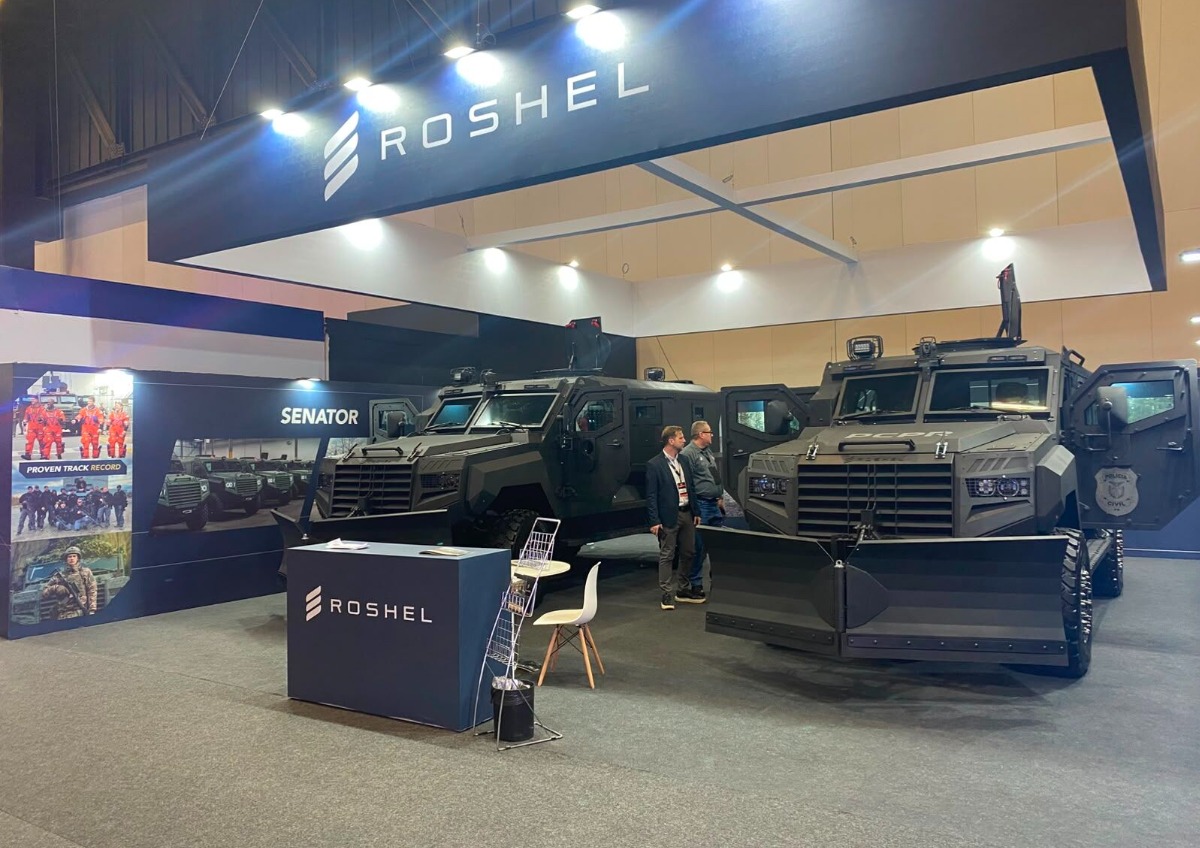
Canadian armored vehicle manufacturer Roshel Smart Armored Vehicles is showcasing its Senator armored personnel carrier this week at COP International 2026, a public safety trade fair running Aug. 11-13 at São Paulo Expo, according to Brazil Defense Brief.
The event has drawn more than 80 exhibitors from eight countries alongside Brazilian and international security officials.
The Senator APC is Roshel’s flagship model, a modular, multi-purpose armored vehicle built for law enforcement and border security missions. Roshel markets the platform in configurations ranging from personnel carriers to mobile command posts and medical evacuation vehicles.
Earlier this year, the government of Brazil’s Paraná state selected the Senator APC to strengthen the armored fleets of its military, civil and correctional police forces, Brazil Defense Brief reported. The state intends to use the vehicles in complex, high-risk operations, including crisis management, bank robbery response and attempted prisoner rescues.
Paraná’s Civil Police received the first of seven Senator APCs on May 5, assigning it to Tigre, a tactical unit that handles anti-kidnapping cases and other high-complexity operations. The remaining vehicles are going to the Military Police’s special operations battalion, Bope, and the Penal Police’s special operations sector, SOE. Each unit cost about 3.1 million reais (roughly $604,000), part of a broader 338 million reais ($68 million) public security investment package the state government has directed toward vehicles, weapons, equipment and vessels. The 4×4 Senator measures more than 5 meters (16 feet) long, runs on a V8 engine, and carries up to 10 occupants.
Roshel has produced the Senator line since 2018 in APC, MRAP, emergency response and explosive ordnance disposal configurations. The company operates four manufacturing facilities in Ontario, Canada, employs about 500 workers and can build up to 140 vehicles a month, with a single Senator taking roughly two weeks to assemble. Roshel recently opened an additional facility in Shelby Township, Michigan, mirroring its Canadian production line and adding a service center for U.S. federal and government clients.
The company’s customer base extends well beyond Brazil. Ukraine is by far Roshel’s largest operator. Defence Blog reported in December 2025 that Roshel had delivered more than 2,000 Senator vehicles to Ukrainian forces since Russia’s full-scale invasion began, up from 1,000 in December 2023 and 1,700 in March 2025, according to founder and CEO Roman Shimonov. Roshel has also supplied vehicles to the U.S. Department of Homeland Security, U.S. Customs and Border Protection, NASA, Canada’s Department of National Defence and the Peel Regional Police in Toronto, along with government buyers in Bosnia and Herzegovina, Costa Rica, Haiti, Kazakhstan, Moldova and South Korea. Brazil’s Federal District government bought six Senator vehicles in April 2025, four APCs for its Riot Police Battalion and two higher-protection MRAP variants for its special operations unit, BOPE.
COP International, now in its sixth year, is being held at a 14,000-square-meter venue this year, and organizers expect more than 25,000 visitors, up from roughly 20,000 at the 2025 edition.
Content preview only. Full article available at source. View Full Article
Roshel Smart Armored Vehicles is showcasing its Senator armored personnel carrier at COP International 2026 in São Paulo from August 11-13. The Paraná state police forces received the first of seven Senator APCs for complex operations, including crisis management and bank robbery response. Each vehicle costs about 3.1 million reais, part of a broader public security investment.
- Roshel Smart Armored Vehicles is showcasing the Senator APC at COP International 2026 in São Paulo.
- The Paraná state police forces received the first of seven Senator APCs for high-risk operations.
- Each Senator APC costs approximately 3.1 million reais ($604,000).
- Roshel has delivered over 2,000 Senator vehicles to Ukrainian forces since the start of the conflict with Russia.