
Ceasefire in Lebanon After 47 Killed Tests Iran-U.S. Agreement Within 60 Days
 Ahmed Al-Rashid
Ceasefire in Lebanon After 47 Dead Tests Iran-U.S. Agreement Within 60 Days
On June 20, 2026, the problem in southern Lebanon was not just a new exchange of fire between Israel and Hezbollah. The most important number was 47 dead in Israeli airstrikes following the death of four Israeli soldiers, and then the cancellation of a Swiss meeting that was supposed to initiate the implementation of the memorandum of understanding between Washington and Tehran. Any military personnel who has served in this area knows that a secondary front, if left without a clear political officer, quickly turns into the front that undermines the entire plan.
A report from The Guardian indicated that the U.S.-Iran agreement opened a 60-day negotiation window regarding the Iranian nuclear file and the resumption of oil movement through the Strait of Hormuz, but it immediately faltered when the fire returned to Lebanon. A report from Axios quoted U.S. officials stating that the ceasefire was brokered by American and Qatari mediation, but fighting continued even after the announced date for its implementation. This is not a procedural detail. It is a signal that the fighting parties do not read the document in the same way.
The Small Front Controlling the Big Agreement
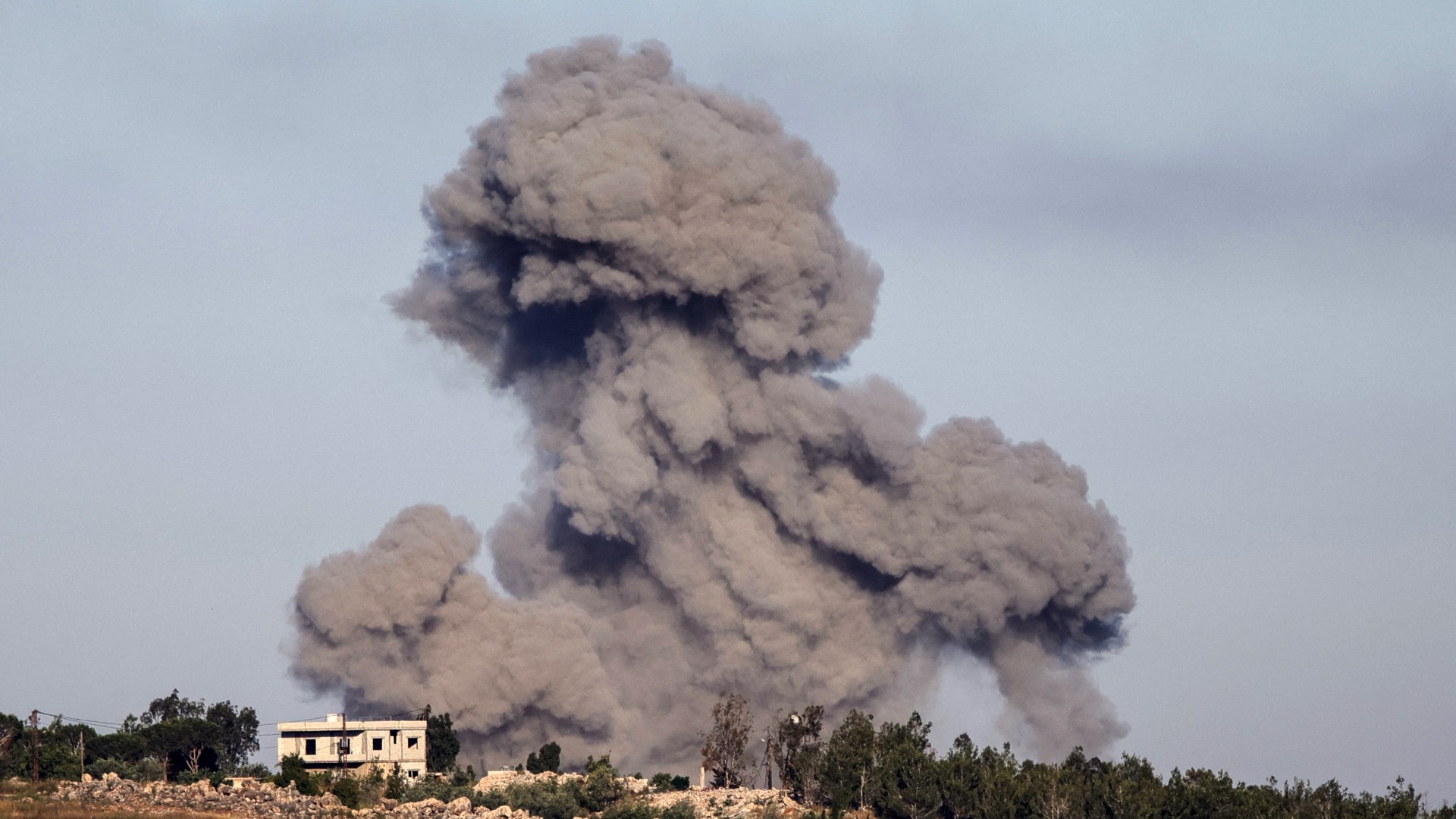
Practically, the Washington-Tehran agreement is not worth much if it does not include Lebanon in an actionable way. Iran can say that Hezbollah is part of the regional deterrence equation, and Israel can say that its forces' presence within a security strip in southern Lebanon is a matter of defending northern settlements. Between these two statements, the Lebanese state is lost, along with any mediator's ability to transform the ceasefire into a stable system.
What happened in the last hours illustrates this. Hezbollah struck Israeli forces near Nabatieh with missiles and drones, and Israel responded with extensive airstrikes in the south and Bekaa, then announced that it would remain in a security area in southern Lebanon as long as it deemed it necessary. In contrast, Lebanese officials are demanding a complete withdrawal, and Tehran considers any ongoing Israeli presence a violation of the spirit of the memorandum of understanding. If the map itself is disputed, how can the ceasefire be monitored?
The Military Dilemma for Israel
Israel emerged from the Iran war feeling that the political objective was not achieved. The Iranian nuclear program was not eradicated, Hezbollah's network was not broken, and Washington is no longer willing to keep every front open indefinitely. Therefore, southern Lebanon becomes for Israeli leadership a space for both compensation and deterrence. The problem is that deterrence here is costly; every operation inside Lebanon gives Tehran a reason to disrupt negotiations, and every rapid withdrawal appears internally as a concession to Hezbollah.
From a purely military perspective, maintaining an Israeli force in a wide border strip means three burdens: protecting short but exposed supply lines, monitoring villages and hills that could turn into anti-tank platforms, and dealing with small drones that are difficult to fully prevent. Air superiority does not solve all of that. The soldier on the ground does not live within a political statement, but within a valley, an earthen berm, and an evacuation route.
- The death of four Israeli soldiers gives the government an incentive for a harsh response, not a quiet retreat.
- The fall of dozens of casualties in Lebanon raises Hezbollah's pressure to respond, even if it announces acceptance of the truce.
- The existence of an Israeli security area creates two conflicting definitions of a ceasefire: stopping the attack north of the line, or ending the occupation itself.
Hezbollah Between Deterrence and Exhaustion
Hezbollah is not in the position it was in 2006. The war of recent months has exhausted Lebanon socially and economically, pushing more than a million people to flee according to estimates circulating in recent coverage. However, the party cannot publicly accept an equation that keeps the Israeli army entrenched in southern Lebanon under the name of a security area. Here lies the paradox of armed organizations: they need a truce to rebuild their networks, but they need to fire to prove they have not been defeated.
In my estimation, this makes the current ceasefire more fragile than the texts describing it. If a local unit fires a short-range missile, Israel will say the threat continues. If Israel targets a warehouse or a field observer, Hezbollah will say the occupation is attacking. Both parties do not need a full war decision for the agreement to collapse; a field commander, a suicide drone, or a mortar shell at the wrong time is enough.
Why the Gulf Matters More Than It Seems
Some Gulf capitals will treat Lebanon as a file relatively distant from their direct security. This is a mistake. The Iran-U.S. agreement is linked to the resumption of oil movement in Hormuz, lifting maritime restrictions, and nuclear monitoring arrangements. If Switzerland falters due to southern Lebanon, oil tankers in the Gulf remain in a political waiting area, even if not a single bullet is fired at them.
Gulf states have purchased long-range radars, Patriot and THAAD batteries, and early warning aircraft over many years, but they lack a defensive battery against the failure of political arrangements. Here I return to the triangle of capability that I always repeat: equipment alone is not enough. The Gulf has equipment, but it relies on U.S.-Iranian understanding to manage the major crisis, on Washington's ability to control Israel, and on Tehran's ability to control Hezbollah. This is not a command and control system; this is a chain of wishes.
The old rule in armies says that a good plan dies at the first contact with the enemy. In the Middle East, the plan sometimes dies at the first contact between allies.
The Role of Washington and Qatar and the Limits of Mediation
The U.S.-Qatari mediation succeeded in re-declaring the ceasefire, but it did not resolve the question of sovereignty. Washington wants a truce sufficient to launch talks with Iran, Qatar wants to prevent Lebanon from swallowing the broader agreement, while Israel wants freedom of action in the south, and Hezbollah wants to establish that any security area is not a fait accompli. The mediator can gather the sentences into one document, but cannot force each party to intend the same meaning.
The cancellation or postponement of the Swiss meeting was a harsh message. The U.S.-Iran agreement is still in its early stages and has not yet entered the phase of nuclear inspections, maritime maps, and transit arrangements in Hormuz. If it collapses at the first Lebanese test, no one will trust its ability to withstand larger tests such as determining the locations of enriched materials, lifting sanctions, or withdrawing forces from sensitive maritime points.
Conclusion
The new ceasefire in Lebanon is not just Lebanese news. It is a field test for a regional agreement larger than any party's ability to sell it to its audience easily. Israel wants security without a complete withdrawal, Hezbollah wants resistance without an open war, Iran wants influence without bearing the cost of every bullet, and Washington wants to end the war without acknowledging that its fronts are still connected.
For this reason, the coming days seem more important than the signing ceremony of any memorandum. If the ceasefire holds in the south, Swiss talks can begin anew, and Hormuz can gradually return to its function as a trade corridor rather than a pressure point. If it collapses, it will become clear that the problem was not in the formulation of the U.S.-Iran agreement, but in a simpler truth: a regional war cannot be closed from the Iranian door while leaving its Lebanese window open.
A ceasefire was declared in Lebanon on June 20, 2026, following Israeli airstrikes that killed 47 individuals and the deaths of 4 Israeli soldiers. Hezbollah launched attacks against Israeli forces near Nabatieh, prompting extensive Israeli airstrikes in southern Lebanon. The ceasefire was mediated by the US and Qatar, but fighting persisted even after its announcement, highlighting the fragile nature of the agreement.
- 47 killed in Israeli airstrikes in Lebanon
- 4 Israeli soldiers killed
- Ceasefire mediated by the US and Qatar
- Hezbollah attacked Israeli forces near Nabatieh
- Israeli airstrikes continued despite ceasefire announcement