
China 2026 Second Thomas Shoal Clash Tests US Philippine Defense Pledge
 Marcus Chen
China 2026 Second Thomas Shoal Clash Tests US Philippine Defense Pledge
Eight Chinese coast guard personnel in an inflatable boat are not a fleet engagement. That is exactly why the July 20 clash at Second Thomas Shoal matters.
According to the Associated Press, the Philippine military said Chinese coast guard personnel approached the BRP Sierra Madre, the rusting World War II-era landing ship that Manila grounded on the shoal in 1999, and repeatedly struck a Filipino sailor on the head with a wooden baton. The Philippine side said the sailor was injured and a navy rubber boat was damaged. Beijing accused the Philippine boats of ramming and claimed its personnel were enforcing Chinese jurisdiction. Three days later, Reuters reported another confrontation near Scarborough Shoal, where Manila said a Chinese coast guard vessel fired a water cannon at a Philippine government fisheries vessel while U.S. Secretary of State Marco Rubio called China's conduct disturbing and reaffirmed Washington's defense commitments.
The useful question is not whether Washington supports Manila. It does. The U.S. State Department condemned China's July 20 actions, reaffirmed the 2016 arbitral ruling, and said the United States stands with its ally. The harder question is whether the U.S.-Philippine alliance has a practical answer for a fight deliberately kept below the threshold where American firepower is easy to use.
Two Shoals and One Pattern
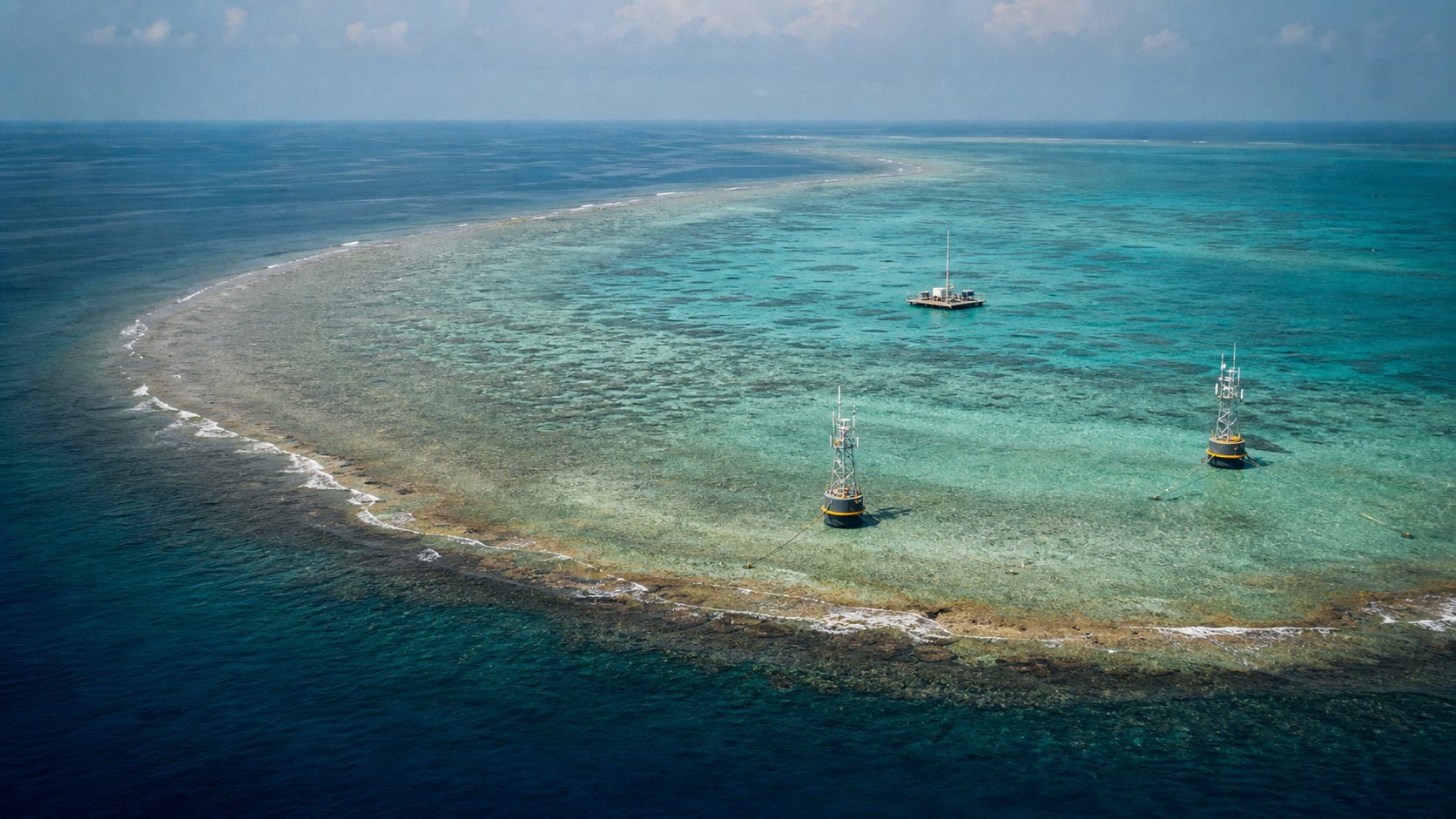
Second Thomas Shoal and Scarborough Shoal are different operational problems, but Beijing is using a similar method at both: crowd the feature, contest access, force the other side to decide how much risk a small vessel is worth.
At Second Thomas, the geography is brutal for Manila. The shoal lies roughly 105 nautical miles west of Palawan, close enough to be inside Philippine planning assumptions but far enough that every resupply mission becomes a visible, slow, predictable movement. The garrison aboard the BRP Sierra Madre depends on food, water, fuel, spare parts and medical supplies moving through a contested envelope. A rubber boat, a small utility craft, or a civilian-contracted resupply vessel has almost no margin against a larger coast guard ship with water cannon, ramming mass, and nearby small boats.
Anyone who has served on a destroyer knows the uncomfortable truth: sea control sounds clean in a briefing, but at close range the fight is often about hull size, positioning, radios, endurance, and who can stay calm while metal and fiberglass touch. That is the zone China is exploiting. It is not sending a Type 055 cruiser to open fire. It is sending coast guard and maritime militia forces to make normal Philippine presence expensive, repetitive, and politically exhausting.
The Alliance Trigger Is Clearer Than the Operational Answer
The 1951 Mutual Defense Treaty applies to armed attacks on Philippine armed forces, public vessels, or aircraft in the Pacific, including the South China Sea. U.S. officials have said that repeatedly. After the July 20 incident, the State Department again condemned China's conduct and referenced lawful Philippine maritime operations.
But treaty language is not an escort plan.
For Washington, the problem is calibration. If a Chinese coast guard sailor injures a Philippine sailor with a baton, does the United States respond with a destroyer escort, a combined patrol, sanctions, intelligence support, or a stronger public warning? If a water cannon damages a government vessel but no one dies, how far does the alliance move up the ladder? Beijing's gray-zone tactics are designed to make those questions awkward every time.
For Manila, the problem is endurance. The Philippines is buying BrahMos shore-based anti-ship missiles, upgrading bases under the Enhanced Defense Cooperation Agreement, and trying to rebuild a navy that still has too few large patrol combatants for the size of its maritime claims. Those are necessary moves, but they do not solve the immediate tactical imbalance at a shoal. A BrahMos battery on land does not keep a rubber boat from being shoved aside at close range. A future missile inventory does not put drinking water on the Sierra Madre next week.
China Does Not Need to Win a Naval Battle
Beijing's objective is probably not a sudden seizure by amphibious assault. A cleaner method is to normalize interference until Philippine access becomes conditional. Reuters reported Manila's foreign ministry saying the provisional arrangement on resupply missions does not recognize foreign jurisdiction and does not require Philippine requests for Chinese permission. That statement matters because permission is the real target. If China can make every resupply appear subject to Chinese control measures, the legal argument starts to produce operational facts.
The ship at the center of the issue is also a clock. The BRP Sierra Madre is a former U.S. Navy tank landing ship from the 1940s. It was grounded intentionally in 1999, but rust does not respect policy. The more China can restrict reinforcement, repair materials, and safe rotation of personnel, the more the outpost becomes a wasting asset. Manila does not have to lose a battle to lose the position. It can be worn down.
That is why the July 20 incident is more serious than its small scale suggests. A baton injury is not a missile strike, but it tests the same chain of decisions that a bigger crisis would demand: who has custody of the escalation ladder, how quickly allies coordinate, and whether Beijing sees restraint as professionalism or permission.
What Would Change the Math
The alliance needs less ambiguity at the operational level. Not necessarily more noise. More routine.
- First, Manila and Washington should make combined maritime domain awareness support routine for every Second Thomas resupply mission, not episodic after a crisis.
- Second, Philippine vessels need layered presence: coast guard, navy, and documented civilian mission profiles that deny China the ability to isolate one small craft.
- Third, the United States should define in advance which coercive acts against Philippine public vessels trigger specific non-kinetic responses, including public release of imagery, joint patrol timing, and legal coordination with allies.
- Fourth, repair and reinforcement planning for the Sierra Madre should be treated as a military logistics problem, not a diplomatic afterthought.
There is a risk in all of this. More allied presence can create more opportunities for collision. But the present approach already creates collisions while leaving Manila's weakest vessels to absorb the first blow.
The credibility of the U.S.-Philippine alliance will not be decided by whether Washington can surge a carrier strike group. It will be decided by whether a Philippine sailor can make a supply run without being beaten back by a coast guard small boat.
That is the uncomfortable math of Second Thomas Shoal. China is not asking the United States to prove it can win a war. It is asking whether the alliance can protect the small, slow missions that prevent a war from being lost before it starts.
Sources
- Associated Press, July 20, 2026, report on the Second Thomas Shoal clash and Philippine military allegations.
- U.S. Department of State, July 20, 2026, statement condemning China's actions against Philippine navy personnel.
- Reuters via U.S. News, July 23, 2026, report on Rubio's comments and the Scarborough Shoal water-cannon incident.
Chinese coast guard personnel injured a Filipino sailor at Second Thomas Shoal on July 20, 2026, during a confrontation with the Philippine Navy. The incident involved the use of a baton and damage to a navy rubber boat. Following this, a Chinese vessel fired a water cannon at a Philippine fisheries vessel near Scarborough Shoal. The U.S. condemned China's actions and reaffirmed its defense commitments to the Philippines, highlighting the ongoing tensions in the region.
- Chinese coast guard personnel injured a Filipino sailor with a baton during a confrontation at Second Thomas Shoal.
- A Philippine government fisheries vessel was targeted by a water cannon from a Chinese coast guard vessel near Scarborough Shoal.
- The U.S. State Department condemned China's actions and reaffirmed defense commitments to the Philippines.
- The BRP Sierra Madre is a grounded World War II-era ship that serves as a garrison for the Philippine military.
- China's tactics aim to normalize interference in Philippine maritime operations.