
China and Russia's Joint Sea 2026 Drills Expose an Indo-Pacific Alliance Gap
 Marcus Chen
China and Russia's Joint Sea 2026 Drills Expose an Indo-Pacific Alliance Gap
Four major combatants, one replenishment ship, one submarine, and a follow-on Pacific patrol are enough to make Joint Sea 2026 worth watching. They are not enough to create a Sino-Russian naval alliance. The difference matters.
According to Defence Security Asia, Russia's Pacific Fleet sent the Slava-class cruiser Varyag, the frigate Surovy, the Improved Kilo-class submarine Ufa, and the rescue ship Igor Belousov to Qingdao for the July 6–13 exercise. China supplied two Type 052D destroyers, a Type 054A frigate, a Type 903 replenishment ship, a submarine, helicopters, and embarked marines. The drill combined air defense, anti-submarine warfare, live-fire sequencing, replenishment, and maritime rescue.
The Force Package Is More Important Than the Headlines
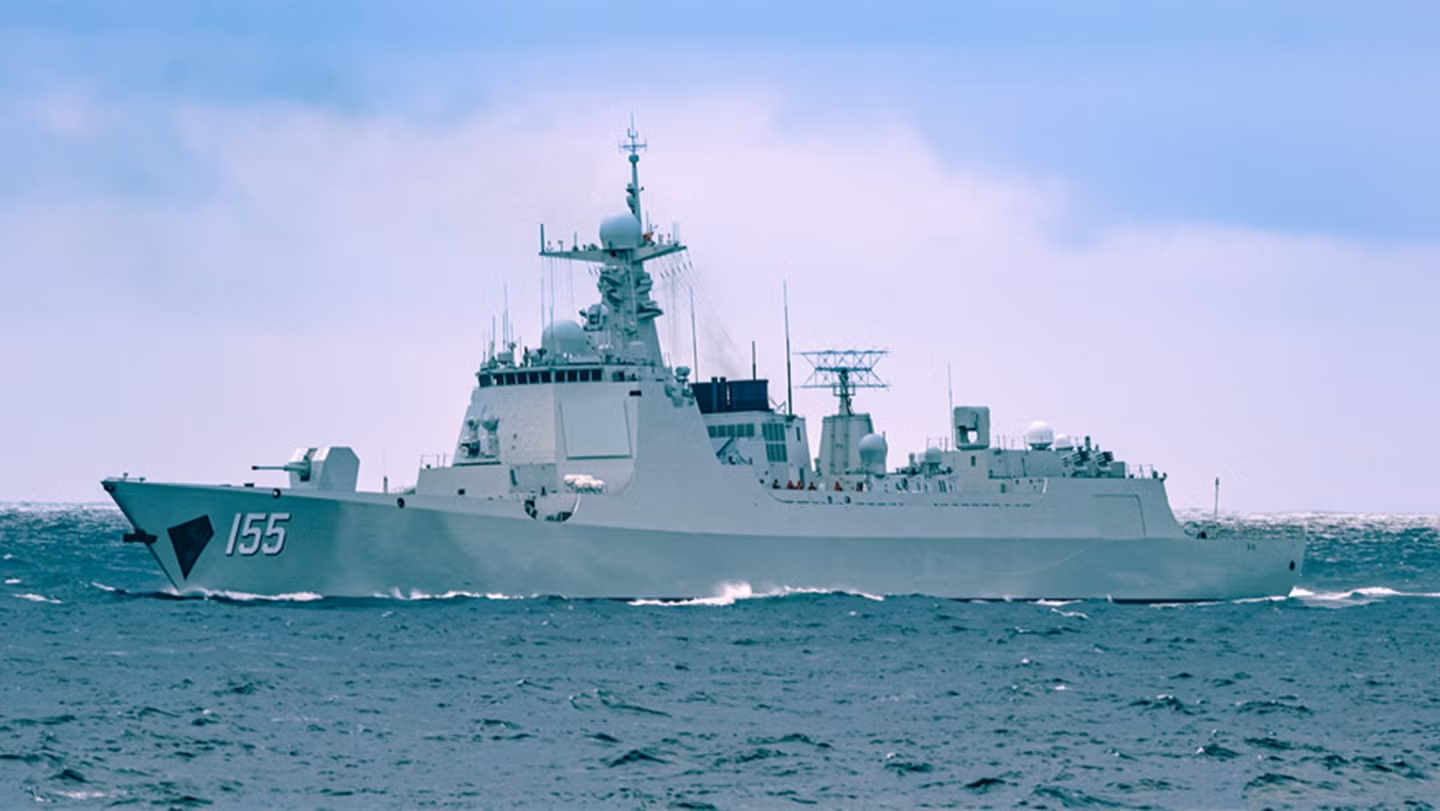
The Chinese contribution shows what Beijing wants its navy to do routinely: combine escorts, sensors, logistics, and undersea forces in one task group. The Type 052D is a roughly 7,500-ton guided-missile destroyer with a 64-cell vertical launch system, phased-array radar, and the ability to conduct air-defense, anti-ship, and land-attack missions. Two hulls do not change the balance of power. They do provide a useful laboratory for command procedures and data exchange with a foreign navy.
The Russian ships add different value. The Varyag brings a large air-defense and anti-surface missile battery, while the Ufa offers a quiet diesel-electric submarine suited to operations in confined waters. Russia's Pacific Fleet has years of experience operating from the region, even if its available force is now constrained by the war in Ukraine and maintenance demands. China, in turn, supplies newer port infrastructure, a larger industrial base, and the logistics depth needed to keep a combined formation at sea.
That is a division of labor, not interoperability by declaration. A mixed formation must still solve communications security, rules of engagement, target identification, replenishment standards, and the hierarchy of command. A destroyer captain who can exchange radar tracks with a foreign ship is not automatically ready to fight under a shared battle-management system.
Why the Pacific Patrol Matters
The exercise's follow-on patrol into the Pacific is the more consequential piece. A harbor drill can be staged. A patrol tests navigation, fuel planning, watch rotations, maintenance, and the ability to operate while another navy is collecting every signature. It also gives both sides a chance to observe how the United States, Japan, and other regional forces respond.
The Munich Security Conference's 2026 assessment describes the Indo-Pacific as a contest shaped by China's growing power and the response of the United States and its partners. The IISS Asia-Pacific Regional Security Assessment 2026 similarly emphasizes the interaction of geography, doctrine, technology, and military readiness. Joint Sea 2026 fits that pattern, but its message should be read precisely: Beijing and Moscow are normalizing contact beyond China's immediate coastal waters, not rehearsing a combined invasion of Taiwan.
For the United States Navy, the practical problem is surveillance burden. A Chinese-Russian formation does not need to defeat a carrier strike group to impose costs. It can force more aircraft sorties, submarine tracking, and surface escorts across waters that already stretch from the East China Sea to the Philippine Sea. Every additional contact consumes attention, fuel, and maintenance life. In a crisis, that clutter can make it harder to identify the movement that actually matters.
The Limits of the Partnership
There are three hard limits. First, Russia cannot provide China with a large, sustainable naval force. The Varyag is an aging Slava-class cruiser, not a modern integrated air-defense destroyer, and its presence is politically louder than its numbers. Second, China cannot assume Russian systems will plug cleanly into the People's Liberation Army Navy's increasingly networked architecture. Familiarity grows through repetition, but it grows slowly.
Third, the exercise does not erase geography. China and Russia do not share a common maritime theater or a treaty commitment to fight for one another. Moscow's main military effort remains tied to Europe, while Beijing's central naval problem is the western Pacific. In an actual Taiwan contingency, Russia might provide diplomatic cover, intelligence, or diversionary activity. That is different from committing a carrier-sized force to a missile-saturated fight near Taiwan.
There is also a political ceiling. The exercise can signal that pressure on either country will not produce isolation, but it cannot guarantee that regional states will see the partnership as credible collective defense. Japan, the Philippines, Australia, and the United States will respond by improving maritime-domain awareness and coalition coordination. A drill intended to complicate allied planning can therefore accelerate the very networking it seeks to challenge.
What to Watch Next
- Whether future patrols last longer and operate farther east of the first island chain.
- Whether Chinese and Russian crews conduct genuinely integrated anti-submarine operations rather than parallel serials.
- Whether replenishment and repair are practiced at sea, not just demonstrated in port.
- Whether the same ships return, or whether Beijing begins rotating larger and newer formations.
The first three indicators will reveal military value. The fourth will reveal intent. If Joint Sea remains a small annual package, it is signaling with hardware. If China begins attaching more destroyers, submarines, maritime patrol aircraft, and sustained logistics, the exercise is becoming a standing operational tool.
The correct conclusion is uncomfortable but limited. Joint Sea 2026 does not create a Sino-Russian navy. It does create another layer of surveillance and planning friction for the United States and its allies. The alliance gap is real, but so is the capability gap inside the partnership. Washington should not panic over four Russian ships. It should stop assuming that every non-allied formation in the Pacific will remain separate when a crisis begins.
Sources
China and Russia conducted Joint Sea 2026 naval exercises in Qingdao from July 6-13, 2026, involving multiple naval vessels and operations such as air defense and anti-submarine warfare. The Chinese Navy contributed two Type 052D destroyers, while Russia sent the Varyag cruiser and Ufa submarine. The drills aimed to enhance operational capabilities and test logistics and coordination between the two navies, indicating increased military cooperation without forming a formal alliance.
- China and Russia conducted Joint Sea 2026 naval exercises in Qingdao from July 6-13, 2026.
- The exercise involved multiple naval vessels and focused on various military operations.
- The Chinese Navy contributed two Type 052D destroyers and other support units, while Russia sent the Varyag cruiser and Ufa submarine.
- The drills aimed to enhance operational capabilities and test logistics and coordination between the two navies.
- The exercise does not signify a formal alliance but indicates increased military cooperation.