

How the U.S. Can Work with Allies to Scuttle China’s Maritime Advantages – On October 13, the Navy celebrated its 251st year, a birthday that predates our Republic by almost a year. President Trump used this historic moment to announce the opening of a new Baltimore shipyard and recommit to a national maritime revival he launched early in his second term.
While the President’s commitment is vital, reviving America’s shipping and shipbuilding will take generations. Today America ranks 14th in shipbuilding by tonnage, operates 190 U.S. flagged ships representing less than 0.3 percent of total shipping engaged in U.S. trade, and graduates several hundred naval architects when thousands are needed. Thankfully, we have trusted allies who would benefit from our maritime revival and support an American maritime renaissance.
It is time to make the American revolution in shipping a global project that lets partner nations benefit together and course-correct our collective overreliance on China’s shipbuilding and shipping.
Trump’s welcome leadership comes after decades of neglect. But this isn’t an impossible task, and as a nation, we’ve overcome worse. Still, today’s threats make reviving our shipping and shipbuilding industry an urgent prerogative of national survival.
Today, American ships can move only 267,799 shipping containers in total, while nationally over two million containers move monthly, making our economy and security dependent on ships from nations many consider hostile. Mitigating this dependency will require a fleet of 1,315 various classes of ships, and building them or securing those ships can most effectively be achieved with our trusted allies.
The pace of this revival has quickened in recent months – buoyed in part by allies. On Sept. 30, Vice President Vance attended the groundbreaking of Port Alpha – a $3 billion shipbuilding project that will double today’s American commercial shipbuilding capacity. The Baltimore project, Arsenal-2, is anticipated to generate 3,100 direct and an additional 11,000 indirect jobs to support nuclear submarine production.
Importantly, this project splits the cost of capital investments between upstart firm Anduril ($3.7 billion) and the government ($ 2.9 billion). Before this there were significant investments by Canadian shipbuilder Davie ($1 billion) in Galveston, Texas to build icebreakers, and by South Korean shipbuilder Hanwha ($5 billion) in Philadelphia, Pennsylvania; who is being contracted to build maritime training vessels and recently missile tracking vessels for the Navy.
This is a good beginning, but we need more than 250,000 new skilled shipbuilders and engineers, and new shipyards to be built if America’s industry is to deliver the maritime capacity it needs.
Today’s sustained bipartisan effort builds on work begun in Spring 2022 by a small group of experts called the Revolution in Shipping. It lives on in presidential executive orders and the SHIPS for America Act, which the Senate is reviewing. They all acknowledge that without our allies’ technical capacity, our maritime revival will falter. Consider the shipbuilding bridging strategy called the Finland Model, which uses initial orders for overseas construction, conditioned on parallel domestic investment to eventually build the ordered ships in the U.S.
Attracting investment capital to American shipyards has so far been a success. But ships must be built, and that requires technical competence as well as industrial capacity. It also requires sustained demand for American-made ships, which can only be assured if they become globally competitive over time. Today, initial orders for new American ships will be for the federal government, but near-term decisions must set the conditions for this to expand into more commercial orders, like Port Alpha.
Timing for America’s maritime revival is opportune; the global commercial fleet today averages just over the typical viable service life of 20 years, and new technologies are taking hold. One is civilian use of nuclear propulsion, where American industry can build on decades of naval nuclear propulsion. Here again, however, is where trusted allies familiar with and trusting of American nuclear propulsion and sharing a common security interest can set market conditions to welcome a new era of nuclear shipping.
Today China dominates the global shipping and shipbuilding market and our allies, like South Korea, are hungry to retake market share. More broadly, a growing group of like-minded nations is seeking to grow their own maritime industries, as India made clear at the recent third Sagarmanthan maritime conference.
As such, now is the time to form a maritime group of nations to ensure our collective efforts complement and nurture our revived maritime industry and no longer remain hostage to a single nation: China. The idea is memorialized in legislation sponsored by Rep. Young Kim (R-Calif.), the FLEETS Now Act.
Modeled on the G7, this “M9” maritime group can enable collective action in multinational maritime regulatory bodies (e.g., IMO, IAEA, UN), coherently focus investments, and act to defend against Chinese predation (see USTR sec. 301 complaint) that could kill our maritime industrial revival before it leaves the pier.
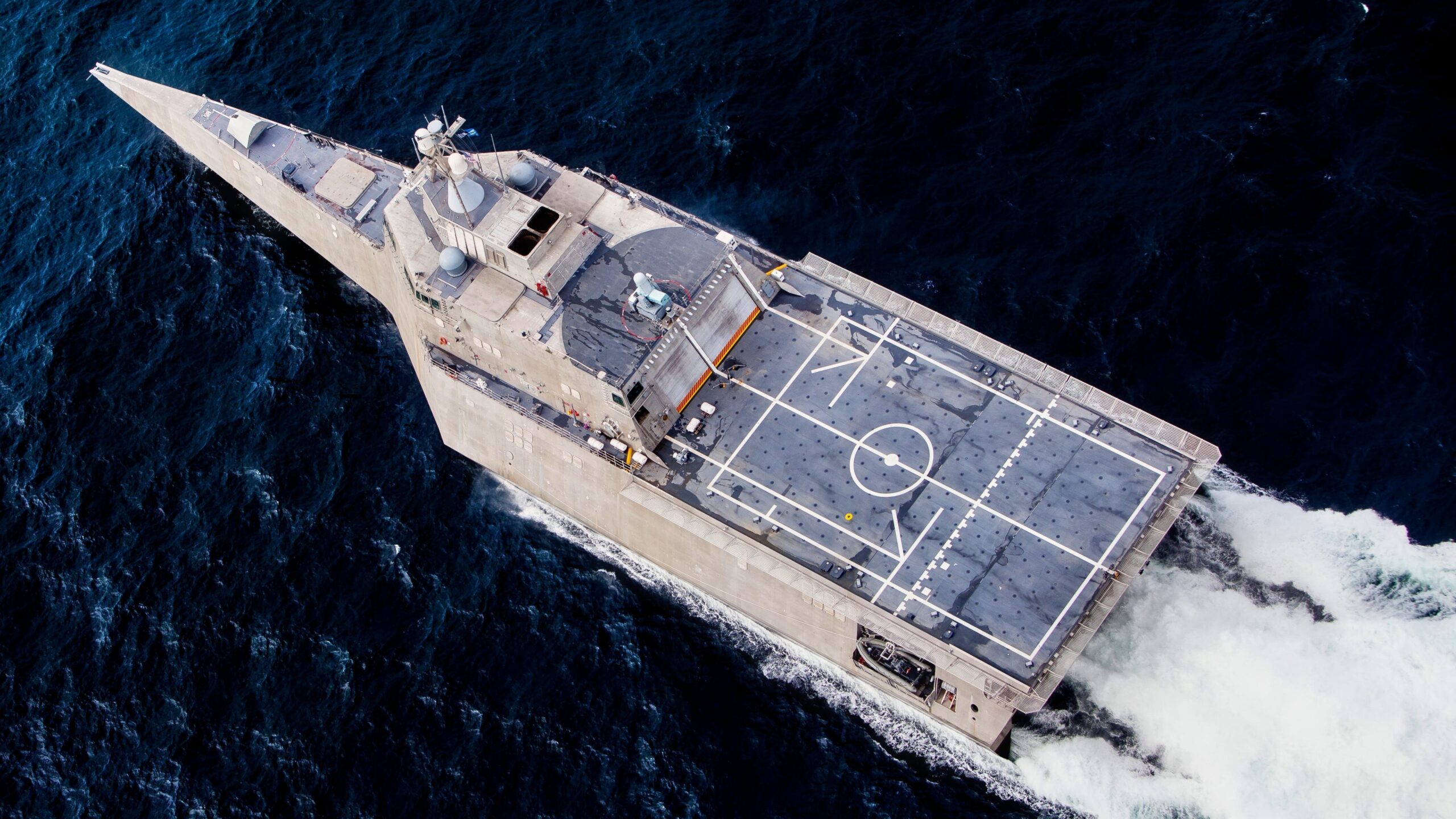
US Navy Littoral Combat Ship. Image Credit: Creative Commons.
Moving out and forming a maritime group starts with a White House invitation to like-minded nations. But success will depend on energetic American ambassadors in key capitals who can communicate the agenda and ensure the right participants. The recent departure of Ambassador Kimberly Guilfoyle from Greece could complicate things in a critical nation for the effort. As such, her replacement, preferably someone with shipping or shipbuilding experience, should be named quickly and confirmed by Congress.
Keeping investments flowing into the U.S. maritime industry, reviving strategic shipyards, and ensuring sustained orders depends on sustaining today’s momentum, something an M9 with key allies can facilitate.
About the Author: Brent D. Sadler
Brent D. Sadler is a senior research fellow specializing in naval warfare and advanced technology at The Heritage Foundation’s Allison Center for National Defense.