
China has tripled its satellite fleet since 2018 as expansion continues: DIA
WASHINGTON — A new report by the Defense Intelligence Agency (DIA) finds that China has tripled its fleet of intelligence, surveillance and reconnaissance (ISR) satellites since 2018 and continues to expand capabilities to detect, track and target US and allied forces on the ground and at sea.
“China employs a robust space-based ISR capability designed to enhance its worldwide situational awareness and enable long-range strikes,” including electro-optical (EO) and synthetic aperture radar (SAR) imagery satellites and others that provide electronic and signals intelligence data, according to the DIA’s 2026 Challenges to Space Security report, released Monday.
The report says China’s ISR satellite network can help the PLA monitor and target US and allied forces worldwide, particularly across the Indo-Pacific — including the Korean Peninsula, Taiwan, the Philippines, the Indian Ocean and the South China Sea.
The DIA report echoes concerns from US Space Force and Space Command about the PLA’s growing ability to build “kill chains” to target US joint forces abroad and at home.
Clayton Swope, deputy director of the Center for Strategic and International Studies’ Aerospace Security Project, said China is investing heavily in space-based sensors to monitor Earth and identify, track and target objects in the Indo-Pacific.
“A concern on the minds of US and allied decision makers should be how PLA sensor webs could erode US advantages derived from stealth in the air and undersea domains. Will we be able to operate undetected in the air and undersea domains in the future?” he told Breaking Defense.
Echoing a July 2026 Space Force fact sheet on space threats, the DIA report states that China had more than 510 ISR satellites in orbit as of July. Unlike the Space Force document, however, the DIA report acknowledges that its count includes satellites owned by both the People’s Republic of China and Chinese commercial firms.
“While many of these ISR satellites are ostensibly affiliated with commercial and civil missions, the dual-use nature of their capabilities and possibly the Chinese military-civil fusion policies means the data or imagery they collect can be used by the PLA,” the report says.
The DIA also says Chinese commercial firms are supplying imagery “to state actors banned by Western providers for supporting weapons proliferation.”
China’s ISR fleet continues to expand and improve technologically, the DIA report stresses, particularly through Beijing’s growing constellation of satellites in low Earth orbit.
However, American Enterprise Institute’s (AEI) Senior Fellow Todd Harrison said the DIA’s data is unclear about which satellites are included in its count and also lacks important context.
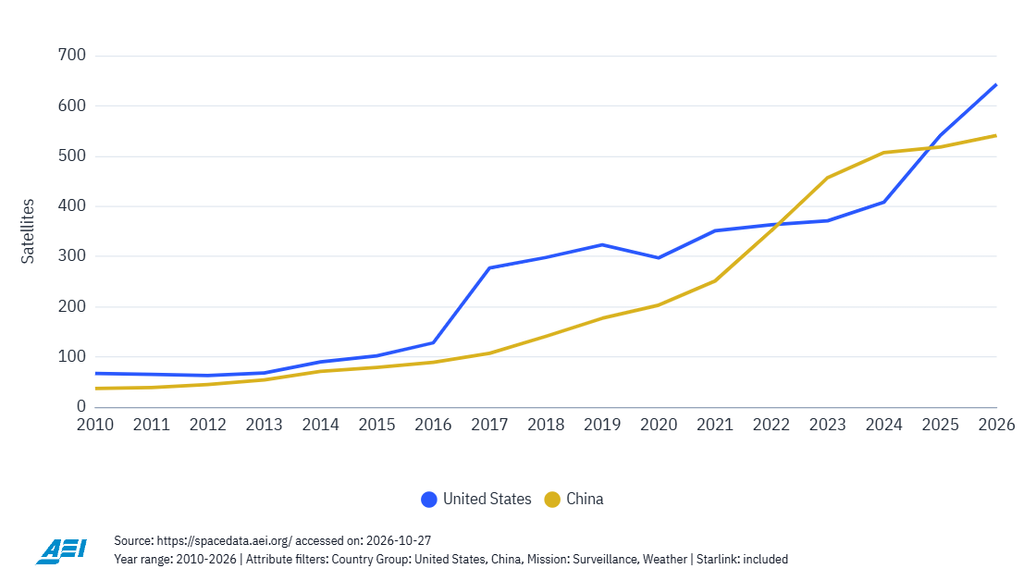
He told Breaking Defense that China’s operational surveillance and weather satellite fleet has grown from 141 in 2018 to 541 today, while its surveillance-only fleet has increased from 124 to 453. “What those numbers don’t tell you is that the slope of the curve has leveled off in recent years — the number of satellites is not increasing as fast,” Harrison said.
Meanwhile, the US has 643 operational surveillance and weather satellites — up from 298 in 2018 — and is expanding its ISR fleet faster than China, he said.
The following chart, created for Breaking Defense from AEI’s Space Data Navigator, shows that trend.
The DIA report is the third in a series of unclassified reports examining US concerns about adversary advancements in military space, with the first version published in 2019.
The new report covers space threats emanating from China, Russia and “emerging” space powers.
It also looks at developments expected to exacerbate future challenges to US interests in space. Among those listed in the 2026 report: reusable space systems, such as rockets and spaceplanes; increasing use of artificial intelligence; orbital congestion; the collision risk posed by the many non-maneuverable spacecraft that will remain on orbit long after becoming inoperable; and the growing interest in satellites stationed in very low Earth orbit.
Intriguingly, the report includes what appears to be the first public image of China’s reusable spaceplane, most recently launched in February. The spaceplane is widely believed to be modeled after the US X-37B. Victoria Samson, chief director of space security and stability at the Secure World Foundation, said the image appears to support that assessment.
“It looks a lot like the X-37B!” she told Breaking Defense.
The DIA concludes by predicting that space will become increasingly congested and competitive as capabilities advance and more countries expand their presence in the domain.
“The increase of Chinese, Russian, Iranian, and North Korean counterspace capabilities, rapid growth in the number of space objects, and the proliferation of requirements for space-enabled services will all complicate operations in space in the coming decade,” the report adds.
China has tripled its fleet of intelligence, surveillance, and reconnaissance (ISR) satellites since 2018, with over 510 satellites now in orbit. The People's Liberation Army (PLA) is enhancing its capabilities to detect, track, and target US and allied forces across the Indo-Pacific, including the Korean Peninsula and South China Sea. This expansion includes advanced electro-optical and synthetic aperture radar satellites, raising concerns about the erosion of US advantages in stealth operations.
- China has tripled its ISR satellite fleet since 2018.
- China has over 510 ISR satellites in orbit as of July 2026.
- The PLA can monitor and target US and allied forces worldwide.
- China's ISR capabilities include electro-optical and synthetic aperture radar satellites.
- Chinese commercial firms are supplying imagery to state actors banned by Western providers.