
The Army’s only remaining SFAB helped broker a ceasefire in southeast Asia
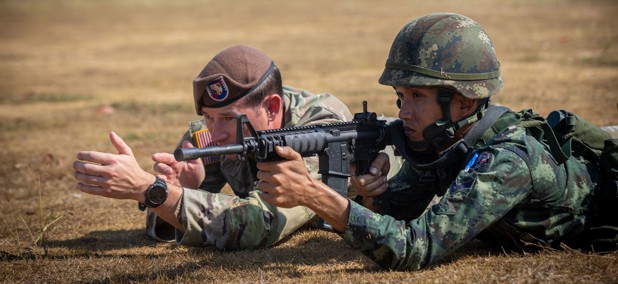
A year ago, after months of fighting spurred by a century-old border dispute, Thailand and Cambodia struck a peace deal in Malaysia, with help from a small U.S. Army unit that had long been training both Thai and Malaysian troops.
The peace talks were led by the Association of Southeast Asian Nations and the Malaysian Land Forces, which sought the advice of the 5th Security Force Assistance Brigade, the unit’s commander told Defense One.
“They asked our advisors, who were in the space of the land force headquarters, ‘Hey, what should we be thinking about? How can we effectively do this?,” said Col. Daniel Hodermarsky. “And we were reporting back to [U.S. Army Pacific] and leveraging experts from the higher headquarters to provide that advice to more rapidly enable them to to take the lead.”
At the same time, 5th SFAB had a team on the ground in Thailand.
“We didn't have anyone near the front or in the conflict, but we were able to say, "Hey, here's what we're seeing with the country team in Thailand,” Hodermarsky said.
But 5th SFAB—the Army’s only remaining train-advise-assist unit—didn’t just happen to be in the right place at the right time. The specialized unit, made up of experienced conventional troops who have already led a squad or platoon, and so on, has been regularly deploying to INDOPACOM to work with partner militaries since 2020.
“So we're able to give a bit more granular, real-time reporting back to the theater, and we're tied in directly with each country team, security cooperation office and defense attaché wherever we have adviser teams,” Hodermarsky said. “So we can get those liaise cells, those assessment cells, and say, ‘Hey, here's what we're granularly seeing, hearing. Here's what the partner is asking, or here's what they're talking about.”
The Army developed the SFAB concept in 2017, when training and advising the Afghan army had no end in sight and the service was anticipating expanding that mission beyond U.S. Central Command. The idea was that rather than rotating conventional infantry and other units as advisers, the service would cultivate specialized units for the mission. The 1st SFAB deployed in Afghanistan in 2018.
By May 2020, six SFABs had been established, each aligned to a different part of the world. They were staffed by volunteers coming off operational assignments, now experienced and theoretically qualified to train a partner unit.
Last year, Defense Secretary Pete Hegseth ordered most of the SFABs to be dissolved. The units assigned to European and Africa Commands have been shuttered, and their CENTCOM and National Guard counterparts will be gone by year’s end. 1st SFAB was reorganized as Army Security Cooperation Group-South in January.
That leaves only Hodermarsky’s 5th, doing its part to keep the United States in the good graces of INDOPACOM countries that might otherwise align themselves with China’s growing military power.
Some have argued that the moves are shortsighted.
“If the U.S. military continues marginalizing the advising mission or ignoring it altogether, then it means going back to the failed train-and-pray model,” argued a 2025 piece published by West Point’s Modern War Institute. “Fully staffed SFABs are not a luxury; they’re a necessity. Without them, the United States risks being flat-footed in the next war.”
ASCG-S and 5th SFAB’s continued existence are an acknowledgement that the train-advise-assist mission is still important for the DOD’s top two priority regions.
5th’s farflung efforts
In INDOPACOM, 5th SFAB has been shaping militaries from Mongolia to the Philippines, embedding in their professional military academies as well as advising their senior leadership.
“We were in the Philippine Army headquarters and their [Training and Doctrine Command] equivalent for years, as they transitioned from a counterinsurgency focus across the Philippines, to a national-defense focus for their land forces” Hodermarsky said.
His unit’s relationships have also laid the groundwork for major exercises the Army now does in INDOPACOM, including Balikatan and Cobra Gold.
“A persistent advisor team can stay in between the planning conferences and come up with the training plan, if we identify the partner unit that's going to exercise with the 25th Infantry Division or the the 7th Infantry Division,” Hodermarsky said. “And say, what are the training objectives for that Royal Thai Army unit or Philippine Army unit or Malaysian Land Force element? And then help them through that training progression.”
He said some division leaders call the SFAB the WD-40 of U.S. Army Pacific, because their teams ease friction between partner nations and conventional units visiting for exercises.
“We see sort of a reverse slope of advisor presence, as we hopefully work our way out of jobs in certain countries, so that you go from a partner force requesting more hands-on training and capability development through security force assistance, to where they're now really exercising as a flank unit or an integrated part of a U.S. division or brigade that is more capable, more trusted to be on our flank, or integrated into one of our major formations,” Hodermarsky said.
The 5th Security Force Assistance Brigade (SFAB) facilitated a peace deal between Thailand and Cambodia in Malaysia a year ago, providing crucial advice during the negotiations. The unit has been actively training partner militaries in INDOPACOM since 2020, emphasizing the importance of military cooperation in the region to counterbalance China's influence. The SFAB's ongoing presence supports military exercises and enhances the capabilities of allied forces.
- Thailand and Cambodia struck a peace deal in Malaysia with the help of the 5th SFAB.
- The 5th SFAB has been regularly deploying to INDOPACOM since 2020.
- The unit's role includes advising partner militaries and facilitating military exercises.
- The 5th SFAB is the only remaining train-advise-assist unit in the U.S. Army.
- The unit's efforts are aimed at countering China's growing military influence in the region.