
China Is Turning Taiwan East Coast Patrols Into a 7,300 Kilometer Problem
 Marcus Chen
China Is Turning Taiwan East Coast Patrols Into a 7,300 Kilometer Problem
Fifty-four nautical miles is not much water. A Chinese Coast Guard task group holding station roughly 100 kilometers east of Taiwan does not look as dramatic as a missile launch, a carrier sortie, or a bomber patrol with Russia. That is exactly why it matters.
In the past two weeks, Beijing has kept coast guard vessels active on the Pacific side of Taiwan, launched Joint Sea-2026 naval drills with Russia, watched Chinese and Russian bombers move near Japan, and test-fired a submarine-launched ballistic missile about 7,300 kilometers into the South Pacific. Defense News reported on July 15 that the coast guard patrols east of Taiwan have taken on the shape of a sustained mission, while the missile test flew from the South China Sea toward open Pacific waters. CNA described the pattern as separate Chinese activities converging into a broader effort to make regional operations routine.
The useful way to read this is not as one synchronized war plan. It is a pressure system. China is testing how much presence it can normalize around the First Island Chain before Washington, Tokyo, Manila, Canberra, or Taipei decide the pattern has crossed from signaling into posture.
The Coast Guard Move Is the Operational Clue
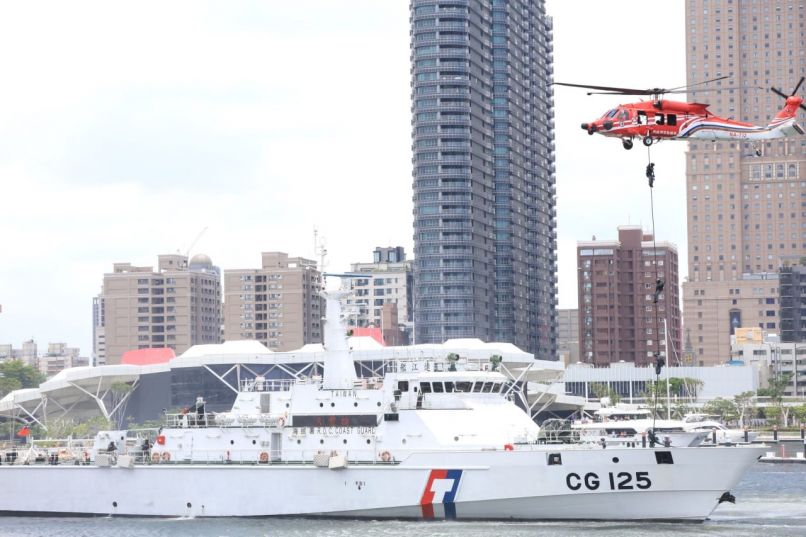
Navies surge. Coast guards loiter. That distinction is central here.
Defense News cited analysts who noted that large coast guard cutters are built for longer deployments than many naval combatants. Beijing can keep white hulls visible while claiming law enforcement restraint, which lowers the political temperature without removing the coercive effect. Taiwan sees a foreign state vessel near its Pacific approaches. Japan sees activity close to its southern island chain. The United States sees a jurisdictional claim being rehearsed on the side of Taiwan that any outside force would need for access, logistics, and air-sea movement during a crisis.
Anyone who has served on a destroyer knows that a contact track is not just a dot on a screen. It creates tasks. Someone has to identify it, shadow it, report it, deconflict it, and decide when to challenge it. A persistent China Coast Guard presence east of Taiwan forces Taiwan and its partners to spend attention every day, even when no shot is fired.
That is the point. If China can make those patrols ordinary, then the first allied response during a Taiwan crisis begins from a worse position. Beijing would already have a surface presence in the waters where outside forces want maneuver room.
The Missile Test Changes the Range Calculation
The July 6 missile launch adds a different layer. According to Defense News, the missile carried a simulated warhead and traveled about 7,300 kilometers before splashing down in the South Pacific. The report said the flight likely passed over parts of the Philippines. It also drew protests from Australia, Japan, New Zealand, the United States, and Pacific island leaders because the splashdown area sat near states covered by the South Pacific Nuclear Weapons Free Zone.
Whether the missile was a JL-2 or JL-3 is less important than the operational message. A Chinese ballistic-missile submarine firing from the South China Sea and reaching deep into the Pacific is telling regional governments that a Taiwan contingency would not stay inside the Taiwan Strait. The sea-based nuclear leg is designed to make intervention more expensive in the mind before it becomes expensive in reality.
There is a basic map problem here. Guam sits roughly 2,700 kilometers from Taiwan. Hawaii is much farther, about 8,000 kilometers from Taiwan. Northern Australia, Japan, the Philippines, and the second island chain all sit inside the planning geometry of a western Pacific fight. A 7,300 kilometer demonstration does not need to be tactically useful against every target. It only needs to remind planners that Chinese submarines, missiles, and warning notices can push risk into spaces that used to feel rear-area.
That does not mean China has solved sea-based deterrence. Ballistic-missile submarines need quieting, patrol areas, secure communications, trained crews, and confidence under pressure. The United States still has decades of experience in that business that China cannot buy quickly. But the test makes the gap smaller in political terms. For deterrence, demonstrated reach can matter almost as much as perfect readiness.
RIMPAC Is the Backdrop, Not the Cause
The timing also matters because RIMPAC is underway around Hawaii with dozens of participating states. It would be too neat to say Beijing launched every activity as a direct answer to RIMPAC. Annual exercises, missile test windows, coast guard rotations, and Russia drills have their own calendars. CNA quoted analysts cautioning that there is no public evidence of a single coordinated campaign.
Still, effects can align even when schedules are not centrally scripted. China is showing four audiences four things at once. Taipei gets a reminder that the Pacific side of the island is not sanctuary. Tokyo sees pressure through nearby straits and bomber routes. Manila sees a missile path and South China Sea launch geography that make its bases relevant. Australia, New Zealand, and Pacific island states see the South Pacific pulled into the deterrence conversation.
Washington should pay attention to that audience segmentation. The US habit is to treat Chinese operations as either military escalation or political theater. This is both, but at a slow tempo. It is theater that changes the patrol pattern. It is signaling that produces more contacts on the chart.
The Allied Response Has to Be Boring and Durable
The wrong response is to answer every Chinese move with a headline deployment. One freedom of navigation operation, one bomber task force flight, or one allied statement will not offset a coast guard presence that returns next week. The answer has to be boring in the same way the challenge is boring.
First, Taiwan, Japan, the Philippines, and the United States need a shared maritime picture on the east side of Taiwan and through the Miyako and Bashi channels. That means coast guard data, naval tracks, commercial AIS anomalies, aerial surveillance, and undersea indicators fused quickly enough to matter.
Second, allied coast guards should be treated as operational actors, not photo opportunities. If China uses law enforcement vessels to shape wartime geography, then democratic coast guards need exercises, communications links, and rules for coordinated presence before a crisis starts.
Third, missile defense and dispersal planning must assume that the South Pacific is no longer a distant diplomatic theater. Long-range demonstrations are meant to stretch the map. The response is not panic. It is hardening fuel, runway repair, ammunition movement, command nodes, and submarine tracking from Japan to Australia.
The indicator to watch is not whether China conducts another loud missile test. The more important indicator is whether a China Coast Guard task group remains east of Taiwan month after month. One test is a signal. A standing patrol is terrain.
If Beijing can create that terrain without firing, the first day of a Taiwan crisis will not begin with a blockade. It will begin with everyone else realizing that part of the blockade architecture has already been normalized.
China has established a sustained Coast Guard presence east of Taiwan while conducting missile tests that reached 7,300 kilometers into the South Pacific. These actions are part of a strategy to normalize military operations in the region, prompting concerns from Taiwan, Japan, and the United States. The missile test, which likely passed over the Philippines, signals that a Taiwan contingency could extend beyond the Taiwan Strait.
- China maintains a Coast Guard presence east of Taiwan.
- A missile test demonstrated a range of 7,300 kilometers.
- The activities are part of a broader strategy to normalize military presence in the region.
- China's actions are causing concern among neighboring countries and the U.S.
- The report highlights the need for a coordinated response from allied nations.