
China PL-16 Missile Makes J-20 a 300 Kilometer Tanker Killer
 Marcus Chen
China PL-16 Missile Makes J-20 a 300 Kilometer Tanker Killer
Six missiles in a J-20 weapons bay matter more than one more stealth fighter on a flight line. Defense News reported on June 22 that China's emerging PL-16 beyond-visual-range air-to-air missile is being described with a 200 to 300 kilometer reach, a dual-pulse or variable-thrust motor, and dimensions small enough to let a J-20 carry as many as six rounds internally instead of the four PL-15s normally associated with the fighter.
Those numbers are still unconfirmed by Beijing. They come from leaked slides, trade reporting, and expert interpretation, not an official People's Liberation Army Air Force release. But if even the lower end is roughly right, the important question is not whether PL-16 beats the American AIM-260 Joint Advanced Tactical Missile in a spec-sheet contest. The question is whether it pushes US tankers, airborne early warning aircraft, and maritime patrol aircraft far enough away from the fight that American carrier air wings lose useful reach over Taiwan and the Philippine Sea.
That is the problem Washington should be doing math on.
The New Missile Math
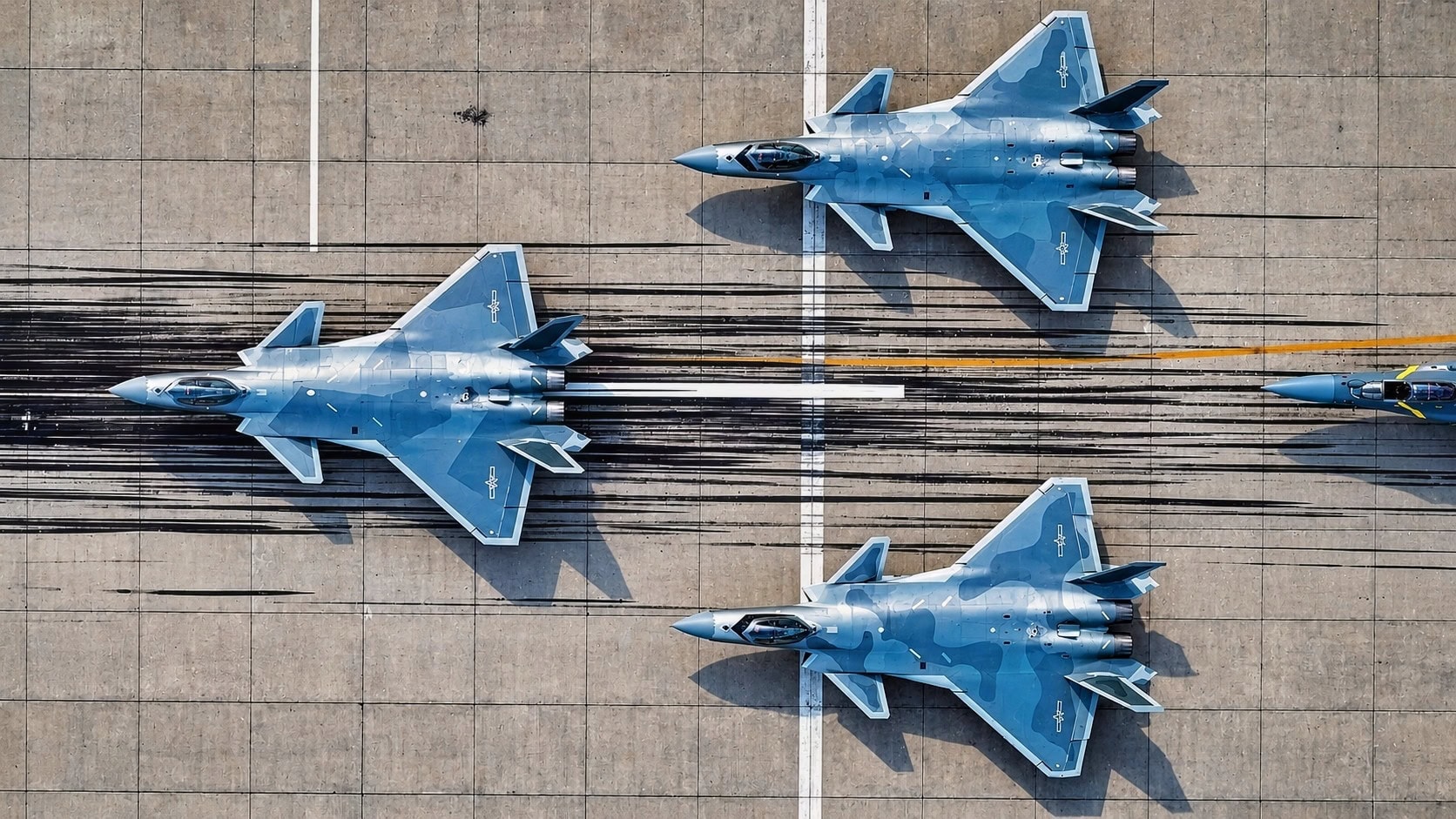
The PL-15 already changed the geometry of Western Pacific air combat by giving Chinese fighters a long-range weapon that could threaten high-value enablers beyond the normal fighter screen. PL-16, as described by Defense News and earlier technical reporting, looks like an attempt to solve two problems at once: preserve long-range energy late in flight and increase the J-20's internal magazine.
That second point is not cosmetic. A J-20 with four PL-15s can make one or two serious shots, hold a pair in reserve, and then has to decide whether to stay in the fight with a thin magazine. A J-20 with six PL-16s gives a four-ship package 24 internal missiles instead of 16. That is eight additional shots before any aircraft has to expose external stores or turn home.
Anyone who has served on a destroyer knows this is how commanders think under pressure. The question is not only range. It is how many rounds are available at the point of contact, how many must be held back, and how quickly the next loaded platform can arrive. Air combat is not exempt from magazine math.
Tankers Are the Real Target
The J-20 is often framed as China's answer to the F-22 or F-35. That framing misses the mission that matters most in a Taiwan scenario. The J-20 does not have to win a clean fighter duel to matter. It has to make a KC-46, E-7, E-2D, P-8A, or RC-135 crew operate farther from the battlespace than the air plan assumes.
Malcolm Davis of the Australian Strategic Policy Institute told Defense News that the PL-16 is designed to hit airborne early warning, tanker, and reconnaissance platforms. That is the right target set. Fighters are hard to find, hard to kill, and tactically agile. Tankers and command aircraft are bigger, slower, more predictable, and indispensable.
Move a tanker track 200 kilometers farther east and the effect cascades. F-35Cs launching from a carrier east of Taiwan burn more fuel before reaching station. Combat air patrol time shrinks. Rescue windows get tighter. The carrier can move closer, but that pulls the strike group deeper into the reach of Chinese submarines, bombers, anti-ship ballistic missiles, and land-based aircraft. There is no free answer.
This is why a 300 kilometer air-to-air missile matters even if its actual no-escape zone is much shorter. The advertised range does not have to equal a guaranteed kill. It only has to impose doubt on the crews and planners responsible for keeping the aerial refueling and surveillance network alive.
AIM-260 Is a Race Against Production
The US answer is the AIM-260 Joint Advanced Tactical Missile, designed to restore reach after the PL-15 narrowed the advantage of the AIM-120 AMRAAM family. On paper, AIM-260 is the right response. In practice, the schedule and production rate matter more than the brochure.
Defense News noted that analysts see PL-16 as a Chinese answer to AIM-260 and an improvement over earlier Chinese weapons. That is only half of the story. The United States can field exquisite missiles and still lose the opening inventory problem if too few weapons are available in the Pacific when the crisis begins.
China has an easier geography problem. A J-20 sortie from the mainland can fight under dense ground-based sensor coverage, land-based air defense, and shorter logistics lines. US and allied aircraft have to project power across Guam, Japan, the Philippines, carriers, tankers, and munitions depots that all become part of the kill chain. In that environment, being late by a year on missile production is not an acquisition nuisance. It changes the first week of a war.
What Is Confirmed and What Is Not
The PL-16 should not be treated as an operational fact until better evidence appears. Huang Chung-ting of Taiwan's Institute for National Defense and Security Research cautioned that online material does not prove the missile's range, propulsion, or mass deployment status. That caution is necessary.
But waiting for a parade reveal is also bad planning. The PLA has been consistent about the operational problem it wants to solve: push US support aircraft away, compress allied air operations, and make the first island chain too expensive to hold. A smaller, longer-legged missile that lets the J-20 carry more internal rounds fits that pattern perfectly.
The more useful assessment is conditional. If PL-16 is real at the 200 kilometer level, it complicates tanker and airborne early warning operations. If it is closer to 300 kilometers and available in quantity, it becomes a serious pressure weapon against the entire US air architecture west of Guam. If it can be carried six at a time by J-20s, then the aircraft becomes less a dogfighter and more a mobile missile battery hunting the aircraft that make US fighters useful.
The Operational Bill
Washington does not need a panic response. It needs a bill of materials response. More AIM-260s. More decoys. More distributed tanking. More hardened fuel storage. More runway repair. More passive sensors. More unmanned aircraft willing to absorb the first shots. More allied dispersal bases with actual fuel and weapons, not just flags and press releases.
The PL-16 story is uncomfortable because it shows how China may be attacking the joint force at its weakest point. The United States still has better pilots, better submarine forces, more combat experience, and stronger allies. But in the Western Pacific, air superiority is not a trophy won by fighter pilots alone. It is a supply chain suspended in the sky.
Beijing does not have to shoot down every F-35. It has to make the tanker plan stop working. If PL-16 helps do that, then one smaller missile in a J-20 bay may matter more than another squadron of fighters on either side.
The PL-16 missile enhances the J-20's capabilities, allowing it to target US tanker and reconnaissance aircraft from a distance of 200 to 300 kilometers. This development could significantly impact US air operations in the Taiwan and Philippine Sea regions, as it forces US support aircraft to operate farther from the conflict zone. The J-20 can now carry six PL-16 missiles, increasing its strike potential against high-value targets.
- The PL-16 missile has a reported range of 200 to 300 kilometers.
- The J-20 can carry up to six PL-16 missiles internally.
- The PL-16 is designed to target US tanker and reconnaissance aircraft.
- The missile's development aims to push US support aircraft further from the battlespace.
- The report highlights the strategic implications of the PL-16 for US air operations in the Western Pacific.