
China Russia 11th Air Patrol Stretches Japan's Intercept Geometry
 Marcus Chen
China Russia 11th Air Patrol Stretches Japan's Intercept Geometry
The 11th Chinese-Russian joint air patrol on June 27 covered three connected pieces of airspace: the Sea of Japan, the East China Sea, and the western Pacific. That geography matters more than the official wording. A bomber track that links those three areas is not just a diplomatic signal. It is a rehearsal in making Japan, South Korea, and U.S. forces watch multiple approaches at once.
China's Ministry of National Defense gave few operational details, saying only that the two air forces conducted the patrol and that it showed their ability to maintain regional peace and stability. China Daily and Global Times carried the same basic formulation. A Huanqiu photo report added images from the mission and described the same route. The lack of aircraft numbers is useful in its own way: Beijing wants the route to be the message.
The Route Is the Payload
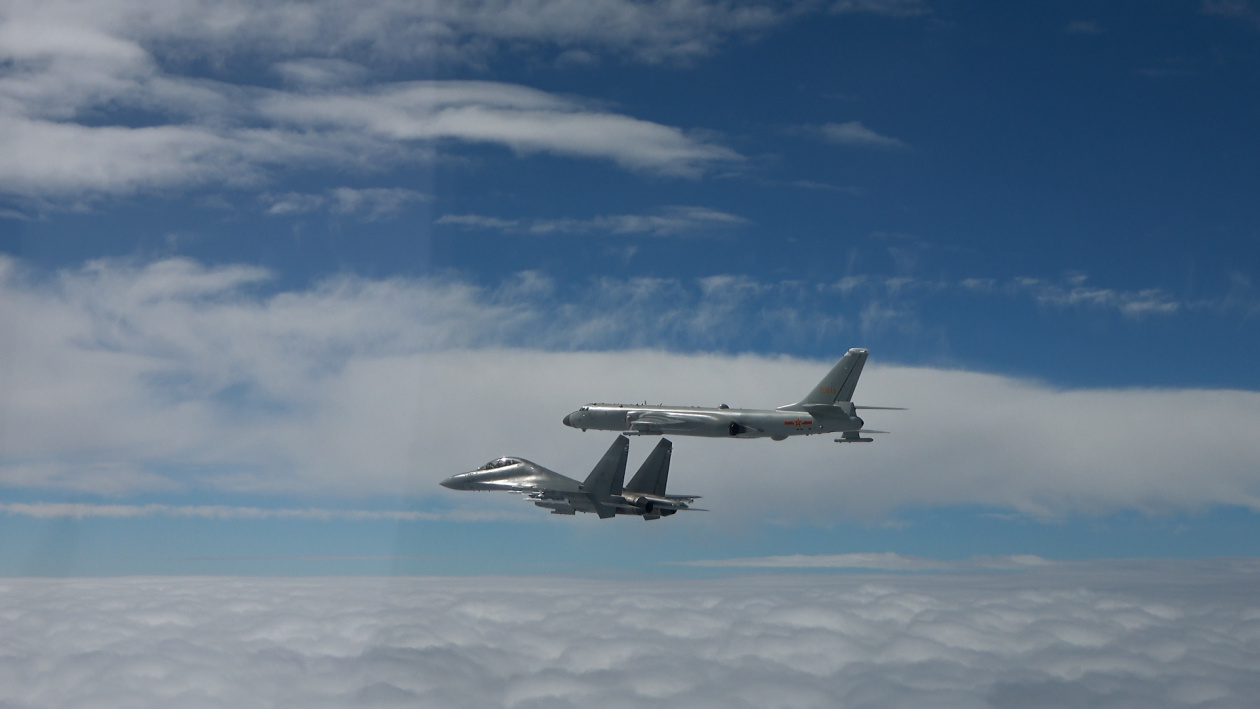
The Sea of Japan-to-East China Sea-to-western Pacific path forces defenders to think in arcs rather than points. Japanese Air Self-Defense Force units in the north watch Russian aircraft coming down from the Sea of Japan. Southwest Air Defense Command watches the Okinawa-Miyako gap. U.S. forces in Japan have to assume that any large bomber package could also be paired with submarines, surface surveillance, cyber activity, or missile force signaling elsewhere.
Anyone who has stood watch on a destroyer knows the problem. The contact itself may not be hard to track. The problem is what else the contact is making you miss. A bomber patrol consumes fighter sorties, tanker planning, airborne early warning coverage, intelligence collection, and political attention. The aircraft can turn around and go home. The defenders still have to prove they can cover the next lane.
The Bomber Math Is Uncomfortable
China has not publicly listed the aircraft in the June 27 package. The usual players in this mission set are Chinese H-6-series bombers and Russian Tu-95MS aircraft, with fighters and airborne early warning aircraft sometimes visible in past patrols. The H-6K is not a stealth bomber and it is not new, but it does not need to be either. With a combat radius often estimated around 3,500 kilometers and the ability to carry long-range cruise missiles, it can threaten from outside the first island chain if targeting data exists.
The Russian Tu-95MS is even older in design terms, but age is not the relevant metric. Range and missile carriage are. A Tu-95MS can fly intercontinental distances and carry air-launched cruise missiles. Pair it with a Chinese bomber package and the operational question becomes simple: how many interceptors, tankers, and airborne warning aircraft does Japan need to keep a bomber track under control from the Sea of Japan all the way into the western Pacific?
That is the arithmetic Beijing and Moscow are putting on the table. They do not need a wartime-sized package to stress the system. A small number of bombers can generate a large number of defensive decisions because the route touches several defense sectors. Add poor weather, a concurrent naval exercise, or a Taiwan crisis, and the same patrol becomes a sorting problem under pressure.
Japan Has the Hardest Geometry
Japan's geography is a gift for sea denial and a burden for air defense. The Ryukyu chain creates natural chokepoints, but it also stretches fighter coverage across a long island arc. Naha, Tsuiki, Komatsu, Misawa, and other bases can generate sorties, but aircraft still need fuel, weapons, maintenance crews, and airspace deconfliction. The map looks clean in a briefing. It is less clean when multiple tracks appear hundreds of nautical miles apart.
The Okinawa-Miyako gap is the key. It is wide enough for aircraft and ships to move through, narrow enough to be politically sensitive, and close enough to Taiwan that every sortie there is read through a Taiwan contingency lens. A Chinese-Russian patrol that moves from the East China Sea into the western Pacific tells Tokyo that a future crisis will not arrive through one door.
This is where U.S. planning gets awkward. Washington often talks about distributed operations, agile combat employment, and resilient posture. Those concepts are necessary. They are not magic. If Japanese bases are already cycling fighters to monitor bomber routes, U.S. aircraft operating from the same broad theater face the same runway, tanker, and command-and-control constraints. The limiting factor is not the slogan. It is sortie generation.
Coordination Is Becoming the Point
The most important development is not that China and Russia can fly together. They have been doing that since 2019. The important part is that the patrols are now routine enough to become a planning assumption. The first flights were events. The 11th flight is a pattern.
That matters because combined pressure does not require a formal alliance. Russia can pull Japanese and South Korean attention north while China increases activity around Taiwan, the East China Sea, or the Philippine Sea. China can do the same while Russia demonstrates long-range aviation access from its Far East bases. Even if neither side shares every targeting file, the operational effect can still be additive.
There is a temptation in Washington to dismiss these flights as messaging. That is too easy. Messaging flights still train crews, validate routes, test communications, and teach defenders how to respond. They also let Chinese and Russian staffs learn how quickly Japan and South Korea react, where fighters appear, and what public language governments use after the fact. Intelligence collection does not stop because a sortie is political.
The First Island Chain Needs More Than Fighters
The answer is not simply more interceptors. Japan and the United States need more runway repair capacity, more dispersed fuel storage, more air defense munitions, more hardened shelters, and more realistic combined air tasking for simultaneous northern and southwestern pressure. Fighters are the visible part of the response. The invisible part is whether the maintenance and logistics system can do it again tomorrow.
The June 27 patrol also reinforces the case for better passive sensing across the island chain. Radar, electronic support measures, maritime patrol aircraft, space-based tracking, and allied data links matter because every extra minute of warning reduces the number of bad choices. If Japan can classify and track a bomber package early, it can decide whether to scramble, shadow, or hold aircraft for a more serious track.
China and Russia are not proving they can win an air campaign with one patrol. They are proving they can make the geometry worse for everyone else. That is a real military result.
What To Watch Next
The next useful indicators are not speeches. Watch whether future patrols push farther into the Philippine Sea, whether Chinese carrier aviation appears in the same window, whether Russian support aircraft accompany bomber legs, and whether Japan releases more detailed scramble data. Also watch Taiwan crisis signaling. A bomber route through the East China Sea and western Pacific has a different meaning during calm conditions than it does during a blockade exercise or missile drill.
For now, the conclusion is narrow but important. The United States and Japan can intercept these patrols. The question is whether they can keep doing it while also defending tankers, bases, ships, and Taiwan-related airspace in the same week. Beijing and Moscow do not need to break the first island chain in peacetime. They only need to keep measuring where it bends.
On June 27, the Chinese and Russian air forces conducted their 11th joint air patrol covering the Sea of Japan, East China Sea, and western Pacific. This operation aims to challenge Japan's air defense capabilities by forcing them to monitor multiple airspace sectors simultaneously. The patrol likely involved H-6-series bombers and Tu-95MS aircraft, highlighting the increasing military cooperation between China and Russia.
- The 11th Chinese-Russian joint air patrol occurred on June 27.
- The patrol covered the Sea of Japan, East China Sea, and western Pacific.
- The patrol aims to challenge Japan's air defense capabilities.
- Chinese H-6 and Russian Tu-95MS bombers were likely involved.
- The patrol is part of a routine military operation between China and Russia.