
China-Russia Conducts 11th Joint Air Strategic Patrol, Passing Through the Sea of Japan, East China Sea, and Western Pacific Airspace
[Global Times reporters Guo Yuandan, Chu Xin, and Liu Yupeng] On the 27th, the Chinese Ministry of Defense announced that the air forces of China and Russia conducted their 11th joint aerial strategic patrol in the airspace over the Sea of Japan, East China Sea, and western Pacific Ocean, demonstrating their determination and capability to jointly maintain regional peace and stability. The Russian Ministry of Defense reported on the 27th that the joint patrol lasted approximately 6 hours. The Russian Ministry emphasized that throughout the patrol, the aircraft of both countries strictly adhered to international law and did not violate the airspace of any country.
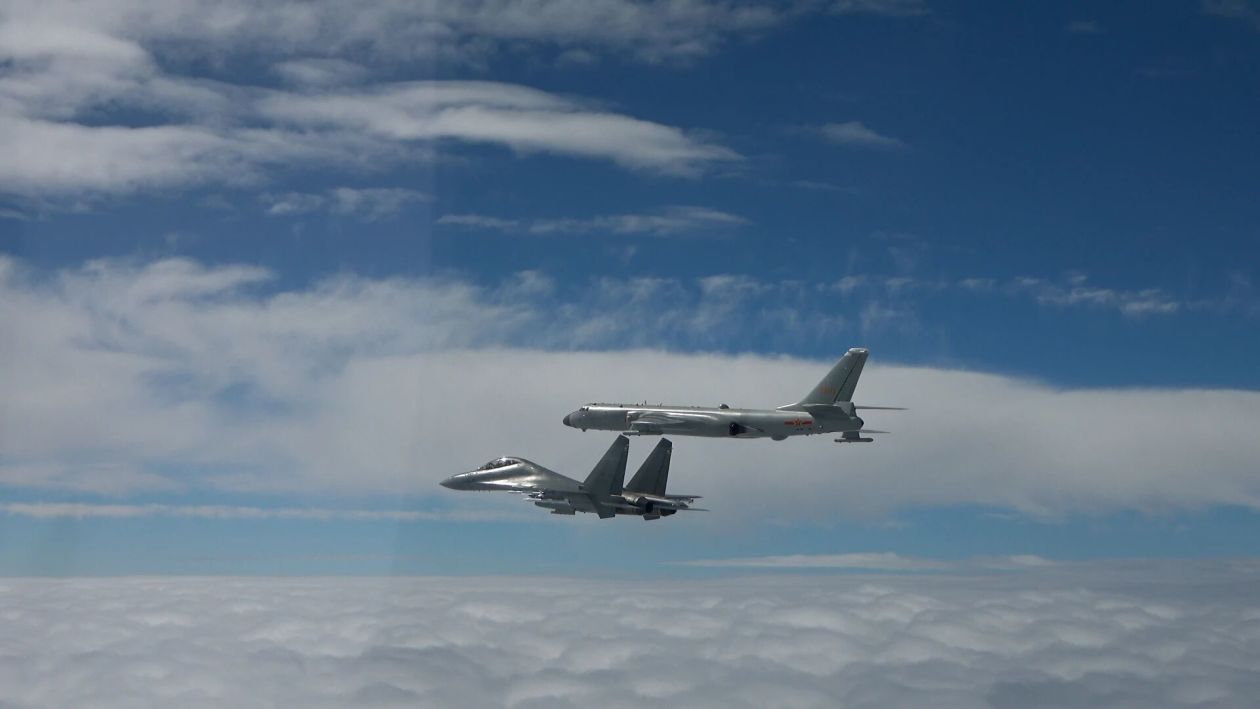
It is understood that in this joint patrol operation, the Chinese side primarily used H-6K bombers and deployed advanced fighter jets such as J-16, J-10C, and J-11B for escort; the Russian side sent Tu-95 bombers and Tu-142 patrol aircraft to form a joint formation with the Chinese side.
Military expert Zhang Xuefeng told Global Times reporters on the 28th that in recent years, the types of aircraft participating in the China-Russia joint strategic patrols have become increasingly diverse, with performance continuously improving and the level of systematization rising. This joint patrol exhibited two major characteristics. First is the systematic use of military forces: in addition to the H-6K and various escort fighter jets, the Chinese side also deployed new large electronic jamming and reconnaissance aircraft to provide intelligence support; the KJ-500A early warning aircraft served as the airborne command platform, and the Y-20A conducted aerial refueling, effectively extending the range of the fighter jets and enhancing their escort capability for the bombers. Second is the high level of realism: for example, escort aircraft like the J-16 were armed with live ammunition, and the electronic reconnaissance and jamming equipment could effectively intercept foreign radar signals for analysis and positioning, and if necessary, implement jamming to strengthen their own protection.
Russian media commented that this joint patrol by Russia and China demonstrated their joint operational and coordination capabilities. This not only strengthened the cooperative partnership between the two countries but also highlighted their common interests in ensuring regional security.
However, Japan reacted excessively to this routine joint patrol by China and Russia. According to a report by Kyodo News on the 28th, the Japanese Ministry of Defense stated late on the 27th that Chinese and Russian bombers conducted long-distance flights from the Sea of Japan to the East China Sea and the Pacific Ocean, prompting the Japan Air Self-Defense Force to scramble aircraft in response. This is the first confirmation by Japan of a joint patrol by Chinese and Russian military aircraft around Japan since December of last year. The Japanese Ministry of Defense also claimed to have expressed its so-called "serious concerns" to China and Russia through diplomatic channels.
It is noteworthy that while the Japanese government expresses its so-called "concerns," it continues to engage in small actions, even tracking, monitoring, and photographing our naval fleet that has advanced into the Western Pacific. Public reports indicate that the naval fleet led by the aircraft carrier Liaoning recently completed long-range realistic training and returned to its home port in Qingdao. However, during our military training, Japanese vessels and aircraft repeatedly conducted close-range tracking, monitoring, and provocative harassment. The Liaoning fleet maintained a high state of alert throughout, continuously organizing combat takeoffs of carrier-based aircraft, flexibly changing combat formations, and professionally and prudently responding to Japan's dangerous actions.
Additionally, reports indicate that Japan had previously deployed air forces to conduct targeted simulated attacks on our aircraft carrier fleet. Military expert Zhang Junsha stated on the 28th that Japan is creating a tense atmosphere by tracking and harassing the Chinese aircraft carrier fleet, which is essentially seeking an excuse for its own military expansion and constitutional revision to reshape its status as a military power. The international community and neighboring Asian countries should remain highly vigilant against this.
On October 27, 2023, the Chinese and Russian air forces conducted their 11th joint aerial strategic patrol over the Sea of Japan, East China Sea, and Western Pacific. The operation lasted approximately 6 hours, with both nations' aircraft adhering to international law. In response, Japan's Self-Defense Forces scrambled aircraft, expressing diplomatic concerns regarding the patrol.
- China and Russia conducted their 11th joint aerial strategic patrol on October 27, 2023.
- The patrol lasted approximately 6 hours and adhered to international law without violating any airspace.
- Chinese forces included H-6K bombers and various fighter jets, while Russia deployed Tu-95 bombers and Tu-142 patrol aircraft.
- Japan's Self-Defense Forces scrambled aircraft in response to the patrol, expressing concerns through diplomatic channels.
- The operation showcased enhanced military cooperation and capabilities between China and Russia.