
China Russia Joint Sea 2026 Turns a Naval Drill Into Pacific Presence
 S.W
S.WChina Russia Joint Sea 2026 Turns a Naval Drill Into Pacific Presence
Ten vessels are the number that matters in Joint Sea-2026. China and Russia completed their twelfth bilateral naval exercise at Qingdao on July 13, then sent some participating forces into the Pacific for joint patrols. That is not a combined fleet. It is a rehearsal for keeping a combined presence moving after the photographers leave.
What the Exercise Actually Tested
According to Defence Security Asia, the exercise brought together ten surface, underwater, aerial, and support units. The harbor phase included tabletop planning, professional seminars, ship visits, and tactical coordination before the at-sea phase. The stated scenario was maritime security, but the useful part was the progression from staff work to live-force and live-fire activity.
That progression is important because interoperability is usually lost in the seams. A ship can exchange data and still fail to coordinate a screen, manage air contacts, or transfer a track to another navy under pressure. Repeated exercises create shared procedures: how commanders describe a contact, how ships maneuver around one another, how an aircraft is controlled, and how replenishment is scheduled. None of this proves that China and Russia could fight a major war as one formation. It does show that they are reducing the number of problems they would face if their patrols overlapped during a crisis.
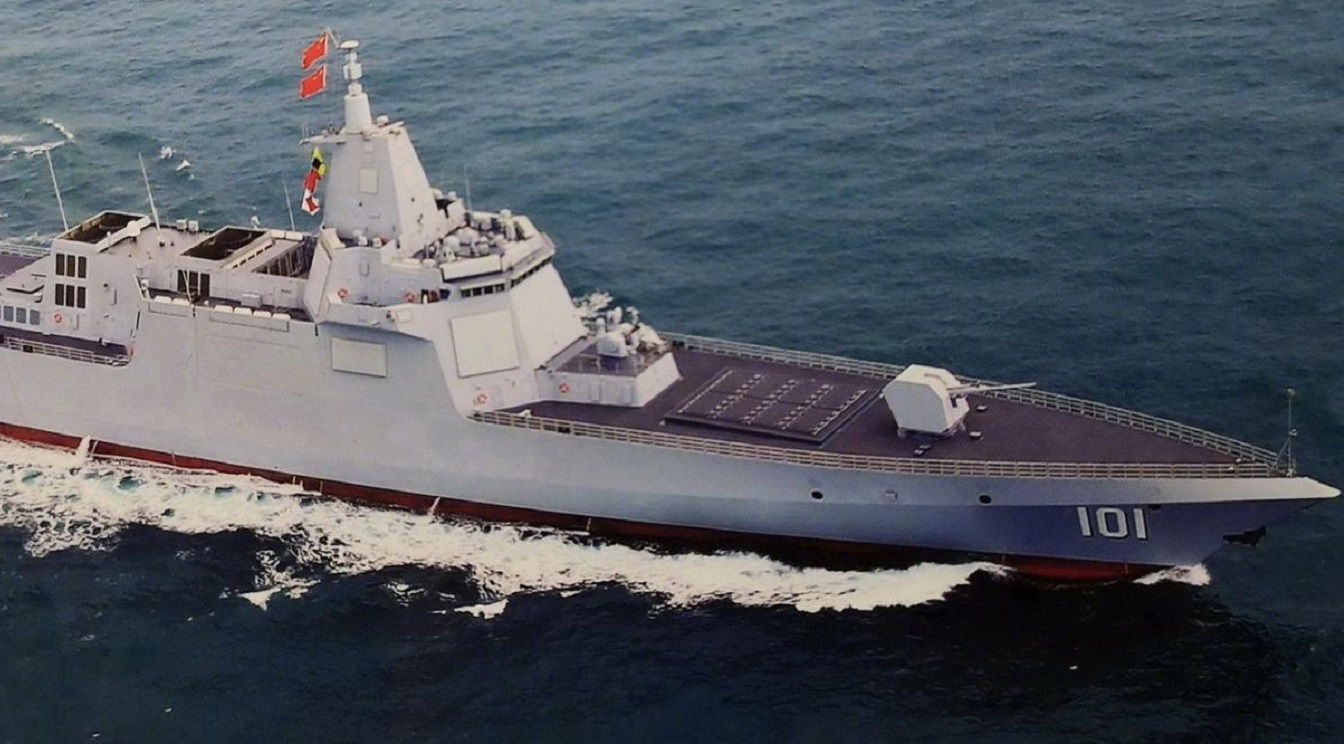
The Chinese platform visible in the exercise reporting also illustrates the imbalance between the partners. A Renhai-class Type 055 destroyer is roughly a 12,000-ton ship with an estimated 112 vertical-launch cells, a large phased-array radar suite, and a 130 mm main gun. Those figures are open-source estimates, not a Chinese specification sheet. The ship is a command and air-defense node as much as a surface combatant. Russia can bring capable submarines, frigates, and maritime aviation, but China supplies the larger industrial base and the more sustained regional operating tempo.
Why the Pacific Patrol Matters More Than Qingdao
The exercise itself was close to home waters. The follow-on patrol is the signal. A drill at Qingdao demonstrates that two navies can assemble. A patrol beyond the exercise area tests whether they can sustain contact, share a picture, and manage logistics when shore support is less convenient.
CSIS counted six China-Russia joint military exercises in 2025, down from fourteen in 2024, while noting that the two countries conducted their first joint submarine patrol. The lower count should temper claims of a formal military alliance. Beijing and Moscow cooperate when the activity is useful, but neither has accepted an Article 5-style obligation to enter the other’s war. Their navies also have different command systems, communications architecture, and priorities.
But frequency is not the only measure. A smaller number of exercises can be more useful if the events become more operationally demanding. Joint Sea-2026 appears to have combined surface, subsurface, air, and support elements, then extended at-sea activity into the Pacific. That is a move from ceremonial access to practical endurance. The question is not whether China and Russia can defeat the US Navy together. The question is whether they can force the United States, Japan, Australia, and the Philippines to track another moving formation while already covering Taiwan, the South China Sea, and the approaches to Guam.
The Pressure It Creates for the United States
China already has the regional geography, shipbuilding capacity, and shore-based missile network to make the western Pacific a difficult operating environment. Russia adds something different: undersea expertise, long-range aviation, and a willingness to operate in directions that complicate American collection and force allocation. A Russian submarine or intelligence ship does not need to be powerful enough to defeat a carrier strike group. It needs to create another contact that must be classified, monitored, and planned around.
This is a sea-denial problem before it becomes a sea-control problem. US Indo-Pacific Command can surge destroyers, submarines, maritime patrol aircraft, and allied sensors, but every additional patrol consumes maintenance days, fuel, weapons, and crews. The burden is asymmetric. Beijing and Moscow gain political value from a relatively small deployment; Washington must maintain a credible picture across a huge ocean and preserve enough forces for the main contingency.
CSIS also documented a sharp increase in Chinese activity beyond the First Island Chain in 2025, including carrier operations and live-fire activity far into the Pacific. Joint Sea-2026 fits that pattern, but it should not be mistaken for proof that Russia has become part of a Chinese war plan against Taiwan. The more defensible reading is narrower: China is normalizing distant operations, and Russia is learning how to participate in them at low political cost.
What the Drill Does Not Prove
Ten ships cannot create a permanent maritime front. The patrol does not establish a Chinese-Russian alliance, and the exercise does not demonstrate that the two navies can execute a complex wartime campaign under American electronic warfare and surveillance. There is no public evidence that they have solved secure communications, weapons deconfliction, or sustained replenishment in a contested environment.
Those limitations are exactly why the event matters. Interoperability is built incrementally, and the first useful product is not a combined battle group. It is a larger set of options for diversion, signaling, surveillance, and pressure. An adversary that must be watched in two places is already consuming force.
The Bottom Line
Joint Sea-2026 was not a Pacific alliance fleet. It was a test of whether China and Russia could turn a scheduled exercise into an operating pattern. The ten-vessel formation, the multi-domain training, and the follow-on patrol all point in the same direction: more routine cooperation at sea, even while the political relationship remains deliberately short of alliance.
For the United States, the response should not be another headline about a new partnership. It should be a readiness calculation. How many submarines can be sustained forward? How many patrol aircraft can keep contact? How quickly can allied ships share a track and replenish? If the answer is measured in short deployments and improvised coordination, then a small Chinese-Russian patrol has achieved more than its size suggests.
Sources
- Defence Security Asia, “China-Russia Joint Sea-2026 Ends with Powerful Naval Show of Force,” July 2026.
- CSIS ChinaPower, “Tracking China’s Increased Military Activities in the Indo-Pacific in 2025,” February 5, 2026.
- Open-source estimates of the Type 055 destroyer’s displacement and vertical-launch capacity; exact Chinese specifications remain unpublished.
China and Russia completed the Joint Sea-2026 naval exercise in Qingdao in July 2026, involving 10 vessels. Following the exercise, they conducted joint patrols in the Pacific Ocean to enhance interoperability and maintain a combined presence. This operation signifies a shift from ceremonial exercises to practical maritime cooperation, despite the absence of a formal military alliance between the two nations.
- China and Russia conducted Joint Sea-2026 naval exercise with 10 vessels.
- The exercise included surface, underwater, aerial, and support units.
- The follow-on patrol extended operations into the Pacific Ocean.
- The exercise aimed to improve interoperability between the two navies.
- China's Type 055 destroyer was a key asset in the exercise.