
China Scarborough 6 Meter Structure Tests Philippine Sea Denial in 2026
 Marcus Chen
China Scarborough 6 Meter Structure Tests Philippine Sea Denial in 2026
Six meters by six meters is not much real estate. It is smaller than the flight deck of a patrol boat and about the size of a cramped apartment living room. But if the object Philippine forces say they recently monitored inside Scarborough Shoal is fixed, not floating, that small square could matter more than another week of coast guard collisions or radio warnings.
Philippine Defense Secretary Gilberto Teodoro Jr. was careful on Monday, saying Manila was still verifying raw information and could not yet call the object a structure. Gen. Romeo Brawner Jr., the Philippine military chief, told Naval News that the monitored item appeared to be a small structure roughly 6 by 6 square meters, while investigators were still trying to determine whether it was floating or anchored. That uncertainty is the point. Scarborough is a shoal, and buoys drift. But China has spent the last decade proving that small facts on the water can become permanent facts on the map.
The Shoal Is a Sensor Problem Before It Is a Sovereignty Problem
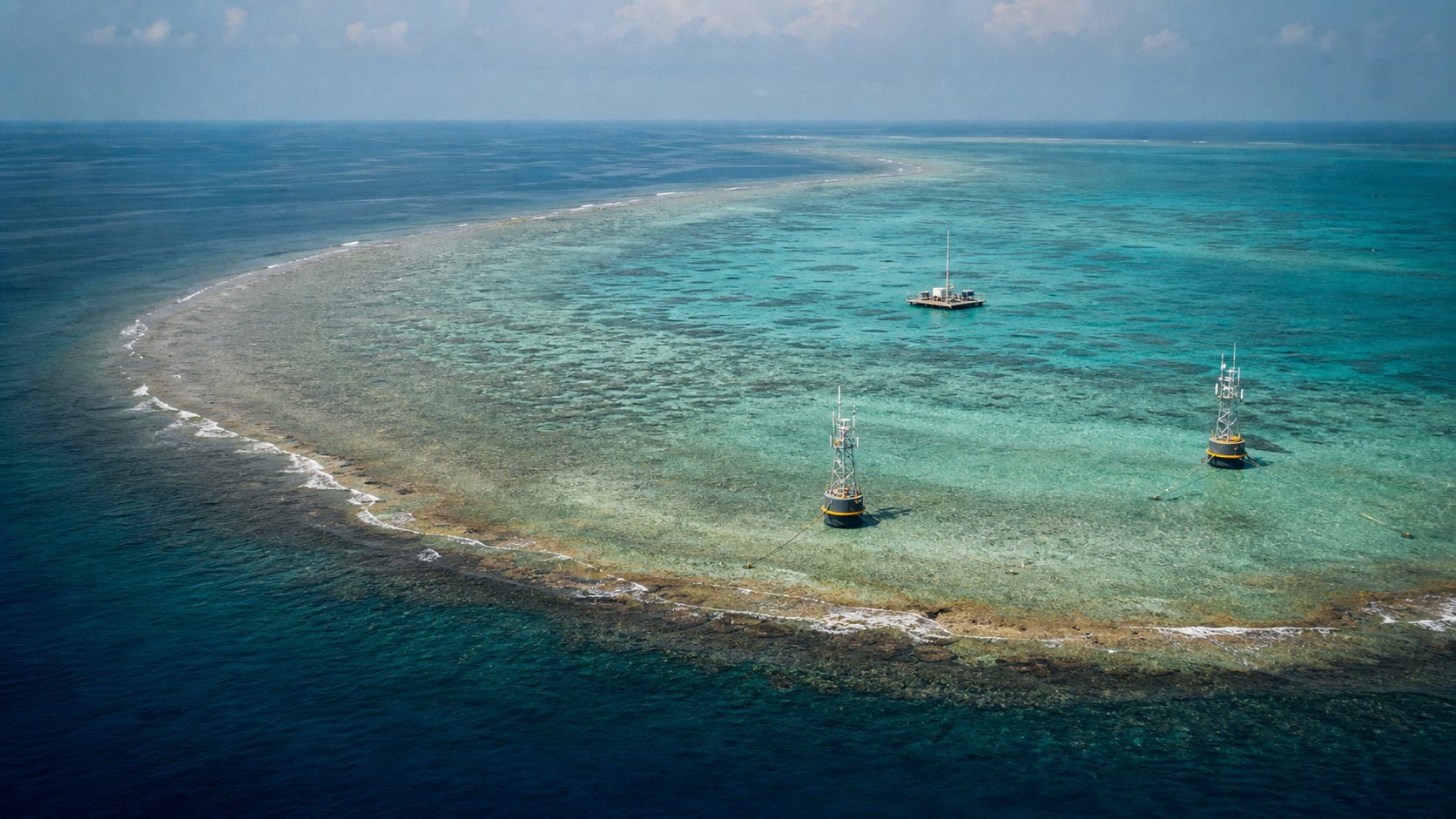
Scarborough Shoal sits about 220 kilometers west of Luzon. That distance is short enough for Philippine aircraft, cutters and fishing boats to reach, but long enough to make constant presence expensive. China took effective control after the 2012 standoff and has maintained a near-continuous coast guard and maritime militia presence since. The 2016 arbitral ruling rejected China expansive South China Sea claims, but Beijing ignores the ruling and works the problem operationally.
A fixed sensor, moored platform, communications buoy or serviceable marker inside the lagoon would not need to look like a military base to change the equation. Anyone who has served on a destroyer knows that surveillance is cumulative. A radar contact, an AIS anomaly, a radio relay and a persistent visual post each reduce uncertainty. Reduce uncertainty often enough and sea denial gets cheaper.
That is why the April barrier matters. Philippine and satellite reporting showed a 352 meter floating barrier across the entrance to Scarborough Shoal earlier this year, later reportedly removed. A barrier is not a base either. But it tests control of the entrance, imposes a response cost on Manila, and gives China a rehearsal for closing access without firing a shot. A small structure would fit the same pattern: not decisive alone, but useful in a layered system.
The Numbers Around Scarborough Are Already Heavy
The latest Philippine Navy count gives the scale. From June 9 to 15, Manila monitored 26 Chinese vessels in the West Philippine Sea, down from 41 the previous week. At Bajo de Masinloc, the Philippine name for Scarborough Shoal, the count included three China Coast Guard vessels and four People Liberation Army Navy vessels. That is seven Chinese hulls around one disputed feature during a week that was not described as a crisis.
Seven hulls do not equal seven combatants ready to fight, but they do equal persistence. A coast guard cutter can block, shadow, film and force legal dilemmas. A PLAN ship nearby changes the risk calculation for Philippine patrol craft. Add helicopters, unmanned aircraft or shore-based maritime patrol coverage from Hainan and the picture becomes less about one shoal and more about an exclusion bubble that can be thickened on demand.
The Philippines can contest that bubble, but not cheaply. The recent U.S.-Philippine maritime cooperative activity near Scarborough from May 26 to 30 included the U.S. Coast Guard cutter USCGC Midgett, the Philippine frigate BRP Antonio Luna, a Philippine AW109 helicopter, two FA-50 light fighters, two A-29B Super Tucano aircraft, a Cessna C-208B, a Sokol helicopter and the patrol vessel BRP Melchora Aquino. That is a serious package for training maritime interdiction, law enforcement and search and rescue.
It is also a reminder of the imbalance. China can keep a small group of cutters and naval ships cycling near the shoal as part of routine pressure. Manila and Washington need to assemble a visible combined package to signal that the shoal has not been conceded. Presence is arithmetic, and Beijing has more hulls to spend.
Scarborough Is Not Second Thomas Shoal
It is tempting to treat Scarborough as another version of Second Thomas Shoal, where the grounded BRP Sierra Madre has become a symbol of Philippine resistance. That is the wrong frame. Second Thomas is about sustaining a vulnerable outpost. Scarborough is about preventing China from converting control into infrastructure.
The operational difference is important. If China can keep Scarborough inside a gray-zone envelope without building anything permanent, it still denies Philippine fishermen reliable access and forces Manila to respond at times and places Beijing chooses. If China adds fixed or semi-fixed equipment, even modest equipment, it begins to solve the persistence problem. The lagoon becomes easier to monitor. The entrance becomes easier to close. Maritime militia and coast guard patrols become more efficient because they can operate around a known point instead of just a patrol box.
That does not mean a 6 meter object is the beginning of a runway. Scarborough is not Fiery Cross Reef, and turning a shoal into a major artificial island would be a major escalation with large engineering signatures. But the South China Sea playbook rarely begins with the most dramatic move. It begins with a buoy, a barrier, a patrol pattern, a new radio claim, a temporary object that is still there next month.
The U.S. Problem Is Credibility at Patrol Speed
Washington has a treaty commitment to Manila, and U.S. officials have repeatedly said the Mutual Defense Treaty applies to Philippine armed forces, public vessels and aircraft in the South China Sea. The hard question is not whether the United States can respond to a missile strike on a Philippine ship. It can. The harder question is whether U.S. and allied forces can deter slow coercion that stays below the threshold of a clean military trigger.
A Legend-class cutter such as Midgett brings endurance, aviation facilities and law enforcement credibility. It is the right tool for some gray-zone work. But it cannot be everywhere, and it does not solve the basic geography. From Guam to Scarborough is roughly 2,600 kilometers. From Okinawa it is about 1,700 kilometers. From Manila it is 350 kilometers by air, but Philippine sea control assets remain thin. China operates from the mainland, Hainan and its existing South China Sea facilities with a dense coast guard fleet behind the front line.
That is the gap.
The United States can surge a cutter, fly surveillance, and run joint maritime activities. China can normalize the pressure between those events. If a suspicious object appears, disappears, or reappears inside the shoal, Manila must decide whether to physically remove it, document it, protest it, or ask for allied help. Every option carries cost. Beijing only needs ambiguity to keep the cycle moving.
What Manila Should Watch Next
The first test is whether the object is fixed. A drifting buoy is an irritant. A moored or anchored platform is a claim of control. The second test is function. A navigation marker, weather buoy, optical camera mast, communications relay or simple service platform each implies a different level of ambition. The third test is whether Chinese vessels begin protecting it as if it has value.
Open-source satellite imagery, Philippine Coast Guard footage and allied maritime patrol data should answer those questions quickly. Manila should publish enough evidence to make the status of the object clear without revealing collection methods. Ambiguity helps China. Precision helps the Philippines.
The fourth test is repetition. If new objects appear after removal, or if barriers return around the entrance, Scarborough is moving from managed dispute toward engineered control. That would not require a dramatic announcement from Beijing. It would only require steady work by cutters, militia boats and survey teams while everyone else debates terminology.
The United States and the Philippines do not need to overreact to a 6 meter object. They do need to treat it as part of a control campaign, not as maritime clutter. In the South China Sea, small things become big when they stay put. Scarborough is where that lesson may be tested next.
Philippine forces are verifying a 6x6 meter structure in Scarborough Shoal, which may signify a change in control dynamics in the area. China has maintained a continuous presence since 2012, with 26 Chinese vessels recently monitored in the West Philippine Sea. The U.S. and Philippine forces conducted joint maritime activities nearby, highlighting the ongoing strategic competition in the region.
- Philippine forces monitored a 6x6 meter structure in Scarborough Shoal.
- China maintains a near-continuous presence in the area since 2012.
- 26 Chinese vessels were monitored in the West Philippine Sea from June 9 to 15, 2026.
- The U.S. and Philippine forces conducted maritime cooperative activities near Scarborough.
- The presence of a small structure could indicate a shift in control dynamics.