
China Sends 21 Aircraft and Ships Around Taiwan as US Carrier Patrols Philippine Sea
 Marcus Chen
China Sends 21 Aircraft and Ships Around Taiwan as US Carrier Patrols Philippine Sea
Taiwan counted 21 Chinese military and government platforms around the island in one 24-hour reporting window. That is not a surge by 2022 or 2024 standards. It is more useful than that. It is the kind of number that shows how Beijing is making pressure routine while Washington tries to make presence credible with a finite number of ships.
Taiwan's Ministry of National Defense reported on July 8 that from 6 a.m. July 7 to 6 a.m. July 8, it detected 9 People's Liberation Army aircraft sorties, 9 People's Liberation Army Navy ships, and 3 Chinese official ships operating around Taiwan. Four of the aircraft crossed the Taiwan Strait median line and entered Taiwan's northern, southwestern, and eastern air defense identification zone. One day earlier, Taipei reported 4 PLA aircraft sorties, 9 PLAN ships, and 3 official ships, with 3 of those aircraft crossing the median line into the southwestern ADIZ.
The numbers are small enough to be dismissed in a headline cycle. Operationally, they should not be.
The Contact Pattern Matters More Than The Sortie Count
A single-day count of 9 aircraft is not a blockade rehearsal. It is not a strike package. It is a contact-management drill. The important detail is geographic spread: northern, southwestern, and eastern ADIZ penetrations in the same reporting period. That forces Taiwan to manage alerts across multiple axes, not simply look southwest toward the familiar approaches from Fujian and Guangdong.
Taiwan said its armed forces responded with combat air patrol aircraft, Navy ships, and coastal missile systems. That is the standard formula in the ministry's daily releases, but the formula describes real wear. Every scramble consumes flight hours. Every surface contact requires tracking. Every coastal missile unit that moves, radiates, rehearses, or shifts posture spends readiness capital. The PLA does not need 60 aircraft every day to create this effect. It needs regularity.
There is a naval layer here that deserves more attention than the aircraft count. Nine PLAN ships plus three official ships gives Beijing a 12-hull maritime presence around Taiwan during a day that most outside readers will not remember. The official ships matter because they blur the line between military coercion and law-enforcement pressure. Anyone who has stood watch on a destroyer knows that a gray hull and a white hull do not create the same rules of engagement problem. The white hull can be politically harder to push away, especially when it is backed by naval combatants over the horizon.
George Washington Is Present But Not A Solution
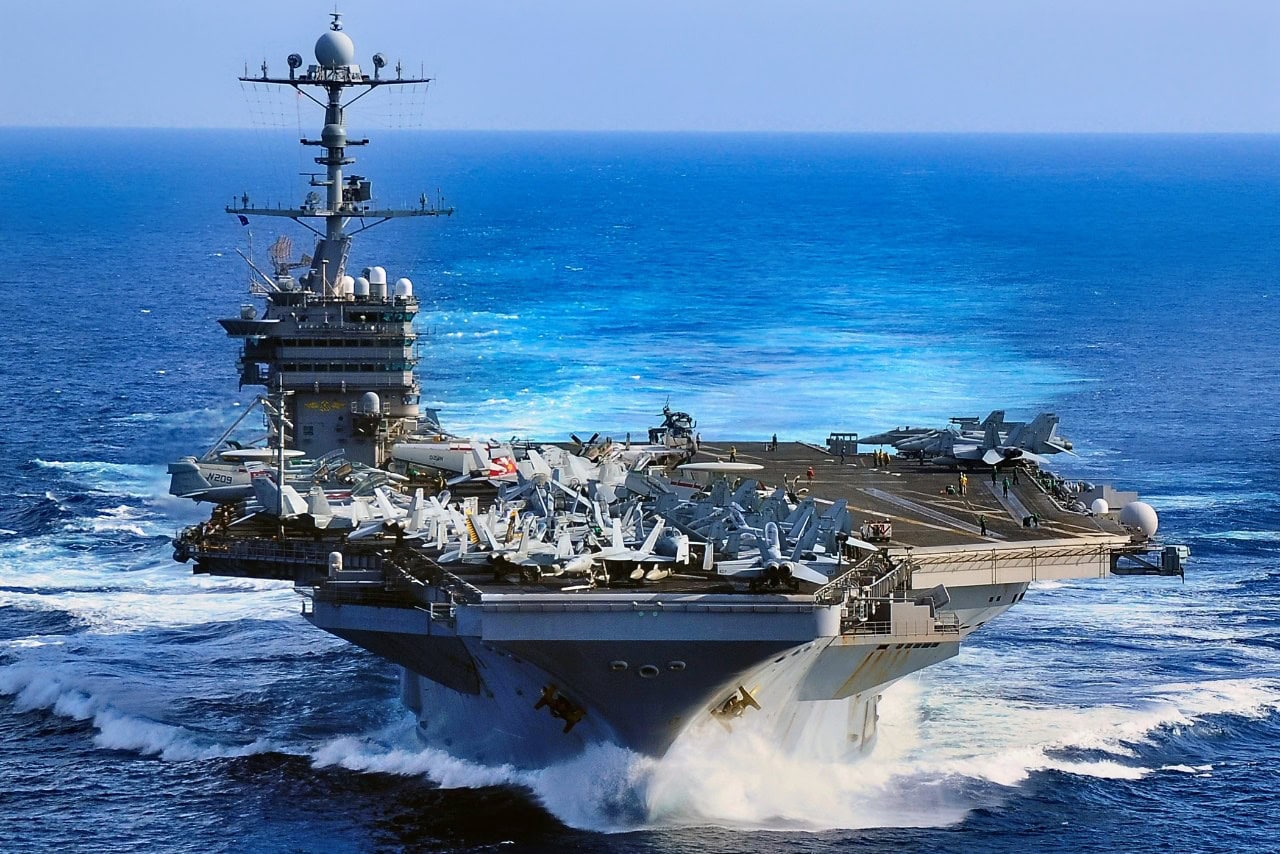
USNI News reported in its July 7 fleet tracker that USS George Washington (CVN-73) was operating in the Philippine Sea on its first patrol of 2026. The carrier strike group included Carrier Air Wing 5, cruiser USS Robert Smalls (CG-62), and destroyers USS Benfold (DDG-65) and USS Shoup (DDG-86). Destroyer USS Pinckney (DDG-91) was also operating in the Philippine Sea.
That is meaningful presence. It places a U.S. carrier air wing on the seaward side of Taiwan, close enough to complicate Chinese planning and reassure Japan and the Philippines. CVW-5 is not a visiting air wing. It is the forward-deployed U.S. naval aviation force built around the Western Pacific problem set. George Washington's return to the patrol cycle matters because carrier availability in the theater has been uneven, and the Navy has been stretched by Middle East demands, depot delays, and a fleet too small for the number of maps politicians ask it to cover.
But presence is not mass. A Nimitz-class carrier can generate enormous tactical power for a short period, but it cannot be everywhere in the first island chain at once. From the Philippine Sea, it is relevant to Taiwan, the Ryukyus, Luzon Strait, and the wider Philippine approaches. That same geography is the problem. The carrier is a high-value mobile airfield operating inside a theater increasingly covered by Chinese long-range sensors, submarines, bombers, and anti-ship missiles.
If the daily Chinese pattern around Taiwan is designed to normalize friction, the U.S. carrier pattern is designed to preserve uncertainty. Beijing wants Taipei to treat incursions as background noise while slowly raising the cost of response. Washington wants Beijing to look east of Taiwan and wonder where the carrier's aircraft, submarines, and escorts would be at H-hour. Both sides are using movement to shape assumptions.
The Math Favors Persistence Over Spectacle
There is a trap in reading Taiwan's daily PLA reports as a tension thermometer. The more useful question is how much capacity each side must spend to maintain the pattern. Beijing can rotate aircraft and ships through short-duration pressure missions from nearby bases. Taiwan must detect, classify, intercept, and message those movements without exhausting its air force. The United States must keep enough combat-credible naval presence nearby to make a Chinese planner hesitate, while also covering the Middle East, Europe, and homeland maintenance cycles.
That is not a balanced equation. China has the geographic advantage. Taiwan has interior clarity but limited depth. The United States has the most capable Navy in the world, but its relevant units are not measured by total battle force numbers. They are measured by what is actually west of Guam on a given morning.
The July 8 Taiwan report and the July 7 USNI fleet tracker describe the same military problem from opposite ends. Taipei sees aircraft and ships arriving daily around its airspace and waters. The U.S. Navy sees a carrier strike group in the Philippine Sea carrying deterrence weight that cannot be casually replaced if it is absent, delayed, or pulled to another crisis.
What To Watch Next
The next useful indicator is not whether the PLA aircraft count spikes for one day. It is whether the maritime count stays steady while aircraft vary. Sustained PLAN and official-ship presence around Taiwan is what turns air activity into an enduring pressure system. If Beijing can keep roughly a dozen hulls around Taiwan while adding aircraft on selected days, it gets a scalable coercion model: cheap on normal days, louder when politics require it.
The second indicator is U.S. carrier and destroyer continuity in the Philippine Sea and nearby waters. George Washington's first 2026 patrol is important because it shows the forward-deployed carrier back in the game. It does not erase the arithmetic problem. Deterrence in the Taiwan theater is not a press release about a carrier. It is the ability to keep ships, aircraft, magazines, repair capacity, and command networks in position long enough for Beijing to believe the bill for action would be immediate.
Twenty-one Chinese platforms around Taiwan in 24 hours is not the crisis. It is the baseline. That should bother Washington more than a spike would, because baselines are how militaries train the other side to live with disadvantage.
China deployed 21 military and government platforms around Taiwan from July 7 to July 8, 2026, including 9 aircraft and 12 ships. Four aircraft crossed the Taiwan Strait median line into Taiwan's air defense identification zone. The USS George Washington was operating in the Philippine Sea, providing a U.S. naval presence in the region. This ongoing military activity reflects China's strategy to maintain pressure on Taiwan.
- Taiwan detected 21 Chinese military and government platforms in 24 hours.
- 9 PLA aircraft sorties and 12 ships (9 PLAN and 3 official) were reported.
- Four aircraft crossed the Taiwan Strait median line into Taiwan's air defense identification zone.
- USS George Washington was operating in the Philippine Sea during this period.
- The presence of Chinese ships is intended to normalize military pressure on Taiwan.