
China's 10,000-Foot Antelope Reef Runway Will Lock Down the Paracels
 Marcus Chen
China's 10,000-Foot Antelope Reef Runway Will Lock Down the Paracels
China has already dredged 1,458 acres at Antelope Reef and graded roughly 4,300 feet of what looks like a future 10,000-foot runway. That is not a vanity project. It is Beijing turning the Paracel Islands from a patrol outpost into an operating base that can keep coast guard cutters, maritime militia, surveillance aircraft, and eventually combat aircraft on station for longer stretches in the northern South China Sea.
Reuters reported this week that the first phase of reclamation work appears complete, with dredgers gone from the scene and a China Coast Guard ship already using the new quay. Asia Maritime Transparency Initiative imagery adds the more important point: the island is now being shaped for infrastructure that matches the footprint of China's established military airfields elsewhere in the South China Sea. Put differently, this is the moment when dredging turns into basing.
What China Built in 10 Months
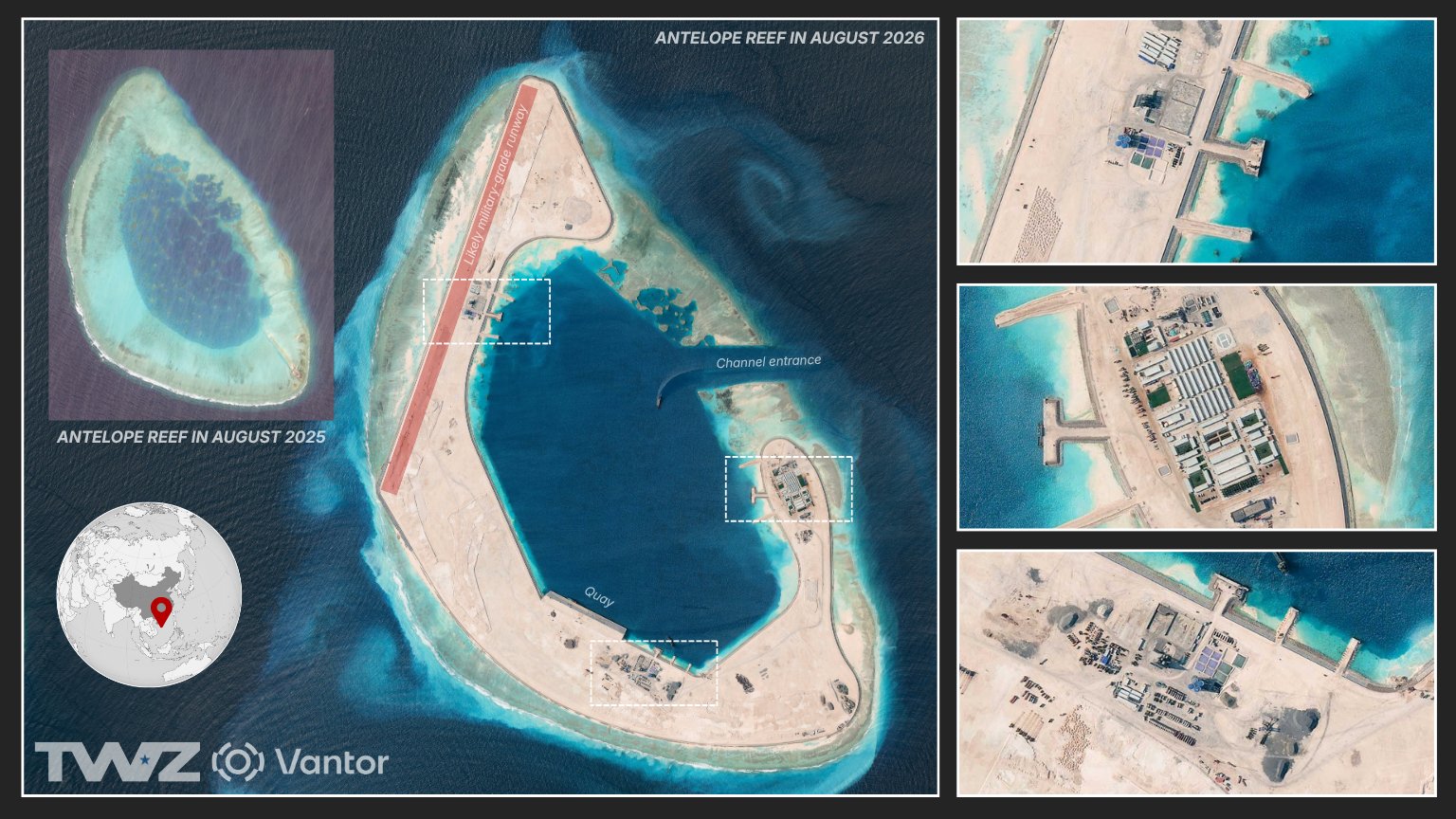
Antelope Reef sits about 160 nautical miles south of Hainan and roughly 200 nautical miles east of Da Nang. That geography matters. It places the reef well inside the Paracels but far enough south to extend China's surveillance and patrol envelope deeper into the sea lanes running across the northern half of the South China Sea.
- The reclaimed landmass now measures about 1,458 acres.
- The northwest edge is the only straight stretch long enough for a 10,000-foot runway, and AMTI says grading has begun there along a 180-foot width consistent with China's other island airstrips.
- A nearby 200-by-200-foot excavation matches the footprint of large aircraft hangars built at Fiery Cross, Subi, Mischief Reef, and Woody Island.
- The lagoon already includes a 680-meter quay, enough to berth coast guard and other large vessels inside sheltered waters.
- Two concrete plants are operating on the island, which is a good sign Beijing is moving from sand-moving to permanent construction.
The key point is speed. Older Spratly outposts took years to mature. Antelope moved from submerged reef to a 3.7-mile artificial island in less than a year. That tells you China's dredging and construction machine is faster, more standardized, and probably less politically constrained than it was during the first island-building wave.
Why the Paracels Matter More Than Another Patch of Sand
The question is not whether Antelope looks impressive from orbit. The question is what the base lets the PLA and the China Coast Guard do tomorrow that they could not do yesterday. Antelope Reef gives Beijing a new forward node tied directly to the force concentration around Hainan, where the PLA Navy's Yulin and Longpo facilities support carriers, major surface combatants, and submarines.
Even before a runway is fully paved, the island improves persistence. Coast guard ships can anchor, refuel, transfer personnel, and stage from a position much farther south than Hainan. Maritime militia vessels get another protected hub. Helicopters and small unmanned systems can work from the site earlier than fast jets can. Ground-based radar, communications gear, and electronic surveillance equipment can start paying off well before the first fighter ever lands.
As AMTI's Greg Poling put it earlier this year, the main benefit is probably the ISR component. He is right. The runway grabs headlines, but the sensing network is what changes daily operations first.
Anyone who has served at sea knows the difference between a ship that must sortie from a rear base and one that can loiter near the action with logistics close at hand. A cutter sailing from Hainan burns time and fuel just getting into position. A cutter sheltered at Antelope can spend more of its cycle on coercion. That is the real math here.
The Operational Payoff for Beijing
If Beijing finishes the runway to the dimensions AMTI expects, Antelope will be able to support the same class of aircraft China operates from its other South China Sea airfields. That means maritime patrol aircraft, transports, drones, and potentially fighters, depending on the support infrastructure eventually added. Beijing would gain another dispersal field south of Hainan, which matters in any crisis because fixed bases are vulnerable and aircraft survive by having places to move.
For peacetime competition, the payoff is even more immediate. China can thicken its coast guard and militia presence around the Paracels, normalize administrative control, and create another platform for radar and airborne patrols. For wartime planning, the island becomes one more anti-access and area-denial node feeding targeting data, hosting helicopters and drones, and complicating any attempt to operate freely in the northern South China Sea.
This also tightens pressure on Vietnam. Antelope Reef is not just a symbol in disputed waters; it sits uncomfortably close to the Vietnamese coast by South China Sea standards. The closer China pushes air and maritime support infrastructure toward Vietnam's approaches, the more Hanoi has to spend on monitoring, dispersal, and survivability instead of mass.
Washington Is Still Losing the Concrete Race
The United States and its partners like to talk about freedom of navigation, and they should. But navigation operations do not undo poured concrete. Once China turns a reef into an administrative center, then a harbor, then an airfield, the operational map changes whether Washington likes it or not.
That does not mean Antelope Reef is some silver bullet. A fixed island base is targetable. It cannot hide. In a shooting war, it would face missile attack and sustained surveillance. But that misses the point. Beijing is building for the long competition before the first shot, where persistence, presence, and local logistical depth matter more than invulnerability.
The sharpest takeaway is that China is still gaining favorable geography without firing a shot. Antelope Reef will not win a war by itself. It does something more useful: it makes the Paracels a denser, more self-sustaining operating zone for Chinese coercion in 2026 and beyond. The runway is only the visible part. The real story is that Beijing is hardening the entire northern South China Sea into a forward military system, one reclaimed acre at a time.
China has completed the first phase of reclamation at Antelope Reef, constructing a 10,000-foot runway to enhance military operations in the South China Sea. This development allows for increased presence of coast guard and military assets, improving logistics and operational capabilities in the region. The infrastructure supports various aircraft and strengthens China's strategic position near Vietnam.
- China has dredged 1,458 acres at Antelope Reef.
- A 10,000-foot runway is under construction.
- The island will support coast guard and military operations.
- Two concrete plants are operational on the island.
- The base enhances China's military presence in the South China Sea.