
China's 2-to-1 Shipbuilding Lead Is Rewriting 2026 Pacific Sea Power
 Marcus Chen
China's 2-to-1 Shipbuilding Lead Is Rewriting 2026 Pacific Sea Power
China built 636,208 tons of combat ships in 2024 and 2025. The United States built 270,509 tons. That is a 2.35-to-1 production advantage, according to the World Defense Shipbuilding report presented ahead of Euronaval 2026 and reported by Defense News.
One number does not win a naval war. But it changes the arithmetic of every war plan. The United States still operates the larger combat fleet: 3.11 million tons above 200 tons on Jan. 1, 2026, compared with China’s 1.44 million. The problem is the direction of travel. Two years earlier, the American lead was 3.22 million to 1.30 million tons. China is not merely adding ships; it is closing the stock gap while expanding the yards that replace losses.
The Production Gap Is the Real Story
The comparison is not a clean measure of combat power. Tonnage counts hulls, not crews, sensors, missiles, maintenance cycles, or training. A nuclear-powered attack submarine and a large amphibious ship are not interchangeable. Nor does a Chinese yard’s output automatically translate into a carrier strike group that can fight at American distances.
Still, production capacity is the foundation beneath those capabilities. China’s 2024-25 output was more than triple its 2022-23 figure of 202,520 tons. In the same comparison, U.S. production rose only from 245,703 tons to 270,509 tons, a modest increase that looks less impressive beside Beijing’s acceleration. China also accounted for more than one-third of global combat-vessel tonnage in the latest period.
That is the part Washington cannot solve with a new concept of operations. If a destroyer, submarine, or logistics ship is lost in a Pacific war, the replacement question begins in a shipyard. The answer may arrive years later, after the campaign that required it.
Numbers Become Operational Pressure
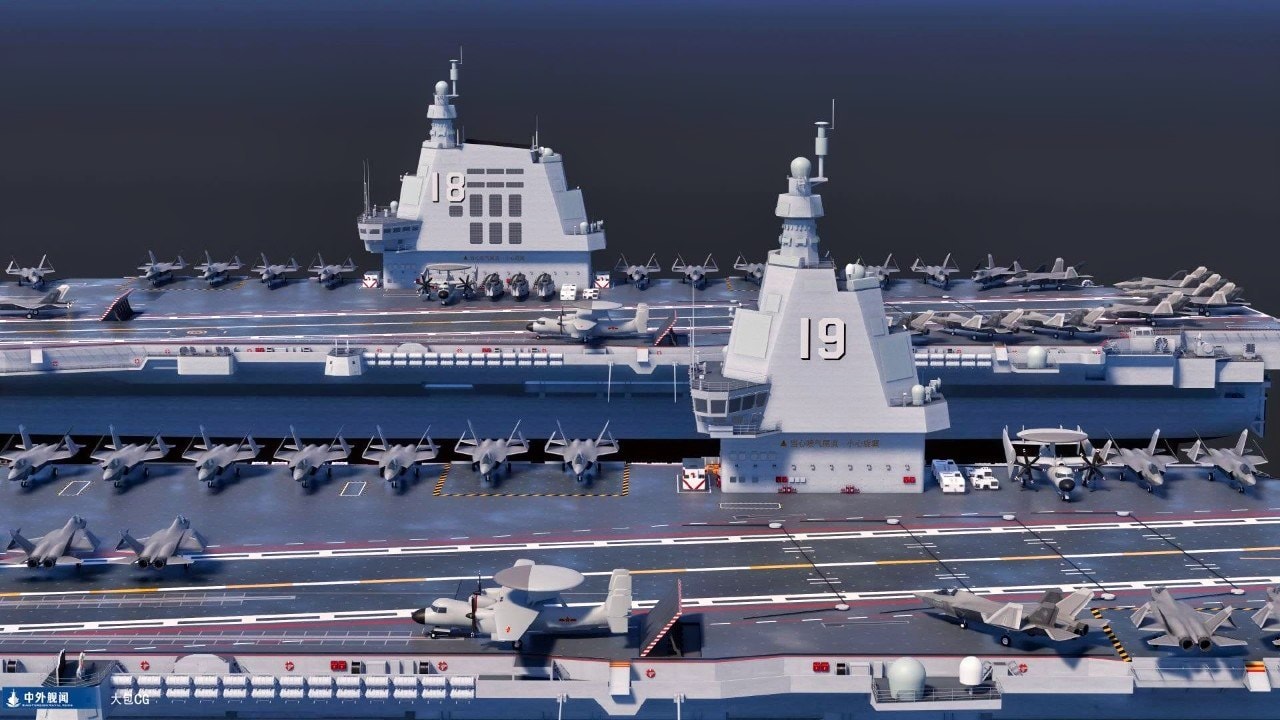
China’s carrier force illustrates how industrial output becomes presence. The Defense News report on the October deployment of CNS Liaoning described a 305-meter carrier operating with two large destroyers and a guided-missile destroyer. The ship is the oldest of China’s three carriers and probably not Beijing’s preferred frontline reaction force. That is precisely why the deployment matters.
Liaoning can train air wings, validate sensors, exercise escorts, and expose crews to long-range operations while Fujian and Shandong absorb lessons. Its voyage near Japan’s southwestern islands, Taiwan, and the Philippines was described by analysts as part of an evolving routine rather than a one-off demonstration. China is turning an aging hull into a training and experimentation asset while its newer carriers remain available for higher-end tasks.
Operational tempo is not just about how many ships a navy owns on paper. It is about how many can be in maintenance, training, transit, and combat at the same time. A larger industrial base gives Beijing more options to distribute those demands. It can accept a higher training tempo, sustain more simultaneous patrols, and replace older hulls without creating an immediate hole in the line.
Why the U.S. Lead Is Less Comfortable
The United States retains advantages China has not erased: a mature nuclear-submarine force, global logistics, combat-tested alliances, undersea experience, and a carrier aviation system with decades of institutional depth. The U.S. Navy does not need to match every Chinese hull one for one. A Virginia-class submarine, a B-21-supported strike network, or a distributed Marine anti-ship unit can impose costs that raw tonnage does not capture.
But those advantages are perishable if the industrial base cannot sustain them. Congressional researchers and lawmakers have repeatedly pointed to delays, workforce shortages, supplier bottlenecks, and cost growth in American naval shipbuilding. The issue is not whether the U.S. can design a better ship. It is whether it can produce enough of the right ships before the first crisis consumes the inventory.
The two-to-one figure also complicates allied planning. Japan, Australia, the Philippines, and Taiwan do not see a theoretical ship-count contest. They see Chinese hulls appearing in the East China Sea, the Philippine Sea, and the South China Sea while American ships rotate through a global demand signal. Allies can add sensors, bases, submarines, and missiles, but they cannot compensate for every shortfall in U.S. fleet availability.
The War-Planning Consequence
Washington should stop treating shipbuilding as a domestic procurement problem and start treating it as a theater-level warfighting variable. The immediate priority is not another promise that a future class will arrive on schedule. It is a credible plan for munitions, repair capacity, unmanned systems, tankers, and smaller combatants that can be produced in volume and dispersed across the Pacific.
China’s advantage is not that every Chinese warship is better than its American counterpart. Its advantage is that Beijing is learning how to convert industrial scale into repeated operations. The Liaoning’s routine deployments are one visible piece of that system; the shipyard numbers are the less visible piece.
The United States still has the larger fleet. China is building the faster replacement cycle.
That distinction will matter more than the fleet scoreboard if a Taiwan contingency lasts months instead of days. The math is not yet a Chinese victory. It is a warning that American sea power is spending a legacy advantage faster than the shipyards are rebuilding it.
Sources
- Defense News, “China built more than twice naval tonnage of US in 2024-25: Euronaval,” Oct. 20, 2026.
- Defense News, “China’s first aircraft carrier forms ‘evolving pattern’ of voyages in disputed Asian seas,” Oct. 23, 2026.
- World Defense Shipbuilding report by Flottes de Combat and Gican, presented ahead of Euronaval 2026.
China built 636,208 tons of combat ships in 2024-2025, significantly outpacing the U.S. Navy's 270,509 tons. This expansion allows China to close the tonnage gap and enhance its naval presence in the East China Sea, Philippine Sea, and South China Sea. The U.S. Navy, while still larger, faces production challenges that could impact its operational readiness in future conflicts.
- China built 636,208 tons of combat ships in 2024-2025, compared to 270,509 tons by the U.S.
- China's naval production capacity has tripled since 2022-2023.
- China accounts for over one-third of global combat-vessel tonnage in the latest period.
- The U.S. Navy retains advantages in nuclear submarines and logistics, but faces production challenges.
- China's carrier force is evolving with routine deployments and training operations.