
China's 2026 PL-16 Missile Turns Tankers Into First Targets
 Marcus Chen
China's 2026 PL-16 Missile Turns Tankers Into First Targets
Two hundred to 300 kilometers is the number that matters. If the reported range of China's PL-16 beyond-visual-range air-to-air missile is even close, the problem is not whether a J-20 can shoot down an F-35 in a clean fighter duel. The problem is what happens to the slow aircraft behind the fighter screen: E-7 and E-2 airborne early warning aircraft, KC-46 and KC-135 tankers, P-8 patrol aircraft, and the communications nodes that make a U.S.-led air campaign over the western Pacific function.
Defense News reported this week that analysts are treating the PL-16 as China's answer to Lockheed Martin's AIM-260 Joint Advanced Tactical Missile. The reported missile is said to use dual-pulse or variable-thrust propulsion, giving it a late-flight energy reserve after the first motor burn. That matters more than the headline range. A missile that arrives at the terminal phase with enough energy to maneuver is a different weapon than a missile that merely glides into the endgame with a large number on a brochure.
The Missile Is Aimed At The Air Campaign, Not The Fighter
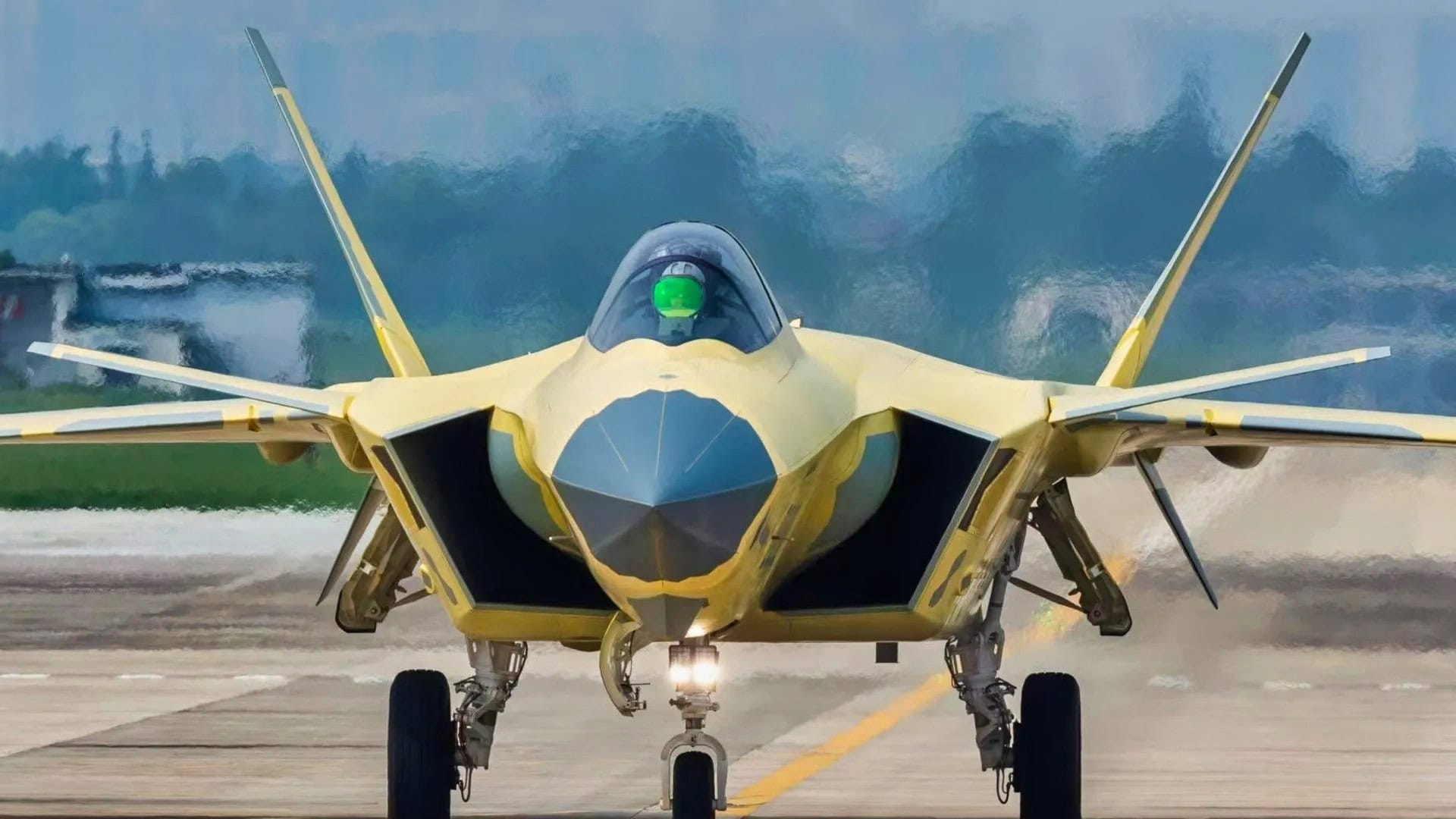
The useful way to read the PL-16 story is as an attack on the support architecture. Malcolm Davis of the Australian Strategic Policy Institute told Defense News that the People's Liberation Army Air Force logic is to hit the enablers that let U.S. and allied aircraft project naval air power. That is exactly how the math looks from a cockpit or a combat information center. The tanker is not glamorous, but the tanker decides how long the package stays in the fight.
Guam is roughly 2,700 kilometers from Taiwan. Kadena Air Base in Okinawa is much closer, but it is also within range of Chinese missile forces and would be under pressure early in a crisis. Carrier air wings can move, but carriers still need airborne early warning, tanking, and a layered screen. If Chinese J-20s can push a long-range air-to-air threat 200 to 300 kilometers beyond the fighter line, U.S. planners must either pull support aircraft farther east or spend scarce fighters protecting them.
That is the trade. Every fighter assigned to defend a tanker orbit is one less fighter available to escort strike aircraft, contest airspace, or protect maritime patrol aircraft hunting submarines. Anyone who has served around a carrier strike group knows that the schedule is built around fuel and sensor coverage. Break those cycles and the operation starts to shrink.
Six Missiles Per J-20 Changes The Sortie Arithmetic
The reported internal-carriage detail is also important. Huang Chung-ting of Taiwan's Institute for National Defense and Security Research told Defense News that a J-20 able to carry four PL-15 missiles might carry as many as six PL-16s if the new weapon is smaller. That claim remains unconfirmed, but it is operationally meaningful.
A four-missile stealth fighter has to be selective. A six-missile stealth fighter can prosecute more targets, keep one or two weapons in reserve, or stay on station after the first engagement. In a large air battle over the Philippine Sea or the approaches to Taiwan, that extra magazine depth multiplies quickly. A four-ship J-20 element would move from 16 long-range missiles to 24. An eight-aircraft package would move from 32 to 48. That is not decisive by itself, but it changes how many intercepts a U.S. commander must plan against before the Chinese fighters need to turn home.
The caveat is real. Beijing has not confirmed the PL-16 program, its range, its propulsion method, or whether the missile is in mass service. The open-source picture appears to rely on leaked seminar material, trade-media reporting, and analyst reconstruction. That should make readers careful, not dismissive. Chinese air-to-air missile development has already moved from the PL-12 to the PL-15 in a way that forced the United States to accelerate its own beyond-visual-range missile work. The direction of travel is not speculative.
AIM-260 Is A Production Question
The U.S. answer is supposed to be the AIM-260 JATM, a classified successor to the AIM-120 AMRAAM designed to restore reach against Chinese and Russian air threats. Public details are limited, but the basic purpose is clear: give U.S. fighters a missile that can reach farther than the AMRAAM without requiring an aircraft redesign. Defense News notes that the JATM is expected to reach at least 200 kilometers and to use extra propulsion for beyond-visual-range engagements.
The question is not whether Lockheed Martin and the U.S. Air Force can build an exquisite missile. They can. The question is whether they can build enough of them fast enough, integrate them across the F-22, F-35, F/A-18E/F, and allied fleets, and stockpile them in theater before a crisis. A missile that exists in low-rate production is not the same as a missile available in the magazines at Kadena, Andersen, Iwakuni, and aboard deployed carriers.
This is where China's advantage may be less about physics than tempo. If PL-16 moves into quantity faster than AIM-260, the western Pacific air balance shifts before the first shot. The United States would still have better pilots, networks, and combat experience in many areas. But long-range missile inventory is a brutally simple problem. You either have enough shots, or you do not.
The Taiwan Scenario Gets Harder At The Edges
In a Taiwan contingency, U.S. and allied airpower would be trying to do several hard things at once: defend bases, protect sea lanes, strike launchers, suppress air defenses, keep submarines and surface combatants under watch, and maintain command-and-control links across a contested electromagnetic environment. None of that works well if tankers and airborne warning aircraft have to retreat hundreds of kilometers from useful orbits.
Moving support aircraft east is survivable, but it burns time and fuel. Fighter escorts must fly longer transits. Tanker tracks become more crowded. Crews spend more of each sortie commuting and less of it fighting. The PL-16 does not have to shoot down many tankers to impose that cost. It only has to make commanders believe the tanker orbit is inside a credible threat envelope.
That is why the PL-16 story deserves attention even with imperfect sourcing. It points to the kind of air war China wants: not a cinematic clash of aces, but a campaign to push U.S. eyes, fuel, and command nodes far enough away that the first island chain becomes harder to defend on schedule.
The counter is not a press release about next-generation missiles. It is production, dispersal, hardened bases, more tankers, more decoys, and enough long-range weapons in theater to absorb the first week of losses. If Washington treats PL-16 as a fighter-versus-fighter problem, it will miss the target. China is aiming at the air campaign itself.
China's PL-16 missile, with a range of 200 to 300 kilometers, is designed to target support aircraft in air campaigns, impacting U.S. operations. The People's Liberation Army Air Force aims to disrupt U.S. air power projection by targeting tankers and early warning aircraft. The J-20 fighter may carry up to six PL-16 missiles, enhancing its operational capacity. The U.S. is responding with the development of the AIM-260 missile to counter these threats.
- China's PL-16 missile has a reported range of 200 to 300 kilometers.
- The missile is designed to target support aircraft, impacting U.S. air operations.
- The J-20 fighter may carry up to six PL-16 missiles, increasing its strike capability.
- The U.S. is developing the AIM-260 missile as a counter to Chinese air threats.
- The operational effectiveness of U.S. air campaigns may be compromised by the PL-16's capabilities.