
China's 244-Ship Pressure Campaign Is Rehearsing a Taiwan Blockade
 Marcus Chen
China's 244-Ship Pressure Campaign Is Rehearsing a Taiwan Blockade
China put 244 coast guard, research and other government ships around Taiwan in July. That is nearly eight hulls a day before you add a single PLAN destroyer. Taiwan's defense ministry then reported that in the 24 hours ending Monday morning, the PLA sent four aircraft, six naval ships and four official vessels into the operating picture around the island, with three of the aircraft crossing the median line into the northern air defense identification zone. On paper, four aircraft does not look like a crisis. In practice, that is the point. Beijing is building control through repetition, not drama.
This is what blockade preparation looks like before a blockade starts. The Chinese military does not need to flood the Taiwan Strait with an invasion armada every morning. It needs enough gray-zone traffic to make Chinese presence routine, enough research vessels to map the battlespace, and enough coast guard hulls to turn jurisdiction into muscle memory. The math is changing faster at sea than in the air.
The Campaign at Sea
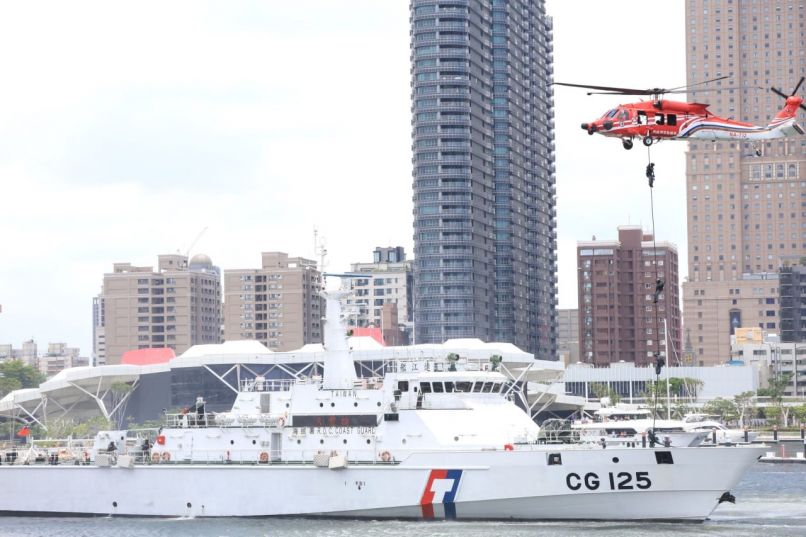
According to Taipei Times, citing Taiwan's Coast Guard Administration, 60 percent of the Chinese vessels detected near Taiwan last month were coast guard ships, with research vessels and other state-owned craft making up the rest. The 244-ship figure was up from 55 in June and 30 in May. In the first 21 days of August alone, the number was already 152. Those totals do not include Chinese warships, which means the coercion campaign is wider than the military daily count most outsiders focus on.
The details matter. Taiwan says it is tracking about 41 Chinese ships operating in its waters. The research ship Tong Ji circled Taiwan in May along the edge of restricted waters, behavior the coast guard assessed as linked to oceanographic sampling and seabed survey work. Another ship, Xiang Yang Hong 03, operated in waters overlapping the exclusive economic zones of Taiwan and Japan while moving over deep trenches and telecommunications cables. Analysts cited by Taipei's coast guard say this kind of data feeds Chinese anti-submarine warfare databases. Anyone who has served around surface ships knows what that means: this is not just presence for television. It is preparation for where submarines can hide, where allied forces can maneuver, and where they can be found.
The escort pattern is just as revealing. According to Taiwanese analysts, Chinese research vessels are now operating with China Coast Guard escorts and, in at least one observed case, maritime militia support. That is a more complete package than a lone survey ship. It suggests Beijing is rehearsing an integrated state presence in waters it does not control but intends to dominate.
Why the Air Numbers Mislead
Taiwan's Ministry of National Defense said that in the 24 hours ending at 6 a.m. on August 31, it detected four PLA aircraft sorties, six PLAN ships and four official ships around Taiwan, and that three of the four aircraft crossed the median line into the northern ADIZ. If you only count sorties, you can talk yourself into thinking pressure is easing. If you count time on station and the number of gray hulls maintaining contact, the pattern looks different. Air incursions are the alarm bell. The ships are the occupation of attention.
That distinction matters because control does not mean Beijing owns the battlespace today. It means China is trying to make every future contingency start from a position of familiarity for its own forces and fatigue for Taiwan's. A war at sea is won partly by firepower, but it is also won by charts, acoustic data, routine access and practiced command relationships. Beijing is collecting all four.
Taiwan's Answer Has to Be Sustainable
Taiwan is not ignoring the problem. Defense Minister Wellington Koo said this month that Taipei is building layered defenses through intelligence fusion, coastal surveillance, domestically produced unmanned systems, counter-drone programs and what he called the "Taiwan Dome." He also backed a NT$210 billion special budget for unmanned systems aimed at surveillance drones, attack drones and one-way unmanned surface vessels. That is the right direction because the island cannot answer a persistent gray-zone fleet with fighter scrambles alone.
Han Kuang 42 pointed the same way. The exercise incorporated 20,000 reservists, civil-military coordination, communications disruption drills and U.S.-influenced command practices. Those are useful adaptations. But the real test is whether Taiwan can sustain maritime domain awareness and denial at a lower cost than China can sustain pressure. That's the gap.
Harpoons, coastal missile batteries and mobile drones matter. So do coast guard hulls, passive sensors, undersea surveillance and enough command bandwidth to separate a research ship from a feint. If Beijing can keep an average of nearly eight non-naval government vessels around Taiwan every day, then the opening phase of a quarantine may not begin with missile launches. It may begin with a traffic pattern that has already been normalized.
The Bottom Line
This is not an invasion fleet. It is something more useful for Beijing: a rehearsal for sea control without open war. China is learning the waters, stressing Taiwan's response cycle and turning civilian-state shipping into an operational tool. Taiwan's best response is not to chase every gray hull with expensive readiness hours. It is to build a cheaper, denser surveillance-and-denial network that makes Chinese persistence less productive.
If Taipei cannot do that, the first island chain problem gets harder in a very specific way. China will not need to seize control of the Taiwan Strait in one violent stroke. It will have already spent months teaching everyone to live with a Chinese operating picture on Taiwan's doorstep. That is how deterrence erodes: not with a single breakthrough, but with a new baseline.
China has deployed 244 ships, including coast guard and research vessels, around Taiwan as part of a pressure campaign rehearsing a blockade. In August 2023, Taiwan detected 152 ships in its waters, alongside military aircraft incursions. The PLA's activities aim to normalize Chinese presence and prepare for potential future operations against Taiwan.
- China deployed 244 ships around Taiwan in July 2023.
- In August 2023, 152 ships were already detected near Taiwan in the first 21 days.
- Taiwan's defense ministry reported four PLA aircraft and six naval ships operating around Taiwan.
- Chinese research vessels are operating with coast guard escorts, indicating integrated state presence.
- Taiwan is enhancing its defense capabilities with unmanned systems and layered defenses.