
China's De Ruyter Expulsion Shows Europe's 2026 South China Sea Risk
 Marcus Chen
China's De Ruyter Expulsion Shows Europe's 2026 South China Sea Risk
The Dutch Navy sent roughly 200 sailors and one NH90 helicopter into the Indo-Pacific. China answered with maritime and air forces, verbal warnings, and what its own military media described as warning electronic jamming around the Paracel Islands on May 27.
That is the useful number here: one frigate. HNLMS De Ruyter is not a token patrol boat. It is a De Zeven Provincien-class air-defense and command frigate, the sort of ship European governments point to when they want to prove they still have blue-water reach. But the encounter shows how thin that reach becomes when it is pushed into a battlespace where China owns the nearby bases, the air picture, and the escalation ladder.
A Small Incident With Real Operational Weight
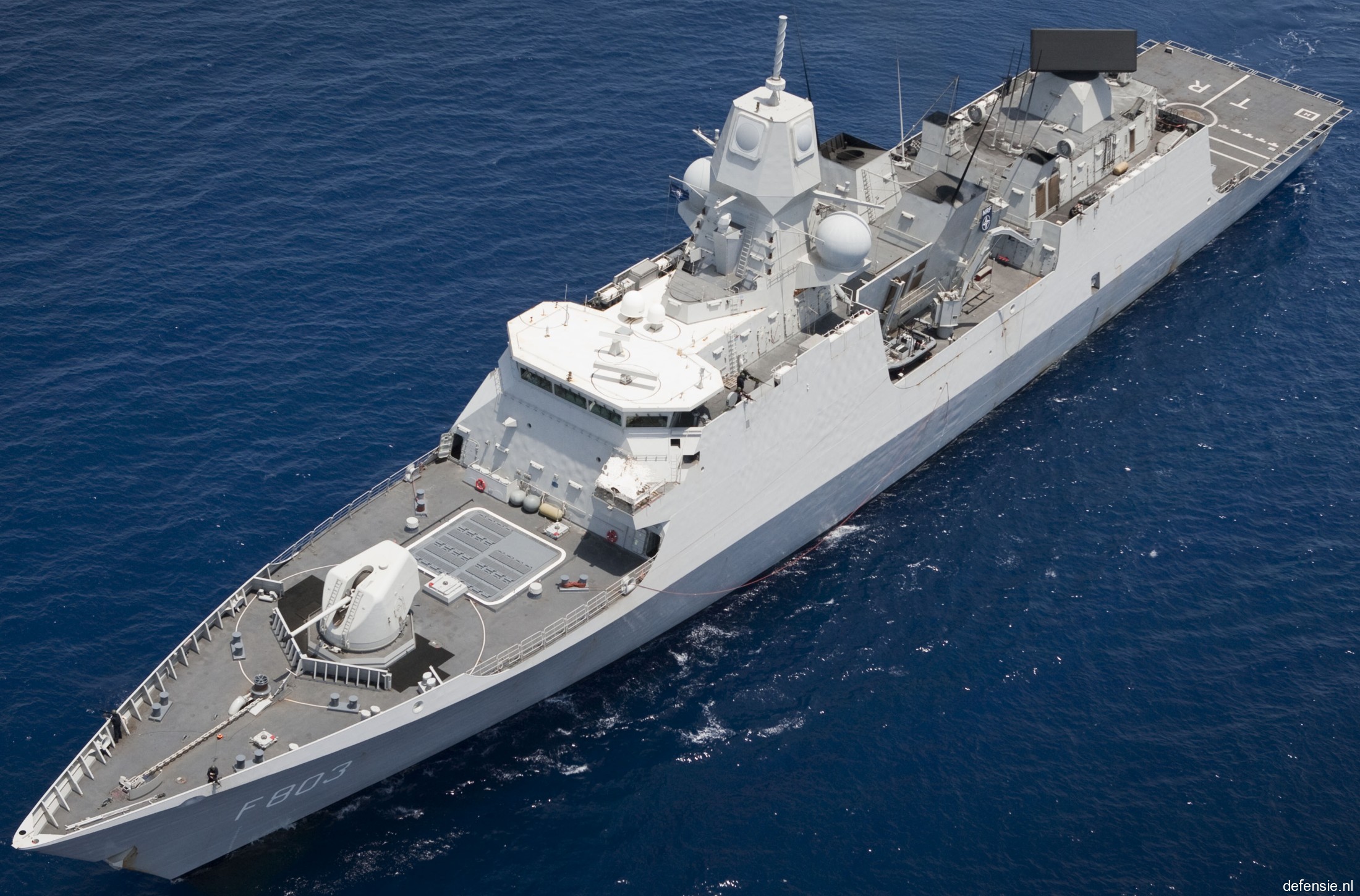
According to the PLA Southern Theater Command statement carried by Global Times and Xinhua, De Ruyter entered waters China claims around Xisha Qundao, better known internationally as the Paracel Islands. Beijing said the ship repeatedly launched its embarked helicopter and accused the aircraft of entering Chinese-claimed airspace. The command said it organized naval and air forces to drive the frigate away.
Strip out the propaganda language and the operational picture is still important. A NATO navy conducted a presence mission through a contested sea. China did not merely shadow it. It escalated the encounter into an electronic-warfare warning, at least according to its public account. That matters because electronic interference is not a press-release maneuver. It affects sensors, radios, datalinks, aircraft recovery, and command discipline.
Anyone who has served on a destroyer or frigate knows that the helicopter is often the ship's longest arm. It extends surveillance, identification, and sometimes anti-submarine reach well beyond the horizon. If that helicopter is being warned off, jammed, or forced into conservative flight profiles, the ship's effective patrol box shrinks. A frigate with a helicopter in the air is one thing. A frigate that cannot safely operate the helicopter near a contested island group is a much smaller military instrument.
De Ruyter Is Capable But Not Built for Alone Time
The Dutch Ministry of Defence said on April 10 that De Ruyter left for a five-month Indo-Pacific deployment with about 200 crew, an NH90 maritime helicopter, and a mission to support free passage and secure maritime routes. The same release noted an awkward detail: the ship's Oto Breda 127 mm gun is not currently operational while awaiting a future replacement. The ministry said the gun was not needed for the deployment and that the ship had other self-defense means.
That is true, but it is also incomplete. De Ruyter's real value is not naval gunfire. The class carries a 40-cell Mk 41 vertical launch system for SM-2 and Evolved Sea Sparrow Missiles, Harpoon anti-ship missiles, torpedoes, advanced air-search radars, and command facilities. It is a serious escort. In a NATO task group, it helps manage the air picture and defend other ships. Alone in the South China Sea, it is still a high-end frigate, but it is also a single radar horizon moving past Chinese shore-based aircraft, missiles, surveillance systems, and coast guard networks.
That is the mismatch. The Netherlands can deploy one excellent ship. China can answer from a theater command.
The Paracels sit roughly 180 nautical miles from Hainan and far closer to Chinese operating bases than to any Dutch support point. De Ruyter's endurance and sensors let it show presence. They do not change the geography. If an encounter escalates from shadowing to jamming, the Dutch commander must protect crew, aircraft, and mission without nearby national reinforcement. That forces caution, and Beijing understands that.
Europe Is Buying Signaling With Scarce Hulls
The Dutch deployment is not happening in isolation. Australia, Canada, and the United States conducted a South China Sea transit in April, according to the Australian Department of Defence. Quad ministers voiced concern this week over South and East China Sea behavior. The Philippines has been drawing more partners into its maritime security network. Europe is trying to show that the South China Sea is not merely a US-China problem.
The political logic is sound. The operational math is less forgiving.
European navies do not have many deployable air-defense frigates. Every ship sent east is a ship not in the North Atlantic, Mediterranean, Red Sea, or Baltic approaches. De Ruyter's itinerary proves the point. The Dutch plan had the ship moving through the Red Sea for EU Aspides, across the Indian Ocean, into Southeast Asia, toward North Korea sanctions enforcement, then on to RIMPAC and Pacific Dragon near Hawaii before returning by way of the Caribbean. That is not a regional deployment. It is a global task list assigned to a single hull.
China can afford to make each European patrol expensive. It does not need to fire a missile or ram a ship. It can shadow, warn, jam, publicize, and force commanders to spend attention on tactical safety instead of strategic messaging. That is classic sea denial below the threshold of combat. The point is not to defeat De Ruyter. The point is to make the next cabinet meeting in The Hague ask whether the patrol was worth the risk.
The Paracels Are Becoming a Test Range for Resolve
The South China Sea is often discussed as if it were one broad waterway. It is not. The Paracels, Spratlys, Scarborough Shoal, and Luzon Strait create different tactical problems. The Paracels are especially useful for Beijing because China controls them physically, Vietnam and Taiwan also claim them, and most external navies do not have the appetite to contest every excessive maritime claim there in detail.
That gives China room to define normal behavior by repetition. If a Dutch helicopter flight is treated as an airspace violation, and if the response includes electronic jamming, Beijing is not just reacting to one frigate. It is writing a playbook for the next Canadian, Australian, British, French, or Japanese patrol.
Washington should pay attention because allied presence is supposed to reduce the burden on the US Navy. It only works if allies can operate without becoming isolated tactical liabilities. A single European frigate inside China's preferred escalation zone is politically useful, but militarily fragile. The answer is not to stop patrols. It is to stop pretending that one hull equals a sustained coalition posture.
If Europe wants a real South China Sea role, it needs repeatable rotations, shared logistics, common electronic-warfare reporting, and rules for what happens when China moves from radio warnings to interference. Otherwise these deployments remain what De Ruyter just demonstrated: brave, visible, and easy for Beijing to pressure one ship at a time.
The Dutch Navy's HNLMS De Ruyter conducted a presence mission near the Paracel Islands on May 27, prompting a response from China that included electronic jamming and naval forces to drive the frigate away. The incident underscores the challenges European navies face in the South China Sea, where China's military capabilities dominate the region.
- The Dutch Navy deployed HNLMS De Ruyter with 200 sailors and an NH90 helicopter to the Indo-Pacific.
- China responded with naval and air forces, including electronic jamming, on May 27.
- The De Ruyter was accused of violating Chinese airspace during its mission.
- The ship's Oto Breda 127 mm gun was not operational during the deployment.
- The incident highlights the risks of European naval presence in the South China Sea.