
China’s Latest 100-Vessel Surge Makes a Taiwan Blockade Regional
 Marcus Chen
China's Latest 100-Vessel Surge Makes a Taiwan Blockade Regional
More than 100 Chinese vessels is not an invasion fleet. It is something more useful for Beijing right now: a rehearsal for stretching Taiwan, Japan, the Philippines, and the United States across the same maritime problem at the same time.
Taiwan National Security Council chief Joseph Wu said on May 23 that Chinese navy, coast guard, and other vessels had been deployed across waters from the Yellow Sea to the South China Sea and the Western Pacific over the previous few days, soon after the Beijing summit between Donald Trump and Xi Jinping. AFP, carried by The Straits Times, reported the same figure and geographic spread. A Taiwan security official told AFP that the numbers rose above 100 in recent days.
The Taiwan Strait count by itself looked ordinary. Taiwan's Ministry of National Defense reported 16 PLA aircraft and eight PLAN ships around the island from 6 a.m. May 22 to 6 a.m. May 23, with 13 aircraft crossing the median line and entering northern, central, southwestern, and eastern air defense identification zones. That is pressure, but not shock pressure. The larger point is that the visible Taiwan box score misses the fleet architecture around it.
The Problem Is Not Eight Ships Near Taiwan
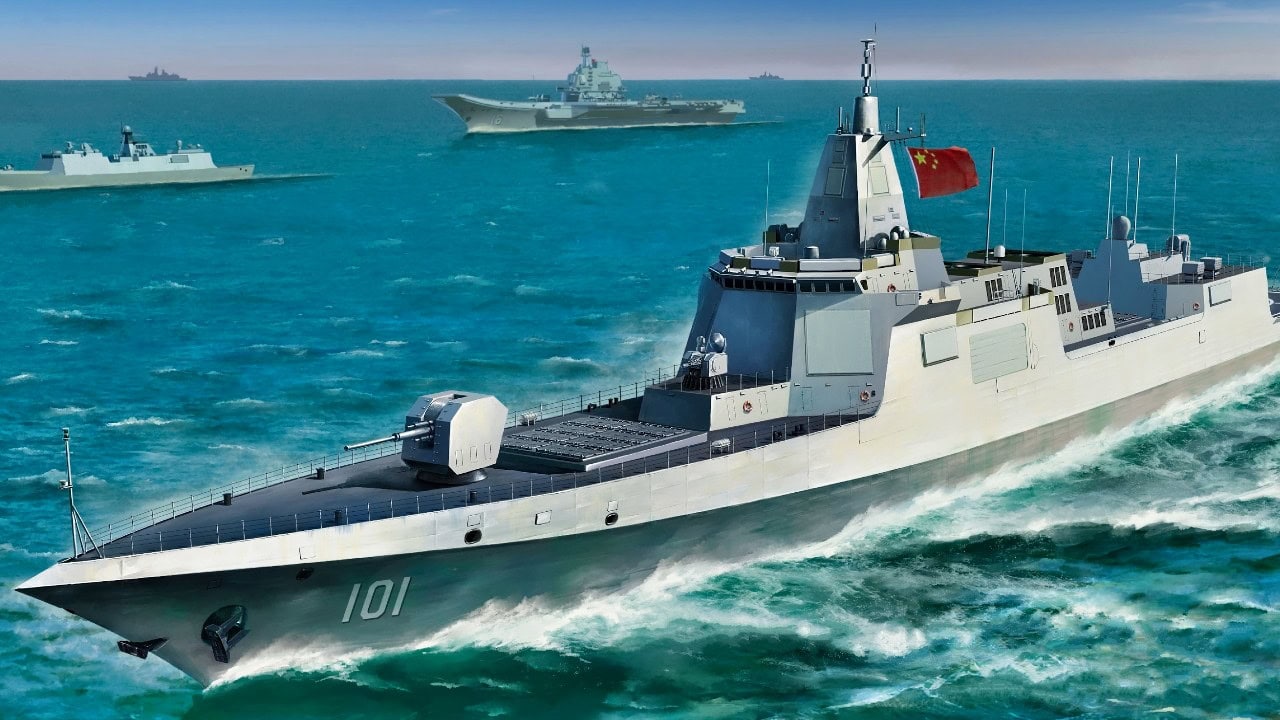
Anyone who has stood watch on a destroyer knows that the ships closest to the charted flashpoint are not always the decisive ones. The screen, the pickets, the shadowers, the coast guard cutters, and the replenishment ships define how hard the operating problem becomes. If Beijing has more than 100 hulls spread from the Yellow Sea through the South China Sea and out into the Western Pacific, the operational question is not whether each vessel is a high-end combatant. It is whether China can create simultaneous friction across every approach to Taiwan.
A Taiwan blockade would not be a neat ring around the island. It would be a regional maritime control campaign. The northern lane runs through the East China Sea and the Ryukyus. The eastern lane depends on access into the Philippine Sea. The southern lane is tied to the Bashi Channel and the Luzon Strait. The southwest lane blends into the South China Sea, where China already uses coast guard and maritime militia presence to normalize coercion below the shooting threshold.
That is why the number matters. One hundred vessels distributed across four or five maritime sectors can put 15 to 25 hulls in each sector while keeping a reserve for rotation, escort, and reaction. Even if half are coast guard or auxiliary ships, the math still forces allied commanders to sort contacts, identify intent, protect commercial shipping, and decide which gray-zone moves justify escalation.
China Is Practicing a Regional Contact Problem
The latest deployment fits a pattern the Pentagon has already described. The 2025 Department of Defense report on Chinese military power said the PLA improved coordination with the China Coast Guard around Taiwan in 2024 and that coast guard operations near Kinmen and Matsu increased from eight restricted-water entries per week in 2023 to 13 per week in 2024. The same report noted that China conducted 38 joint combat readiness patrols around Taiwan in 2024, a near-weekly cadence designed to test air and naval interoperability.
Those numbers should be read together. Beijing is not only building a larger navy. It is building a habit of integrated presence. The People's Liberation Army Navy provides the hard edge. The China Coast Guard provides law-enforcement ambiguity. Maritime militia and other state-linked vessels provide mass, surveillance, and plausible deniability. A 100-vessel surge is therefore not a single formation. It is a distributed command-and-control problem imposed on everyone else.
The United States and its partners just finished a useful counter-demonstration. Balikatan 2026 put 17,000 personnel from the Philippines, the United States, Canada, France, Japan, Australia, and New Zealand along the Philippine western seaboard, according to South China Morning Post. Defense News reported that the exercise included a maritime strike event in which partner forces sank two decommissioned ships.
That kind of live-fire training is valuable, but it solves only one slice of the problem. Sinking a known target during a scheduled exercise is not the same as discriminating between a coast guard cutter, a fishing vessel, an auxiliary ship, and a missile-armed combatant in a crowded sea lane under political pressure. Beijing is trying to make that distinction harder before the first missile flies.
Arms Sales Delays Make the Signal Worse
The timing also lands badly for Washington. Taiwan has been waiting for a new U.S. arms package that Reuters has reported could be worth up to $14 billion, and Defense News reported on May 22 that Taipei said it had not been notified of any pause after a senior U.S. official suggested some foreign military sales were being delayed to preserve U.S. munitions stocks for the Iran war.
For Taiwan, the weapons that matter most in this scenario are not prestige systems. They are coastal anti-ship missiles, mobile air defense, mines, drones, secure communications, and enough reloads to keep firing after the first 72 hours. A blockade attempt is a magazine contest as much as a fleet contest. If Chinese vessels can stay on station and Taiwan runs short of shots, the blockade works even without a beach landing.
Washington has a bad habit of treating Taiwan arms sales as diplomacy with hardware attached. Beijing treats maritime pressure as operations with diplomacy attached. That difference matters. A delayed missile battery is not just a procurement issue; it is a gap in the kill chain that Chinese planners can measure.
The U.S. Navy Cannot Answer Everywhere
The U.S. Navy can break a blockade in theory. In practice, it has to arrive, sustain, and sort the battlespace while protecting bases and logistics nodes from Chinese missile forces. The Pentagon report lists Chinese conventional strike systems that cover the theater: DF-21 and DF-17 ranges of roughly 1,500 to 2,000 kilometers, DF-26 at 3,000 to 4,000 kilometers, and H-6 bomber anti-ship reach measured in the thousands of kilometers when aircraft radius and missile range are combined. That does not make U.S. intervention impossible. It makes every sortie and every replenishment run expensive.
This is where the first island chain stops being a slogan. If Chinese ships are active near Taiwan, the Ryukyus, the South China Sea, and the Western Pacific at the same time, the United States has to choose where scarce high-end assets go first. A carrier strike group cannot be in the Luzon Strait, east of Taiwan, and near the Senkakus at once. Destroyers can cover more water, but only by thinning their missile magazines and increasing their dependence on forward logistics.
China does not need to win sea control everywhere. For a blockade, it needs to deny confidence. Insurers hesitate. Commercial carriers reroute. Taiwan burns fuel and food stocks faster than planned. Allied governments argue over thresholds. That is the point of a regional 100-vessel surge.
The Real Warning
The right response is not to panic over a single Chinese deployment count. Some vessels will return to port. Some may be counted twice by outside observers. Some are probably doing routine presence missions under a louder political spotlight.
But the operational lesson is clear. Beijing is practicing the ability to turn a Taiwan crisis into a first island chain crisis. That forces Washington and its allies to defend not a point on the map, but a system of sea lanes, ports, sensors, airfields, and political decisions.
The blockade rehearsal is becoming regional. If the U.S. and its partners keep answering it with island-by-island plans and delayed munitions pipelines, the math will keep moving in China's direction.
China deployed over 100 naval and coast guard vessels across the Yellow Sea, South China Sea, and Western Pacific in recent days, indicating a rehearsal for a potential blockade of Taiwan. Taiwan reported 16 PLA aircraft and 8 PLAN ships in its vicinity, while the U.S. faces delays in arms sales to Taiwan, affecting its military readiness. This deployment reflects China's strategy to create simultaneous pressure across multiple maritime approaches to Taiwan.
- China deployed over 100 vessels across multiple maritime regions including the Yellow Sea and South China Sea.
- Taiwan reported 16 PLA aircraft and 8 PLAN ships around the island during a specific timeframe.
- The deployment is part of a rehearsal for a potential blockade of Taiwan.
- The U.S. is experiencing delays in arms sales to Taiwan, impacting its defense capabilities.
- China is improving coordination between its navy and coast guard for operations around Taiwan.