
China's Liaoning Carrier Just Flew 170 Deck Cycles Near Japan
 Marcus Chen
China's Liaoning Carrier Just Flew 170 Deck Cycles Near Japan
One hundred and seventy carrier takeoffs and landings in three days is the number that matters. Japan's Joint Staff reported on June 1 that the People's Liberation Army Navy carrier Liaoning conducted roughly 80 launch-and-recovery events on May 26, 50 on May 27, and 40 on May 28 while operating in the Western Pacific south of Japan's southwestern islands. That averages about 57 deck cycles a day. For a ski-jump carrier that Western analysts still too often treat as a training platform, the sortie math deserves more attention than the usual adjectives about Chinese naval ambition.
Liaoning is not a US Navy supercarrier. It does not have catapults. Its J-15 fighters take off from a ski jump, usually trading fuel or weapons load for the physics of short takeoff. Its air wing lacks the same airborne early warning depth that a Nimitz or Ford-class carrier can put overhead. But the latest Japanese tracking does not show a museum piece. It shows a carrier group moving, generating flight operations, and practicing the work of staying useful outside the First Island Chain.
The Japanese Track Is Operationally Specific
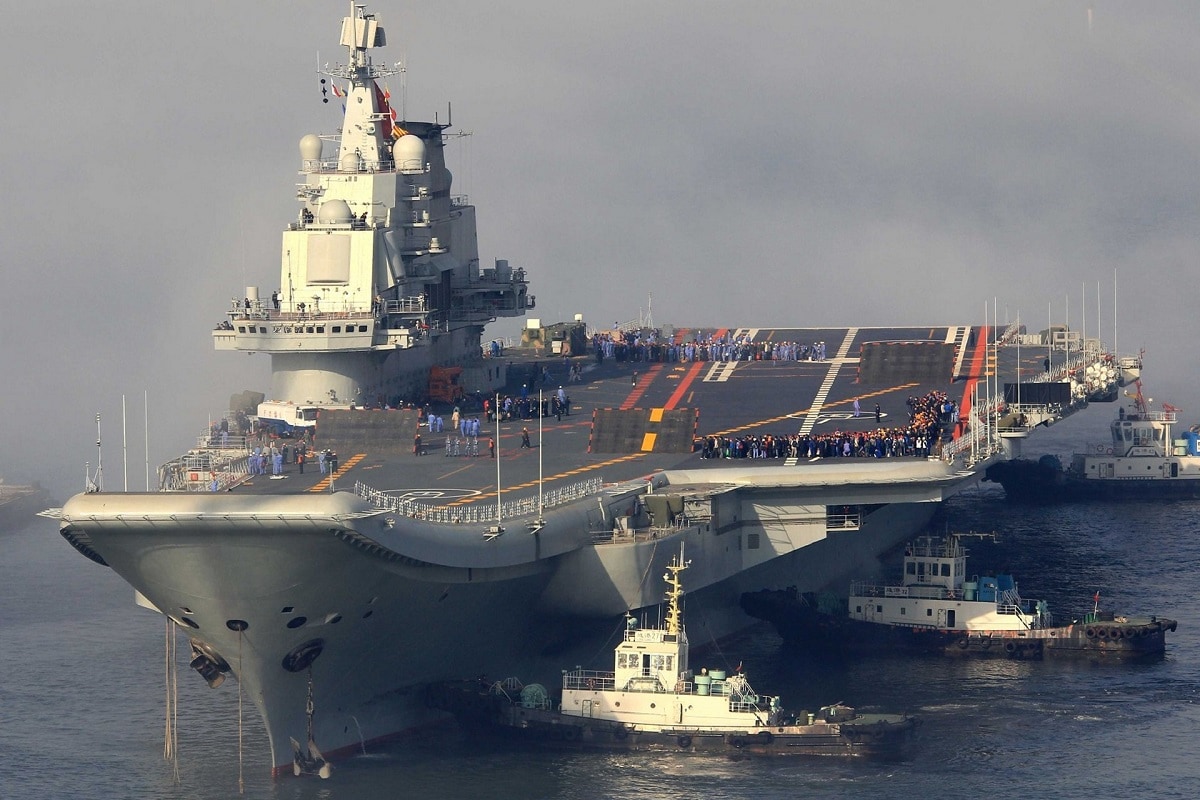
Japan's May 28 release placed five Chinese vessels about 880 kilometers southwest of Okinotorishima on May 25: Liaoning, a Renhai-class Type 055 destroyer, a Luyang III-class Type 052D destroyer, a Jiangkai III frigate, and a Fuyu-class fast combat support ship. The June 1 update then tracked the group across several positions: about 1,090 kilometers southwest of Okinotorishima on May 26, about 790 kilometers south of Miyako Island on May 27, about 590 kilometers southwest of Miyako on May 28, and then southeast in waters east of the Philippines on May 29.
That geography matters. A carrier east or southeast of the Philippines is not conducting a Taiwan Strait photo opportunity. It is operating in the outer maritime space where US, Japanese, Philippine, and Australian planners would want room to maneuver in a Taiwan contingency. It is also where a Chinese carrier does not need to defeat the US Navy in a blue-water duel to be useful. It only needs to complicate US and allied air, surface, and surveillance operations long enough to impose delay.
This Was Not Just Liaoning Alone
The escort list is more important than the carrier hull. A Type 055 destroyer gives the group a large-area air defense and command ship with 112 vertical launch cells. A Type 052D adds another modern air-defense and anti-surface combatant. The Fuyu-class Type 901 support ship is the endurance piece. Without it, the carrier group is an excursion. With it, the group starts to look like a deployable package.
The frigate is also worth noting. Multiple open-source reports identified hull 545 as Luohe, the new Type 054B or Jiangkai III frigate. If that identification is correct, this was one of the first visible integrations of China's newest frigate design into a carrier task group. The 054B is larger than the older 054A and is generally assessed as a better anti-submarine and escort platform. Carrier aviation gets the headlines, but anyone who has served on a destroyer knows the escort screen is where the real endurance problem lives. A carrier group that cannot protect itself from submarines is not a carrier group. It is a target with flight-deck markings.
The Sortie Rate Is Modest And Still Important
Fifty-seven deck cycles per day would be unimpressive next to an American carrier in wartime surge conditions. A Nimitz-class ship can generate far more aircraft sorties if the air wing, weapons elevators, deck crews, and logistics chain are all aligned. But that comparison can be misleading. Liaoning is a conventional, ski-jump carrier derived from the Soviet Kuznetsov design. Its value is not measured by whether it can match USS Ronald Reagan or USS Carl Vinson sortie for sortie. Its value is whether the PLAN can make repeatable deck operations routine at distance.
On that measure, the trend is moving in Beijing's favor. Three days of flight operations, tracked by a capable Japanese surveillance system, suggest a crew that is practicing rhythm rather than symbolism. Launch, recover, refuel, reposition, maintain, repeat. That is the carrier business. It is boring until it is not.
The limitation is equally clear. A ski-jump J-15 launched from Liaoning cannot carry the same fuel and weapons combination that a catapult-launched fighter can. Without a fixed-wing airborne early warning aircraft, the group still leans on helicopters, shipborne sensors, and land-based support where available. The coming Fujian, with electromagnetic catapults, is the ship that could change the ceiling of Chinese carrier aviation. Liaoning is not that ship. But Liaoning is training the people, escorts, and command habits that Fujian will need.
The US Answer Is Bigger Exercises But Not More Time
Washington's counterpoint arrives later this month. US Pacific Fleet says RIMPAC 2026 will run from June 24 to July 31 with 31 nations, about 40 surface ships, five submarines, 140 aircraft, and more than 25,000 personnel. That is a serious coalition exercise. It also highlights the asymmetry. The United States demonstrates alliance mass at scheduled intervals. China is now showing that it can put a carrier group into the Western Pacific and keep it working while everyone else watches the track lines.
Those are different kinds of military pressure. RIMPAC builds interoperability. Liaoning builds familiarity with the operating areas where a crisis would unfold. The first is necessary. The second is cumulative. Every transit through the Miyako area, every day of deck cycles south of Japan, and every escort integration gives PLAN crews more local knowledge. Charts, currents, weather windows, communications discipline, replenishment timing, Japanese response patterns. These details do not appear in strategy documents. They decide whether ships keep fighting after day three.
Taiwan Is The Near Problem But Not The Whole Problem
Taiwan's Ministry of National Defense reported 18 PLA aircraft, eight PLAN ships, and six official ships around Taiwan from 6 a.m. June 2 to 6 a.m. June 3, with 14 aircraft crossing the median line or entering Taiwan's northern and southwestern air defense identification zone. That daily pressure is now routine. The carrier activity south of Japan is the outer layer of the same campaign.
In a Taiwan scenario, China's first objective would not be to send Liaoning into a cinematic carrier battle. More likely, a carrier east of Taiwan or east of the Philippines would help stretch allied surveillance, threaten less-defended approaches, cover maritime militia and surface groups, and force US commanders to allocate scarce submarines, long-range missiles, and patrol aircraft across a wider map. That is sea denial by operational nuisance. It does not need to be elegant. It needs to consume attention and magazines.
The US and Japan still have better carriers, better submarines, better anti-submarine experience, and a deeper network of allies. But superiority is not the same as unchallenged access. The 170-cycle Liaoning run is a small data point with a large message: the PLAN is getting more comfortable operating where US planners would prefer it to remain uncomfortable.
The old line was that China's first carrier was a training ship. That was true. It is less useful every year. A training ship that can take a Type 055, a Type 052D, a new frigate, and a fast combat support ship into the Western Pacific while cycling aircraft for three straight days is no longer just training. It is rehearsing the geography of a future fight.
Sources
- Japan Joint Staff Office, June 1, 2026, Chinese naval vessel movements and Liaoning flight operations.
- Japan Joint Staff Office, May 28, 2026, Activities of Chinese Navy Aircraft Carrier.
- Taiwan Ministry of National Defense, June 3, 2026, PLA activities around Taiwan.
- U.S. Indo-Pacific Command, April 17, 2026, RIMPAC 2026 announcement.
The People's Liberation Army Navy's Liaoning aircraft carrier conducted 170 deck cycles over three days from May 26 to 28, 2026, in the Western Pacific, south of Japan. The carrier group included five vessels, demonstrating operational capabilities and rehearsing for potential future military engagements. This activity complicates US and allied operations in the region, indicating a shift in the PLAN's operational comfort.
- Liaoning conducted 170 deck cycles from May 26 to 28, 2026.
- The carrier group included five vessels: Liaoning, a Type 055 destroyer, a Type 052D destroyer, a Jiangkai III frigate, and a Fuyu-class support ship.
- The group operated in the Western Pacific, south of Japan's southwestern islands.
- The carrier's operations are seen as a rehearsal for future military engagements.
- The sortie rate indicates increasing operational capability of the PLAN.