
China's Type 076 Drone Carrier Changes the Taiwan Strait Math
 Marcus Chen
China's Type 076 Drone Carrier Changes the Taiwan Strait Math
A 40,000-ton Chinese amphibious ship has just done something the People's Liberation Army Navy could not do a year ago: launch and recover a stealth combat aircraft at sea. The Type 076 Sichuan (hull 51) completed its first reported flight operation with the GJ-21 unmanned combat aerial vehicle last week, according to a November 2 report by USNI News citing a PLAN release.
That is not a carrier battle group. It is not proof that Beijing has solved autonomous aviation, deck-cycle management, or maritime command and control. But it is a meaningful change in the Taiwan Strait problem. China is testing a cheaper way to put persistent reconnaissance and strike aircraft inside the contested zone without risking a pilot or tying up a conventional fighter carrier.
The Platform Is Big Enough to Matter
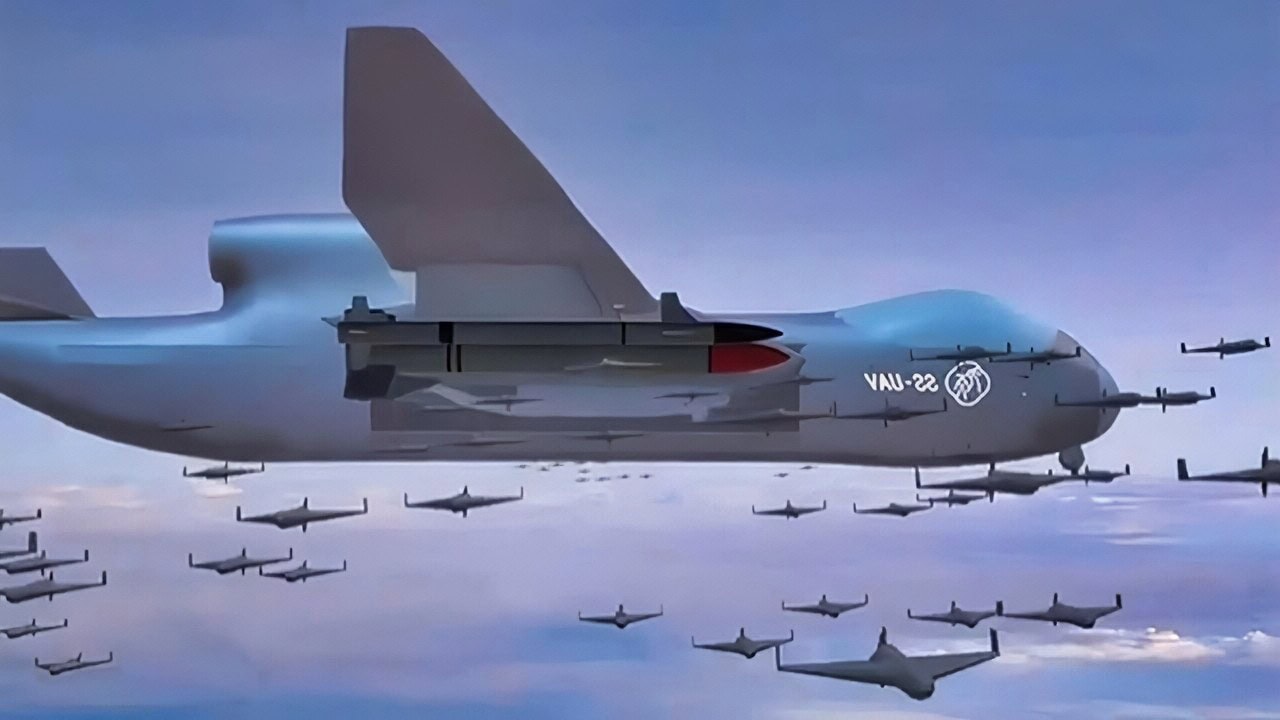
Sichuan is the first Type 076 and builds on China's Type 075 landing helicopter dock design. USNI News reports a displacement of roughly 40,000 tons, an electromagnetic catapult, and a dedicated aviation island. The combination matters. A helicopter deck can operate rotary-wing aircraft and short-takeoff systems; a catapult gives the ship a path to launch fixed-wing unmanned aircraft with useful fuel and payload fractions.
The GJ-21 is described by the PLAN as a stealthy reconnaissance-strike drone. Public information remains thin: China released a graphic, not operational video, and has not published the aircraft's range, payload, sortie rate, or datalink architecture. Those omissions are important. A stealth airframe that can launch once is a technology demonstration. A force that can generate sorties every few minutes, maintain the aircraft, and pass targeting data to ships and missiles is a combat capability.
Still, the deck test moves the discussion from artist's impressions to integration. The ship began its maiden sea trial in November 2025 and has spent the intervening year completing system and stability tests. The sequence suggests Beijing is treating the platform as an operational experiment, not merely a prestige hull.
This Is About Persistence, Not Air Superiority
The wrong comparison is to a US Ford-class or Nimitz-class carrier. Sichuan will not provide the same fighter numbers, airborne early warning, defensive counter-air, or sustained strike capacity. Its value is narrower and potentially more useful: keep unmanned eyes over the approaches to Taiwan, the Bashi Channel, or a surface group while conventional carriers remain farther away.
In a Taiwan contingency, the first question is not whether China can win a clean carrier duel. It is whether Chinese commanders can maintain a usable picture of the sea and keep enough weapons in the air after US, Japanese, and Taiwanese forces attack bases and large ships. A mobile drone carrier gives Beijing another node in that sensing network. It can launch, relocate, and force an opponent to spend expensive interceptors or long-range fires against a platform that is less politically and operationally costly than a manned carrier.
That creates an awkward exchange-rate problem. Defenders may have to use a surface-to-air missile, an aircraft sortie, or a submarine-launched weapon to remove an unmanned sensor-strike aircraft. China can replace some of those aircraft faster than it can replace a J-20 pilot or a carrier air wing. The arithmetic favors the side that can produce and distribute acceptable losses.
China Is Building a Distributed Drone Architecture
Sichuan should not be viewed in isolation. CSIS's February 2026 review of Chinese activity in 2025 found record or near-record operational tempo around Taiwan, 163 recorded Chinese operations in the South China Sea, and increased carrier activity beyond the First Island Chain. The trend is a larger operating system: more sensors, more patrols, more launch points, and more opportunities to impose uncertainty on an opponent.
USNI News has also reported Chinese work on containerized electromagnetic launchers and vertical-launch systems carried by a merchant ship concept. That does not mean every Chinese freighter is about to become a drone carrier. It does mean the PLA is exploring multiple ways to distribute aviation and missile functions across military and civilian hulls. A Type 076 is the most visible version of that experiment; a containerized launcher is the cheaper version.
The operational benefit is redundancy. Taiwan and the United States can plan against a known carrier strike group. They have a harder problem when surveillance drones come from air bases, amphibious ships, converted merchant vessels, and conventional carriers at the same time. The goal is not to make every platform powerful. It is to make the network difficult to suppress.
The Weak Points Are Still Severe
There is no reason to assume the Type 076 has solved the hard parts. Electromagnetic catapults require reliable power generation and maintenance. Stealth drones need secure communications, navigation in a jamming environment, and enough onboard autonomy to continue a mission when the link is degraded. Recovery operations are demanding even in calm water; wartime weather, smoke, electronic attack, and deck damage make them worse.
Doctrine is another gap. The PLAN has not publicly explained whether the GJ-21 will support marine forces, scout for carrier groups, conduct electronic attack, or deliver weapons. Each mission requires different payloads, control arrangements, and rules for identifying targets. An unmanned aircraft does not remove the command problem. It moves that problem into software, networks, and headquarters.
Nor does one ship change the balance by itself. Sichuan is a sole hull. It needs escorts, replenishment, air defense, maintenance teams, trained operators, and a protected operating area. If it must remain close to the Chinese coast, its survivability improves but its reach shrinks. If it moves toward Taiwan, its exposure rises sharply. That is the tradeoff.
The Conclusion Is Uncomfortable
China's Type 076 is not a replacement for a fleet carrier, and it is not evidence that a Taiwan invasion is imminent. It is more consequential than both of those headlines suggest. Beijing is testing whether unmanned aviation can make maritime surveillance and precision strike persistent, distributed, and politically cheaper.
The United States and Taiwan should measure the platform by the number of targeting cycles it enables, not by the number of aircraft it carries. If a drone carrier helps China find ships, cue missiles, and keep pressure on the strait after the first wave of attacks, it has done its job even if the ship never enters the center of the fight. The Type 076 does not give China sea control. It gives China another way to deny it.
Sources
- USNI News, November 2, 2026: China's New Drone Carrier Launches, Recovers First Autonomous Combat Aircraft
- USNI News, November 14, 2025: Next-Generation Chinese Amphibious Assault Ship Holds First Sea Trial
- USNI News, January 7, 2026: Chinese Merchant Ship Sports Electromagnetic Drone Launcher, Vertical Launching Systems
- CSIS ChinaPower, February 5, 2026: Tracking China's Increased Military Activities in the Indo-Pacific in 2025
China's Type 076 Sichuan completed its first flight operation with the GJ-21 unmanned combat aerial vehicle in the Taiwan Strait in November 2026. This development marks a significant advancement in China's military capabilities, allowing for persistent reconnaissance and strike operations without risking pilots. The Type 076 is designed to enhance China's maritime surveillance and complicate defense strategies for the United States and Taiwan.
- China's Type 076 Sichuan launched and recovered a GJ-21 drone at sea for the first time.
- The Type 076 has a displacement of approximately 40,000 tons and features an electromagnetic catapult.
- The GJ-21 is described as a stealthy reconnaissance-strike drone, but details on its capabilities are limited.
- The Type 076 is part of China's strategy to enhance maritime surveillance and strike capabilities in the Taiwan Strait.
- China is exploring distributed drone architecture to complicate defense planning for adversaries.