
Chinese Coast Guard Inspects 198 Vessels East of Taiwan, Warnings from the US, UK, France, and Germany Shake Japan's SLOC Defense
 Tanaka Takashi
Chinese Coast Guard Inspects 198 Vessels East of Taiwan, Warnings from the U.S., U.K., France, and Germany Shake Japan's SLOC Defense
In the waters east of Taiwan, commercial vessels are asked via radio about their departure and destination. It is an event without gunfire, but for those who have observed maritime traffic for a long time, this appears not merely as harassment but as a slow operation to establish jurisdiction as a fait accompli.
According to a report by Reuters on June 24, the United States, United Kingdom, France, and Germany issued warnings regarding the activities of the Chinese Coast Guard in the waters east of Taiwan, stating that they threaten regional stability and freedom of navigation. The joint statement from the Taiwan liaison offices of the U.K., France, and Germany is particularly noteworthy, as it indicates a shift in European interest not only to the western side of the Taiwan Strait but also to the open sea east of Taiwan.
What the Numbers of Coast Guard Activities Indicate
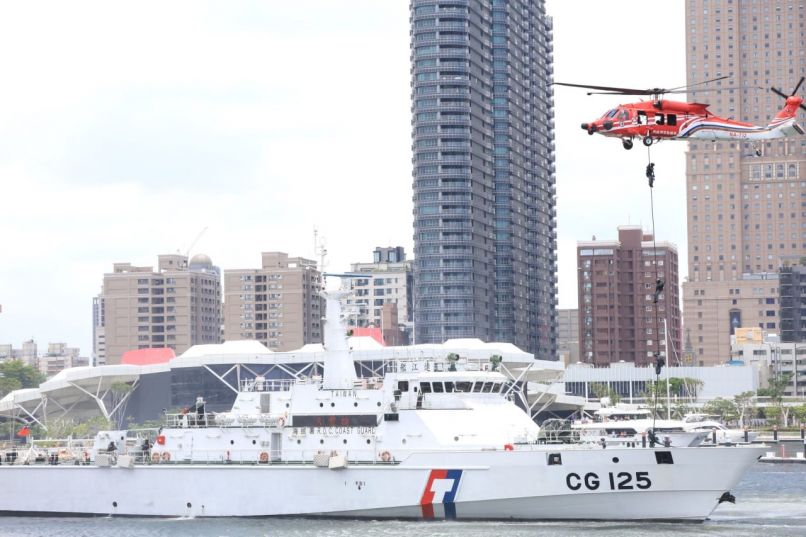
The Chinese side claims to have confirmed 198 transiting vessels during this "special maritime traffic law enforcement operation" and has rectified violations for three of them. It is also reported that they conducted hydrographic surveys in the same waters and cruised around undersea cables. The Taiwanese side explains that at least three commercial vessels were asked by the Chinese Coast Guard for information regarding their departure and destination, asserting Chinese jurisdiction.
What should not be overlooked here is not the combat capability of the Coast Guard vessels themselves. The issue is that the three actions of law enforcement, surveying, and cruising around the cables overlapped in the same maritime area. This is not a blockade by warships, but it has the effect of teaching commercial vessels, insurance companies, and undersea communication operators that "there is a possibility of receiving Chinese confirmation in this maritime area."
The East of Taiwan is Not a Back Door
When discussing a Taiwan contingency, attention often turns to the front of the Taiwan Strait. However, from the perspective of the Japan Maritime Self-Defense Force (JMSDF), the waters east of Taiwan are not a rear area but rather a sea of sustained combat capability. The line from off Hualien to Yonaguni, Ishigaki, Miyako Island, and reaching Okinawa Island involves all aspects of air operations, resupply, evacuation, and intelligence gathering.
For Japan, this is not an abstract "Taiwan issue." The defense of the Nansei Islands involves not only protecting the islands but also safeguarding SLOCs (Sea Lines of Communication) and undersea cables. If the Chinese Coast Guard can stage a semblance of jurisdiction east of Taiwan, the next question will be the response speed of the U.S. and Japan if the same methods are used around the Senkaku Islands or the Miyako Strait.
Practical Implications of the Joint Statement from the Three European Countries
The U.K., France, and Germany do not have formal diplomatic relations with Taiwan. Nevertheless, they jointly expressed concerns through their Taiwan liaison offices this time. In the author's view, this move is closer to aligning legal terminology rather than military deterrence. The European side countered the activities that China calls "law enforcement" with vocabulary such as "freedom of navigation," "safety of seafarers and vessels," and "opposition to unilateral changes to the status quo."
This unification of vocabulary may seem understated in peacetime. However, in times of crisis, it will serve as a foundation connecting joint statements, sanctions, naval deployments, and maritime insurance decisions. The U.K.'s carrier strike group, France's Indo-Pacific deployment, and Germany's port diplomacy are each limited in isolation, but if they share the same maritime awareness, their political effect will increase.
Two Blind Spots Japan Should Consider
- First, the response to Coast Guard activities is not solely the issue of the Japan Coast Guard. The speed of information sharing among the JMSDF, Japan Coast Guard, Ministry of Internal Affairs and Communications, and private communication operators will be tested.
- Second, the crisis east of Taiwan will arise not only as a matter of protecting Japanese bases but also as an issue of commercial shipping traffic. Not only the number of escort ships but also ports, tugboats, and repair capabilities will be part of deterrence.
During the Cold War, the JMSDF considered SLOC defense by tracking Soviet submarines. The current difficulty lies in the fact that the adversary combines not only submarines but also Coast Guard vessels, survey ships, civilian ships, and legal claims. The more white ships come to the forefront, the more gray judgments increase.
The number of 198 vessel inspections east of Taiwan does not signify the beginning of a blockade. However, it is a number that should be sufficiently monitored as an attempt to obscure whose permission is required for navigation in peacetime.
Reference Information
- Reuters / U.S. News, Reported on June 24, 2026
- Taipei Times, June 10, 2026, Report on inquiries by the Chinese Coast Guard to commercial vessels
- Defense News, June 24, 2026, Article distributed by Reuters
The real challenge is not just how many Chinese Coast Guard vessels can be monitored. It is about when the U.S., Japan, Europe, and Taiwan will treat the incremental jurisdiction of white ships as a security issue.
The Chinese Coast Guard inspected 198 vessels in Eastern Taiwan waters, asserting jurisdiction and prompting warnings from the U.S., U.K., France, and Germany about threats to regional stability. Taiwan reported that vessels were questioned about their routes, indicating a strategic move by China to establish control over maritime traffic. This situation raises concerns for Japan regarding the security of its sea lines of communication (SLOC).
- Chinese Coast Guard inspected 198 vessels in Eastern Taiwan waters.
- The U.S., U.K., France, and Germany issued warnings regarding these activities.
- Taiwan reported that vessels were asked for their departure and destination information.
- The activities are seen as an attempt to assert jurisdiction in the region.
- The report highlights the implications for Japan's SLOC defense.