
Chinese Navy 103, 124, and 903 Southbound through the Tsushima Strait to Reassess Japan's Sea Defense Line in 2026
 Tanaka Takashi
Chinese Navy 103, 124, and 903 Descend South Through the Tsushima Strait, Prompting a Reassessment of Japan's Maritime Surveillance Line for 2026
Around 9 PM on August 2, three ship silhouettes confirmed about 50 kilometers north of Tsushima were too significant in formation to be treated merely as passing vessels. According to the Ministry of Defense's Joint Staff Office, the three ships of the Chinese Navy—Type 055 Renhai-class missile destroyer 103, Type 052D Luyang III-class missile destroyer 124, and Type 901 supply ship 903—were advancing southwest in the same maritime area, descending through the Tsushima Strait from August 2 to 3, heading towards the East China Sea.
What the Combination of 103 and 124 Signifies
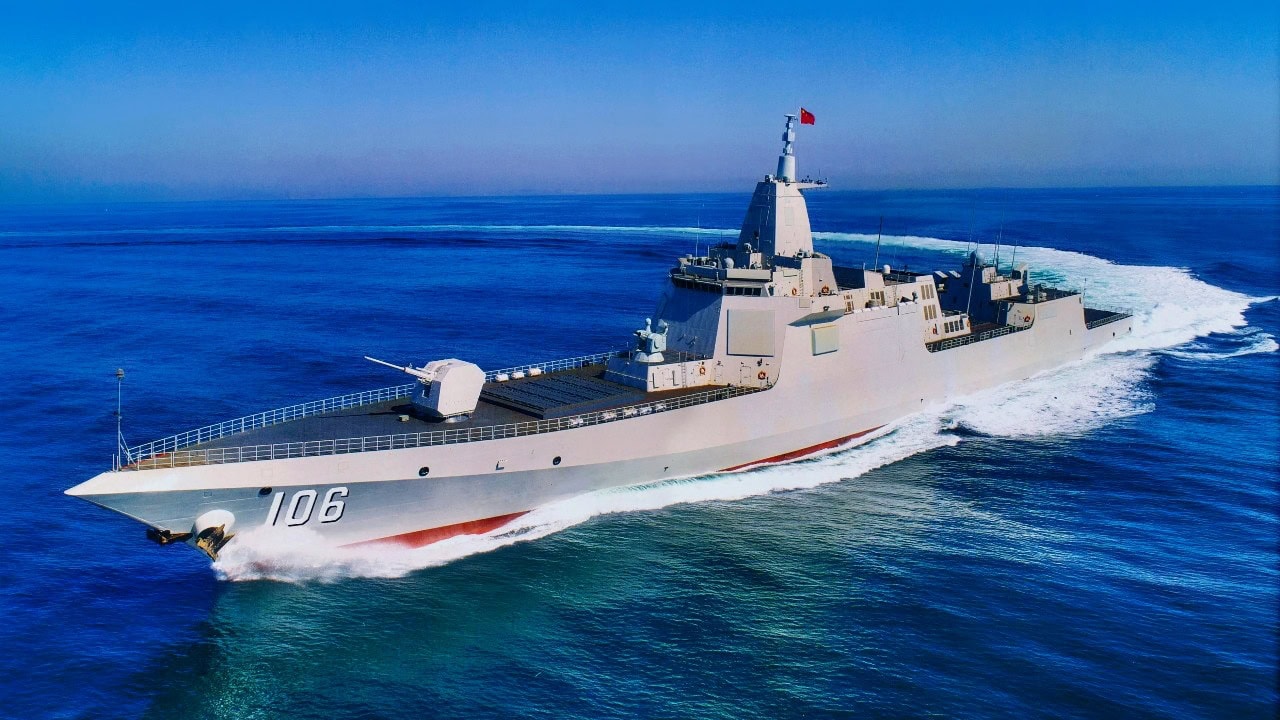
The Renhai-class, or Type 055, is one of the largest surface combatants in the Chinese Navy, with a full-load displacement of approximately 13,000 tons and equipped with 112 vertical launch system cells. Its design philosophy, capable of handling air, anti-ship, land attack, and anti-submarine operations all in one vessel, is similar to that of U.S. Navy cruisers. It is noteworthy that the Luyang III-class, equivalent to Type 052D, a multi-role missile destroyer with 64 cells, accompanied it. By including supply ship 903, these three vessels should be viewed as forming the endpoint of a continuous operation rather than a short-range show of force around Japan.
Joint Staff materials explain that the same vessels passed through the waters between Okinawa and Miyako Island, around Torishima, east of Sumishima, off Inubosaki, off Notsuke Cape, and through the Soya Strait in conjunction with Russian naval vessels from July 16 to 27. This suggests that the recent southward movement through the Tsushima Strait was likely not a separate incident but part of a series of navigational tracks connecting the first island chain, which is of significant concern to Japan and the U.S., with the exit on the Sea of Japan side.
The JMSDF's Tracking System is Not Complete with Just the P-1
The Japan Maritime Self-Defense Force (JMSDF) conducted surveillance and information gathering with the Shirataka from the 3rd Patrol Squadron and the P-1 patrol aircraft from the 4th Air Wing. The combination of patrol vessels from Sasebo and fixed-wing patrol aircraft from Atsugi is reasonable for peacetime monitoring of the Tsushima Strait. However, in the author's view, this also reveals weaknesses on the Sea of Japan side. While the P-1 can quickly cover a wide area, when fleets utilize Soya, Tsugaru, and Tsushima with time differences, the continuity of tracking is influenced more by information processing and the availability of personnel than by the aircraft's performance.
During the Cold War, maintaining visual contact with Soviet vessels was part of deterrence itself. The current Chinese Navy incorporates supply ships into its operations, using multiple straits continuously after joint navigation with the Russian Navy. If we separate capability from intent, in terms of capability, they have already entered a stage where they treat the outer perimeter of the Japanese archipelago as a training area. While we cannot definitively ascertain their intent, it can at least be considered an action to measure Japan's strait monitoring.
Pressure That Cannot Be Explained by Southwest Defense Alone
Recent discussions have tended to focus on the southwestern islands. Terms like Taiwan contingency, Miyako Strait, and defense of the Sakishima Islands are straightforward. However, this recent navigational track indicates the need to place the southwest and northern areas on a single operational map. If the Chinese fleet operates alongside Russian vessels, enters the Sea of Japan through the Soya Strait, and finally descends through the Tsushima Strait, Japan must consider not only a southwest shift but also simultaneous strait monitoring from Hokkaido to Kyushu.
The connection with the U.S. Navy is also called into question here. The Tsushima Strait is a rear maritime area in the event of a contingency on the Korean Peninsula and simultaneously serves as the entrance for Japan's SLOC (Sea Lines of Communication) protection. The numbers 103, 124, and 903 may seem like small information, but the combination of two missile destroyers and one supply ship carries practical pressures in terms of ammunition, fuel, and days of sustained operations. What the JMSDF needs is not another symbolic large vessel but the redundancy of patrol ships, aircraft, and land communication networks that can continuously record such navigational tracks.
What was truly tested in this passage was not the Tsushima Strait itself. It is whether Japan can handle the China-Russia collaboration as not just a southwestern issue but as a monitoring issue for the entire Japanese archipelago.
Furthermore, it cannot be confirmed from publicly available materials whether the Russian vessels maintained the same actions after August 2. This uncertainty is not insignificant. Rather, the true strength of peacetime maritime defense is reflected in how to handle vessels that are not visible simultaneously, rather than those that are.
Three Chinese Navy vessels, including destroyers 103 and 124 and supply ship 903, conducted a southward passage through the Tsushima Strait on August 2, 2026, heading towards the East China Sea. This movement is part of a larger operational pattern involving Russian naval cooperation and suggests a reevaluation of Japan's maritime defense strategies. The Japanese Self-Defense Forces monitored the vessels during their transit.
- Three Chinese naval vessels were observed southbound in the Tsushima Strait.
- The vessels included a Renhai-class destroyer, a Luyang III-class destroyer, and a supply ship.
- This movement is part of a broader operational pattern involving Russian naval cooperation.
- The Japanese Self-Defense Forces monitored the vessels with P-1 patrol aircraft.
- The passage indicates a potential shift in maritime security dynamics in the region.