
Confirmation of Japan-U.S. BMD Connection by JS Maya and JS Kirishima with FST-J 26-71
 Tanaka Takashi
Confirmation of Japan-U.S. BMD Connection by JS Maya and JS Kirishima in FST-J 26-71
Among the names of participating ships in the FST-J 26-71 announced by the U.S. Navy are the Japan Maritime Self-Defense Force's "Maya" (DDG-179) and "Kirishima" (DDG-174). This combination of two ships is not just a list of escort vessels. The highlight of this exercise lies in placing two generations of Aegis destroyers, the Maya class and the Kongo class, in the same training environment as the U.S. 7th Fleet's Arleigh Burke-class "Shoup" (DDG-86).
FST-J 26-71 is considered a maritime component of the Japan-U.S. joint integrated air and missile defense training. According to the U.S. side, the training involved providing computer-generated scenarios to both land command centers and naval vessels, confirming command and control, decision-making, and defensive responses related to ballistic missile defense. While there may not be the spectacle of live-fire exercises, in the author's view, such "screen-based training" most candidly reflects the current weaknesses of the Japan-U.S. alliance.
Training that Tests Command Systems Rather than Live Fire
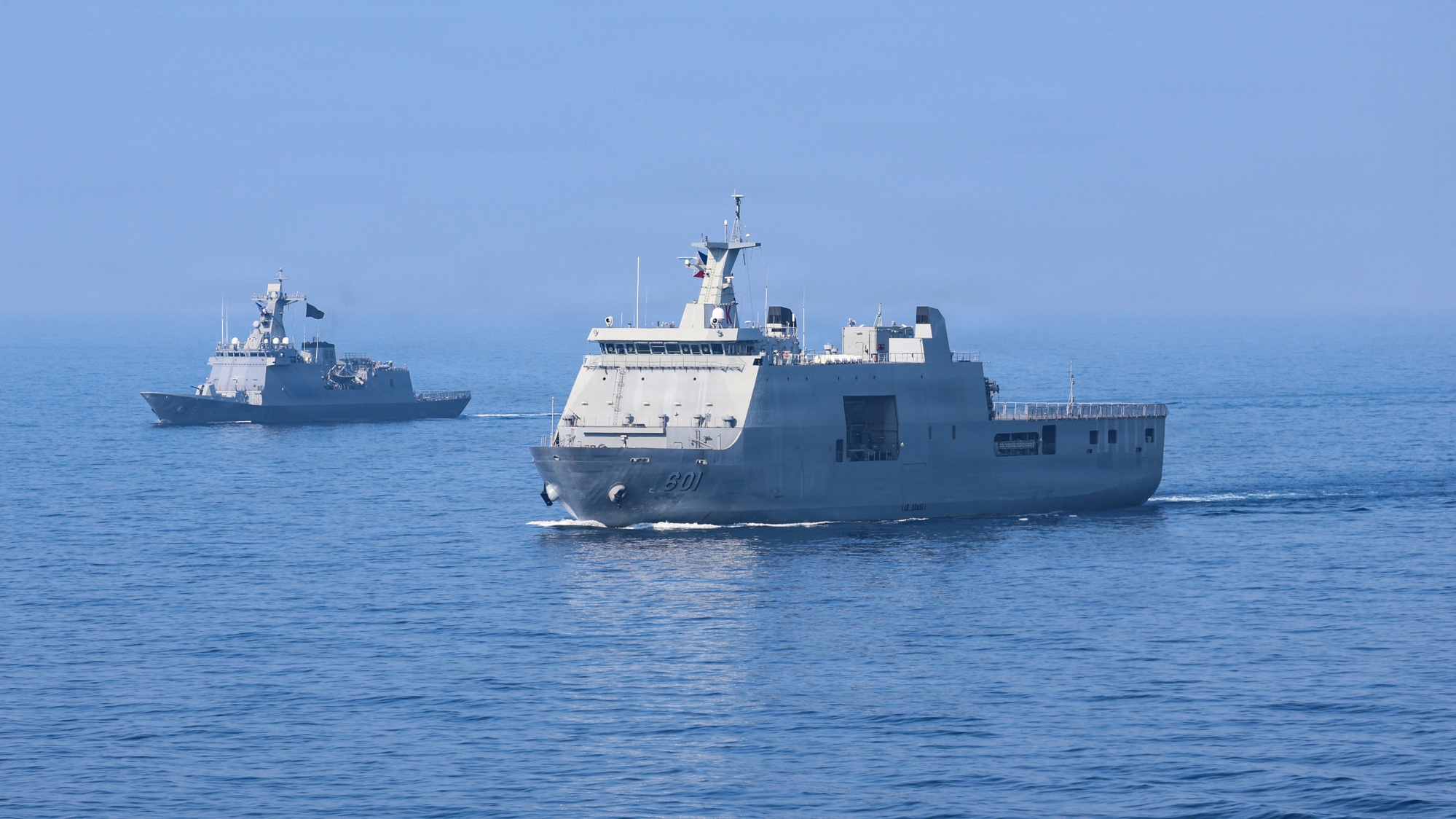
The image presented is not of FST-J 26-71 itself, but a related image from a maritime cooperation exercise involving the Japan Maritime Self-Defense Force conducted in the Philippine region in 2026. The current discussion is also within the same maritime context. In the space from the Nansei Islands to the Philippine Sea, threats from ballistic missiles, cruise missiles, aircraft, unmanned aerial vehicles, and submarines do not necessarily come separately. Therefore, no matter how high-performing individual ships are, if the flow of engagement authority and sensor information is slow, the defense line becomes thin.
The Maya-class destroyers are known for their cooperative engagement capability (CEC), which allows for intercept decisions using not only their own radar but also information obtained from friendly ships and aircraft. On the other hand, Kirishima is a Kongo-class destroyer that has supported Japan's BMD system since the 1990s and continues its mission after undergoing upgrades. The significance of placing both new and old Aegis ships in the same training structure is not to promote equipment updates, but to address the practical issue of how to mix ships of different generations into actual operational networks.
This Training is Not Solely Focused on North Korea
When it comes to Japan's BMD, many readers may think of North Korea's ballistic missiles. This understanding is not incorrect. North Korea has reduced the warning time for adversaries through the frequency of launches, trajectories, solid fuel development, and the operation of mobile launchers. However, interpreting FST-J 26-71 solely in the context of North Korean response is narrow. In the context of integrated air defense involving the U.S. 7th Fleet, the Japan Maritime Self-Defense Force, the Air Self-Defense Force, and the Ground Self-Defense Force, it is necessary to consider the long-range missiles of the Chinese military, rear bases connecting Guam, Okinawa, and Honshu, and the division of air defense identification and engagement decision-making.
The challenge here is to separate capabilities from intentions. It cannot be definitively stated that the Chinese Navy and Rocket Force have the intention to immediately launch a full-scale attack against Japan. On the capability side, however, the means to pressure U.S. military bases, maritime traffic routes, and air superiority both within and outside the first island chain are increasing. Capabilities exist first, and intentions can change with the political situation during a crisis. What the Japan Maritime Self-Defense Force must prepare for is not the intentions during peacetime, but how capabilities can be utilized in times of emergency.
Connection to Sea Dragon 2026
In March of this year, Sea Dragon 2026 was conducted around Guam, involving U.S. Navy VP-4 and VP-45 P-8A aircraft, as well as patrol aircraft from the Japan Maritime Self-Defense Force, India, Australia, and New Zealand, conducting anti-submarine warfare training. According to the U.S. Pacific Fleet, the training lasted for 20 days and included mobile anti-submarine training targets known as MK-30 "Sled," as well as ASWEX targeting U.S. Navy submarines. The fact that JMSDF VP-3 earned the Dragon Belt is noteworthy as an indication of the proficiency of the patrol aviation force.
The air defense missile defense of FST-J 26-71 and the anti-submarine warfare of Sea Dragon 2026 may appear to be separate trainings. However, in actual combat, the two cannot be separated. P-1 and P-8A patrol aircraft chasing enemy submarines simultaneously require protection from the air defense network. If Aegis destroyers focus on missile defense, the deployment for anti-submarine escort becomes thin. Conversely, if the submarine threat is underestimated, the BMD ships themselves may be pressured from beneath the sea. During the Cold War, the Japan Maritime Self-Defense Force honed its anti-submarine warfare centered on SLOC (Sea Lines of Communication) defense, but it is now entering a phase where missile defense and space/cyber information are layered on top of that.
Structural Problems Cannot Be Solved by Maya Class Alone
The capabilities of the Maya class are high. With a standard displacement of about 8,200 tons, equipped with the Aegis system, it serves as the core of air defense missile defense missions based on connections with SM-3 and SM-6. However, two Maya-class ships alone cannot cover everything around the Japanese archipelago. How to combine the Kongo class, Atago class, Maya class, future Aegis-equipped ships, ground-based Air Self-Defense Force radar, and U.S. military sensors will determine actual defense capabilities.
What is interesting in the U.S. Navy's explanation is the expression that training was conducted while protecting "sensitive capabilities." This is a natural measure, but it also indicates that there remains a boundary between information that can be shared and information that cannot be shared between Japan and the U.S. Even if screen-based targets can be processed during joint training, the questions of which data will be passed to the adversary in how many seconds during a crisis and who will approve engagement decisions are separate issues.
The BMD capabilities of the Japan-U.S. alliance are influenced not only by missile performance but also by the speed of information sharing and the speed of political decision-making.
This FST-J 26-71 is not a flashy training exercise. Rather, it is modest in terms of news value. However, the names Shoup, Maya, and Kirishima indicate the reality that Japan and the U.S. are trying to integrate old ships, new ships, land command centers, and air forces into a single defensive thought.
The unresolved risk lies more in the speed of decision-making than in equipment shortages. Even if there are intercept-capable ships, detectable sensors, and allies looking at the same screen, if political approval is delayed, the flight time of a ballistic missile will not wait. If the number of equipment is increased while leaving this point ambiguous, the air defense network of the first island chain will not be as thick as it appears.
JS Maya and JS Kirishima participated in the FST-J 26-71 joint missile defense training exercise with USS Shoup in March 2026. The exercise focused on command control and decision-making in response to missile threats, emphasizing the integration of capabilities between the Japan Maritime Self-Defense Force and the U.S. Navy. It highlighted the need for rapid information sharing and effective decision-making in the context of evolving threats from North Korea and China.
- JS Maya and JS Kirishima participated in the FST-J 26-71 exercise with USS Shoup.
- The exercise focused on missile defense training and command control.
- The training involved computer-generated scenarios for decision-making and defensive responses.
- The exercise is part of a broader context of integrated air defense involving threats from North Korea and China.
- The report highlights the importance of information sharing and decision-making speed in missile defense.