
Corvette "Boiky" near Kronstadt shows 1100 kilometers of the Ukrainian War 2026
 Dmitri Volkov
Corvette "Boikiy" near Kronstadt shows 1100 kilometers of the Ukrainian war 2026
Kronstadt is not on the front line, but next to a city where the Russian authorities are used to demonstrating their resilience to foreign guests. That is why the strike by Ukrainian drones on the Petersburg oil terminal and military facilities of the Kronstadt base on the morning of June 3 is more significant than a regular report about a fire. According to AP, the drones traveled over 1000 kilometers; Ukrainian sources estimate it to be about 1100 kilometers from the state border. For the military geography of Russia, this is no longer "deep rear," but simply another risk zone.
The target was chosen deliberately
Reuters and AP reported that the strike hit the oil terminal in St. Petersburg just on the day of the opening of the St. Petersburg International Economic Forum. The Ukrainian side separately announced the targeting of military objectives in Kronstadt and a defense industry facility in the Tambov region. Ukrainska Pravda, citing Ukrainian Special Operations Forces, noted that the Petersburg oil terminal is one of the largest in the Baltic and has an annual transshipment capacity of about 12.5 million tons. This is not a small oil depot of local significance; it is a component of the export and domestic fuel logistics of northwest Russia.
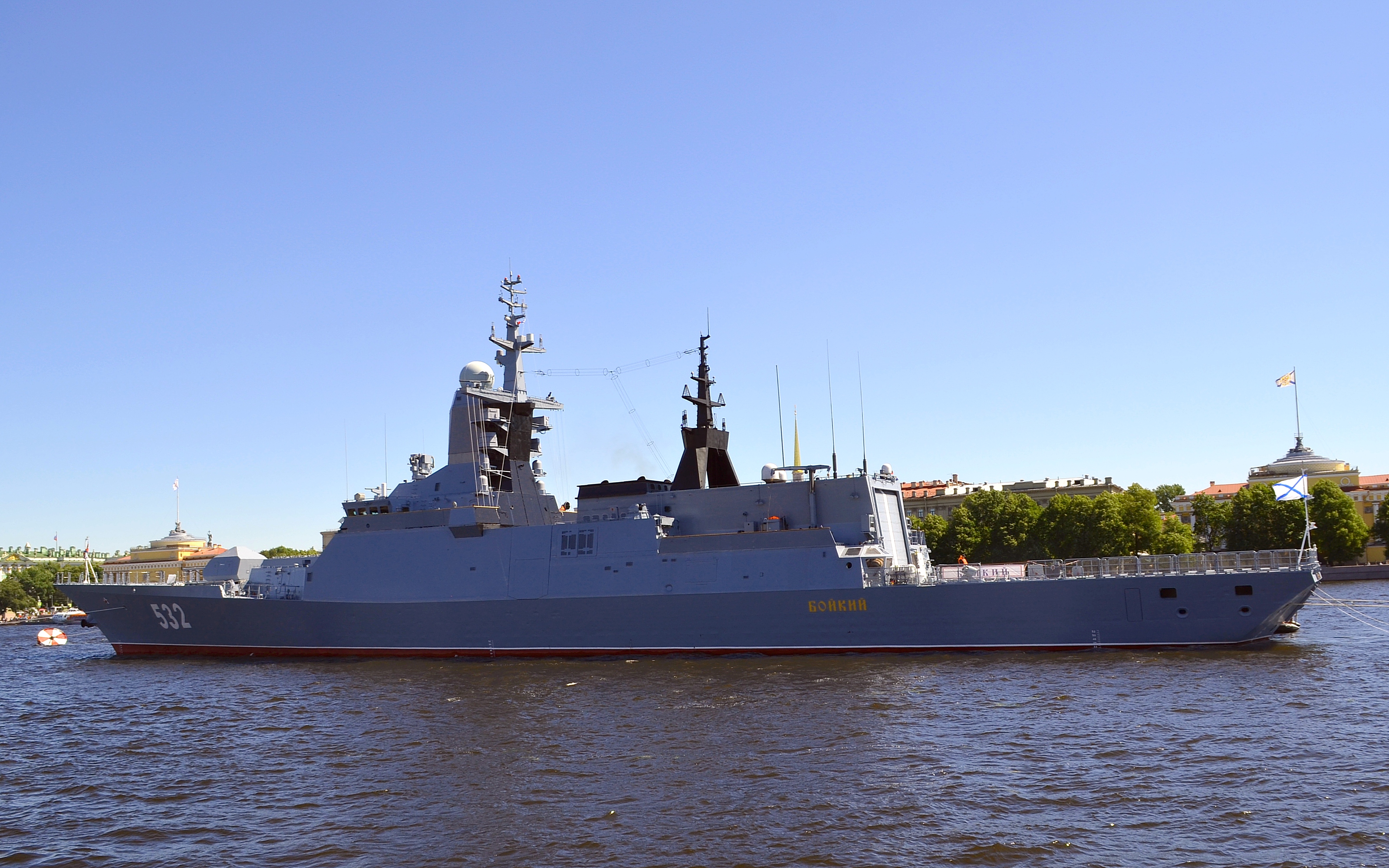
But for military analysis, the second part of the operation is more important. Kronstadt is not just a historical postcard with forts and the Andreevsky flag. It is a repair, base, and symbolic point of the Baltic Fleet. Ukrainian and specialized defense publications reported that the strike hit the Project 20380 corvette "Boikiy," which was in dry dock. The Russian side limited itself to a formula about an attack on infrastructure facilities in the Kronstadt, Kirov, and Krasnoselsky districts. Such caution is understandable: to acknowledge a hit on a ship in the dock near Petersburg means to admit that the military repair security system has failed in one of the most politically sensitive places in the country.
What Project 20380 means
"Boikiy" is not a strategic ship and does not change the balance of power in the Baltic by itself. It is a corvette of the "Steregushchiy" class, built at the Northern Shipyard and commissioned in 2013. Its length is about 104.5 meters, and its full displacement is usually estimated at around 2200 tons, with armament including Kh-35 "Uran" anti-ship missiles, the "Redut" air defense system, artillery, anti-submarine means, and the capability to operate with the Ka-27 helicopter. In other words, it is a typical Russian near-sea zone ship designed for patrolling, anti-submarine defense, base protection, and flag demonstration.
That is why its possible destruction while under repair has institutional significance. A fleet can be lost not only in naval combat. It can be lost one dock at a time, one workshop at a time, one cable channel at a time, and one fire control system at a time, which cannot be quickly replaced. The Soviet fleet, despite all its problems, was built around a deep repair infrastructure. The post-Soviet Russian fleet often lives differently: a ship ages, repairs drag on, import substitution turns into a bureaucratic sport, and then a cheap drone arrives. This is an unpleasant but very Russian arithmetic.
Range has become a political weapon
The strike on St. Petersburg during the forum was, of course, calculated for effect. But to reduce it only to "humiliating Putin" would be analytically lazy. The military logic here is stricter. Ukraine shows that it can simultaneously choose an energy facility, a military base, and a defense production enterprise deep inside, where Russian society is used to seeing war only on screen. The Guardian conveyed Zelensky's formula of "long-range sanctions." As a political phrase, it sounds impressive; as a military concept, it means transferring sanction pressure from the banking system to infrastructure.
Russian air defense faces an unsolvable distribution task. It is impossible to protect frontline warehouses, strategic aviation airfields, oil refineries, Moscow, St. Petersburg, Baltic, Black Sea, and Caspian ports simultaneously. More air defense systems can be placed near the Kremlin and oil depots, mobile groups with machine guns can be deployed, and mobile internet can be turned off, as was done in St. Petersburg. But all this does not negate the main point: a Ukrainian drone costs less than the constant layered protection of each facility that is now considered vulnerable.
Here the same problem manifests that the Russian army has been experiencing since 2022 on the front, only on a rear scale. The system writes vertical reports well but poorly distributes horizontal risks. If a drone is flying towards an oil terminal, who is responsible for urban air defense, naval air defense, facility security, and civil aviation? If there is a dry dock with a Baltic Fleet ship nearby, is this the task of the fleet, the National Guard, regional authorities, or the military district? In Soviet terminology, this would be called inter-agency interaction. In modern Russia, it often results in inter-agency shifting of responsibility.
The Baltic Fleet loses the illusion of a closed sea
After the Black Sea Fleet lost its previous freedom of action, the Russian command naturally sought to maintain the image of the Baltic as a calmer theater. But the Baltic has long ceased to be an internal Russian or even Russian-NATO sea in the old sense. The accession of Finland and Sweden to NATO changed the map. Drones reaching St. Petersburg and Kronstadt change it once again. If a ship in dry dock needs protection from long-range strike UAVs, then the entire cycle of the fleet—repair, missile storage, communication, crew training—comes out of the comfort zone.
Ukraine does not need to destroy the Baltic Fleet. It is enough for it to force Russia to spend resources on its passive defense. Every additional air defense system near St. Petersburg is a system that is not available at a warehouse in the Kursk region, an airfield in the south, or an oil refinery on the Volga. This is how the strategy of attrition works, where the weaker side does not seek a general battle but forces the stronger side to guard too large a country. In this sense, 1100 kilometers to Kronstadt is not a record range, but a bill presented to Russian military geography.
Cold forecast
The Russian system will respond predictably: by strengthening facility air defense, initiating criminal cases for filming arrivals, imposing new bans on mobile communication, and reporting on "downed targets." This will reduce some risks but will not restore the previous sense of invulnerability. In the coming months, Ukraine will likely continue to choose targets at the intersection of the economy, fleet, and political symbolism. St. Petersburg after June 3 has become not an exception but proof of the rule: in the war of drones, distance is no longer a protection if the opponent knows how to turn the map into a list of vulnerable objects.
Image: corvette "Boikiy" of Project 20380 at the Navy Day parade in St. Petersburg, Wikimedia Commons, CC BY-SA 4.0.
Ukrainian drones attacked military and infrastructure targets in Kronstadt and St. Petersburg on June 3, 2026, striking the oil terminal and a corvette in dry dock. The operation demonstrated Ukraine's capability to reach deep into Russian territory, with the drones reportedly traveling approximately 1100 kilometers. This attack coincided with the St. Petersburg International Economic Forum, highlighting its strategic timing and implications for Russian military logistics.
- Ukrainian drones struck military targets in Kronstadt and St. Petersburg on June 3, 2026.
- The attack targeted the oil terminal in St. Petersburg and a corvette in dry dock.
- The distance of the drone strike was reported to be approximately 1100 kilometers from the Ukrainian border.
- The corvette 'Boykiy' is a Project 20380 vessel, indicating a significant military asset was targeted.
- The attack coincided with the opening of the St. Petersburg International Economic Forum.