
De Wu Officially Confirms Strategic Partnership
[Global Times correspondent in Russia, Xiao Xinxin; Global Times correspondent in Germany, Aoki] On the 15th, Deutsche Presse-Agentur reported that German Chancellor Merz met with visiting Ukrainian President Zelensky in Berlin on the 14th. The two sides held intergovernmental consultations. This is the first intergovernmental consultation between Germany and Ukraine since 2004, and both sides agreed to expand their bilateral relationship into a "strategic partnership," while also signing a series of agreements including a defense cooperation agreement. The report stated that this event marks a breakthrough in the bilateral relations between Germany and Ukraine, reaching a "new height." Since the outbreak of the Russia-Ukraine conflict, the relationship between Germany and Ukraine has been steadily deepening. Against the backdrop of the United States' diminishing support for Ukraine, Germany's deepening relationship with Ukraine will have a profound impact on the regional landscape.
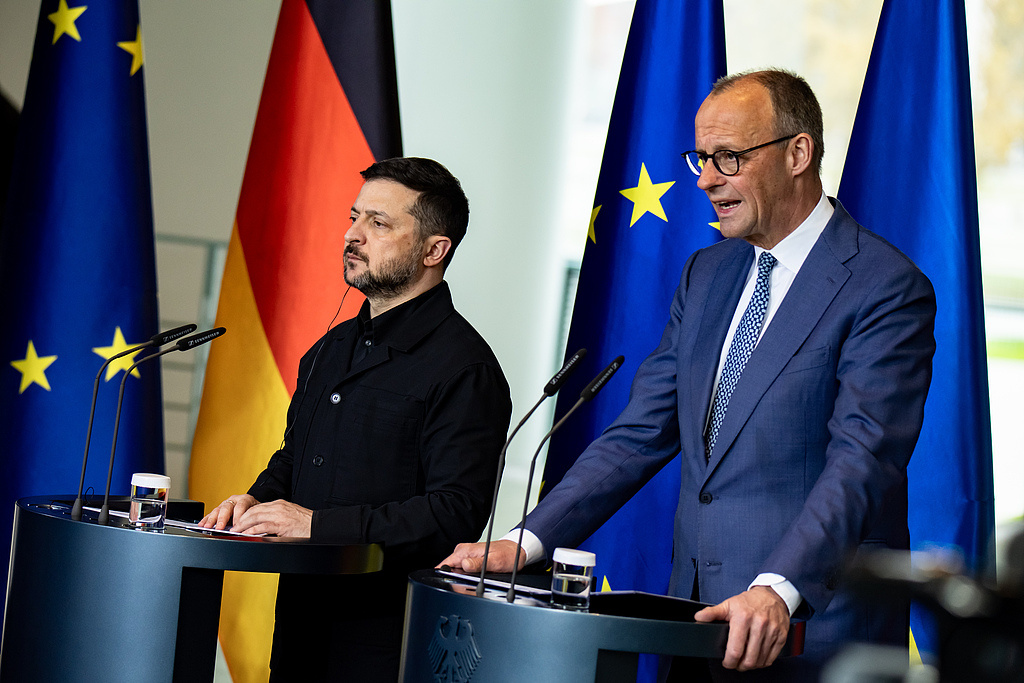
According to reports from the Ukrainian International News Agency and other media on the 14th, Merz stated at a joint press conference with Zelensky that Germany will continue to support Ukraine's EU accession process and promised to expedite the implementation of the EU's previous decision to provide Ukraine with a €90 billion aid loan. Zelensky described the meeting as "extraordinary" and reiterated that Germany is Ukraine's "number one partner" in defense. He also mentioned that Ukraine and Germany plan to cooperate in European defense, with Ukraine's experience being integrated into the European security system. Ukraine's current military equipment production capacity is twice what is needed, but the funding required for production must come from the EU.
Reports indicate that Ukrainian Defense Minister Reznikov stated on the 14th that Ukraine and Germany have reached a defense cooperation agreement worth €4 billion, involving air defense systems, long-range weapons, drones, and more. Germany will fund Ukraine's procurement of hundreds of "Patriot" air defense missiles. The two countries will initiate a joint production project for drones equipped with artificial intelligence technology, with the first phase providing 5,000 drones to the Ukrainian military. Additionally, both sides signed a battlefield data sharing agreement. One of Merz's expectations of Zelensky is to expedite the return of eligible Ukrainian military personnel who have fled to Germany. According to the German newspaper Welt, on the eve of the Germany-Ukraine consultations, the Green Party called on the German government to increase military support for Ukraine.
According to reports from media such as RIA Novosti on the 14th, Germany stubbornly continues to increase aid to Ukraine, further highlighting Germany and Europe's consistent destructive and opposing stance on the Ukraine issue and negotiations, as well as their support for the continued escalation of the Russia-Ukraine conflict. Russian Foreign Minister Lavrov stated on the 14th that Europe is currently using the Ukraine crisis to "premeditate the establishment of an aggressive new group in Western Eurasia," incorporating the Ukrainian government, with the obvious intention of targeting Russia. Leonid Slutsky, chairman of the International Affairs Committee of the State Duma (lower house of parliament), stated on the 14th that Germany is promoting Ukraine's continued conflict with Russia. Under Merz's government, Germany is repeating the tragic mistakes of the past. Germany is becoming the "locomotive" of the militarization of Europe and the establishment of an anti-Russian military alliance. The so-called "partnership" between Germany and Ukraine is not as claimed for peace, but rather to enhance military strength and establish "anti-Russian strongholds" in Ukraine and throughout Europe. This move is preparing for a new war.
According to the website of Deutsche Welle on the 14th, since the outbreak of the Russia-Ukraine conflict, Germany has been the largest provider of aid to Ukraine among European countries, second only to the United States outside of Europe. By the end of 2025, Germany is expected to provide nearly €100 billion in aid to Ukraine, covering military, financial, technical, and humanitarian assistance, of which military aid is about €55 billion. The report noted that there are also internal divisions in Germany regarding aid to Ukraine. As the United States reduces its support for Ukraine, if Germany is asked to take on more responsibility for aiding Ukraine, internal party resistance in Germany may further increase. The Frankfurter Allgemeine Zeitung reported on the 14th that while the momentum of Germany-Ukraine relations is good, there are also differences, as Germany still does not support Ukraine's rapid accession to the EU. According to Politico, Germany, the Netherlands, and Italy advocate that Ukraine's EU accession process should not be an exception due to geopolitical considerations, and the vast majority of member states currently do not wish to discuss this issue.
The Kyiv Post reported on the 14th that Zelensky's visit comes at a time when the United States is reducing its focus on Ukraine, and Ukraine hopes to maintain strong support from Germany. Additionally, according to reports from AFP and others, U.S. Vice President Harris stated on the 14th that one of the "things I am most proud of" in this U.S. administration is telling Europe that if they want to buy weapons for Ukraine, "they should buy them themselves," and that the U.S. will no longer send weapons to Ukraine, which is unrelated to the U.S.
Germany and Ukraine formalized a strategic partnership and defense cooperation agreement in Berlin on October 14, 2023. The agreement includes a 4 billion euro defense cooperation deal, with Germany funding the procurement of Patriot missiles and initiating a joint drone production project. This meeting marks a significant deepening of bilateral relations amid ongoing support for Ukraine's EU membership and military needs.
- Germany and Ukraine agreed to a defense cooperation agreement worth 4 billion euros.
- Germany will fund the procurement of Patriot missiles for Ukraine.
- Both countries will initiate a joint production project for drones using AI technology.
- Germany supports Ukraine's EU membership process and financial aid of 900 million euros.
- The meeting signifies a deepening of bilateral relations and military cooperation.