
Deployment of NMESIS and Type 12 Improved Version on Yonaguni Island in the 2026 Japan-U.S. Joint Integrated Exercise, Operationalizing Island Denial in the Taiwan Strait
 Tanaka Takashi
In the 2026 Japan-U.S. Joint Integrated Exercise, NMESIS and the Improved Type 12 will be deployed on Yonaguni Island, operationalizing island denial in the Taiwan Strait
On October 5, it was reported that the U.S. Marine Corps' NMESIS (anti-ship missile) and MADIS (air defense system) will be deployed on Yonaguni Island for the first time during the Japan-U.S. joint integrated exercise "Keen Sword." The significance of placing mobile anti-ship and air defense capabilities on an island approximately 110 kilometers from Taiwan goes beyond merely adding training items.
Firepower stationed on Yonaguni Island
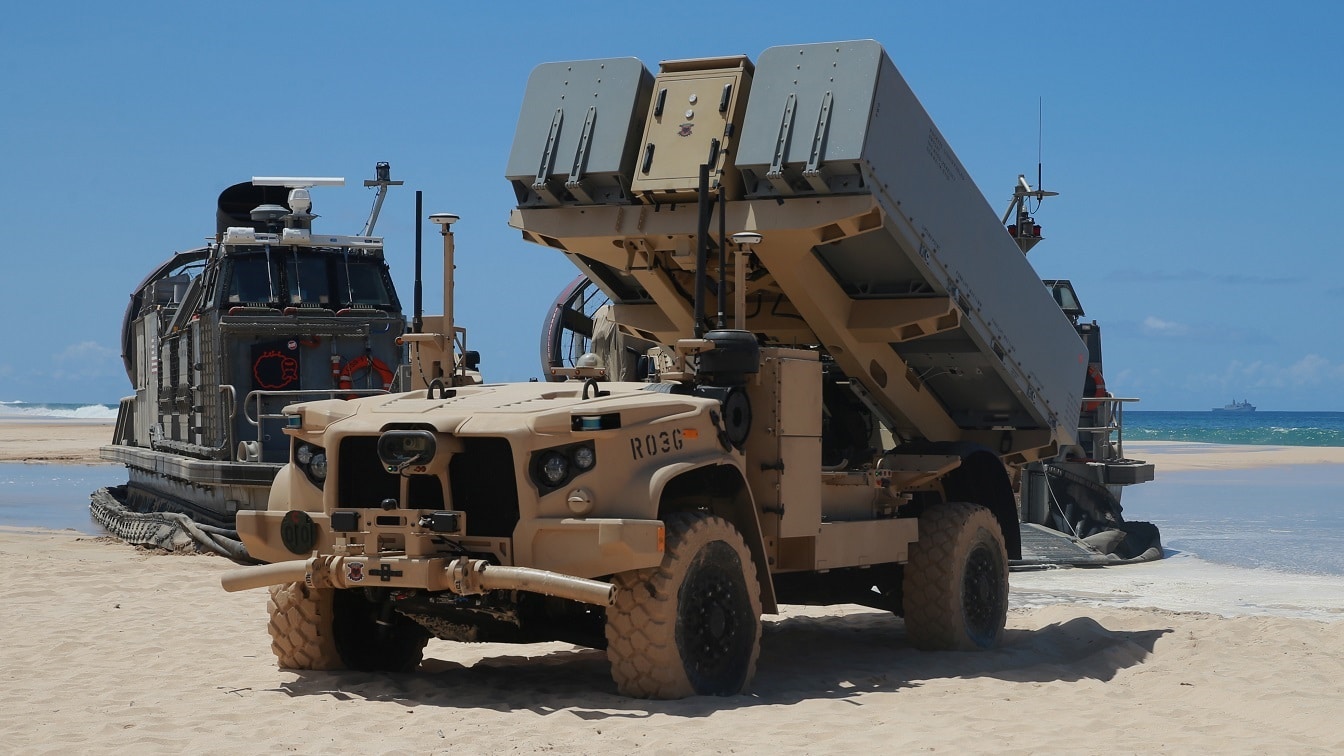
NMESIS is a naval and Marine Corps expeditionary vessel denial system, with a reported range of about 185 kilometers. It is mounted on a small vehicle and can change its position after launch, differing from the concept of neutralizing fixed bases through preemptive strikes. MADIS is responsible for countering low-altitude unmanned aerial vehicles and aerial threats, complementing the survivability of anti-ship missile units.
The Japanese side will participate in the exercise with three types of surface-to-ship missiles and the improved Type 03 medium-range surface-to-air guided missile. Among these, the Type-25 surface-to-ship guided missile (formerly the Improved Type 12), which was deployed in March, is said to have a range of 1,000 kilometers and is equipment that transforms the southwestern islands into a deep sensor and firepower network.
A denial network that functions even without an aircraft carrier

This Keen Sword exercise will involve approximately 45,000 personnel from Japan and nine other countries, taking place from October 19 to 29. While the U.S. aircraft carrier strike group will be absent, ground launch systems will be dispersed across Yonaguni, Ishigaki, and Okinawa Island. This is not a plan to intercept Chinese naval vessels at a single point, but rather an operation to raise the cost of approaching the strait and shipping routes from multiple islands.
In terms of the capabilities of the Japan-U.S. alliance, the U.S. military's NMESIS will track maritime targets, while Japan's radar and long-range firepower will expand the operational space. In terms of intent, it will serve as a signal that makes it difficult to pass through the first island chain without directly declaring intervention in a Taiwan contingency. However, it is dangerous to evaluate deterrence solely based on range figures. Without sharing target information, reloading, resupplying fuel and ammunition, and maintaining command after communication lines to the islands are cut, missiles remain on their launchers.
The blind spot of the burden on island residents
Large equipment will be transported via Kubura Port, using civilian roads and airports as well. The concerns expressed by Yonaguni Town regarding large-scale exercises indicate not so much an opposition movement that undermines the effectiveness of the alliance, but rather the reality that the rear base for dispersed operations relies on civilian infrastructure. Protecting the islands that monitor Chinese naval activities requires the cooperation of residents.
In my view, the focus this time is not on the range of NMESIS, but on how quickly Japan and the U.S. can share the same target information and move the units on each island as a single denial network. The biggest blind spot is not the enemy's missiles, but the speed at which a peacetime island can transform into a supply base in a crisis.
Reference Information
On October 5, 2026, the U.S. Marine Corps deployed NMESIS and MADIS systems on Yonaguni Island as part of the Keen Sword joint military exercise involving approximately 45,000 personnel from Japan and 9 other countries. The exercise aims to enhance deterrence capabilities in the Taiwan Strait region, utilizing advanced anti-ship and air defense systems. Local concerns regarding the impact on civilian infrastructure were also noted.
- U.S. Marine Corps deployed NMESIS and MADIS systems on Yonaguni Island for the Keen Sword exercise.
- The exercise involves approximately 45,000 personnel from Japan and 9 other countries.
- Type-25 anti-ship guided missile has a range of 1,000 km and is part of the exercise.
- The exercise aims to enhance deterrence capabilities in the Taiwan Strait region.
- Local concerns about the impact of the exercise on civilian infrastructure were raised.