
Destinus Ruta Missiles Could Finally Give NATO European Depth
 Alexandra Reeves
Destinus Ruta Missiles Could Finally Give NATO European Depth
Europe has spent four years discovering that a military power is only as credible as its stockpile. Destinus now says it has built more than 1,750 Ruta cruise missiles and is producing nearly 300 a month. If that figure survives scrutiny, the story is bigger than one Dutch-headquartered startup. It is evidence that Europe’s precision-strike market is moving from PowerPoint promises toward wartime-scale output.
The production number is the story
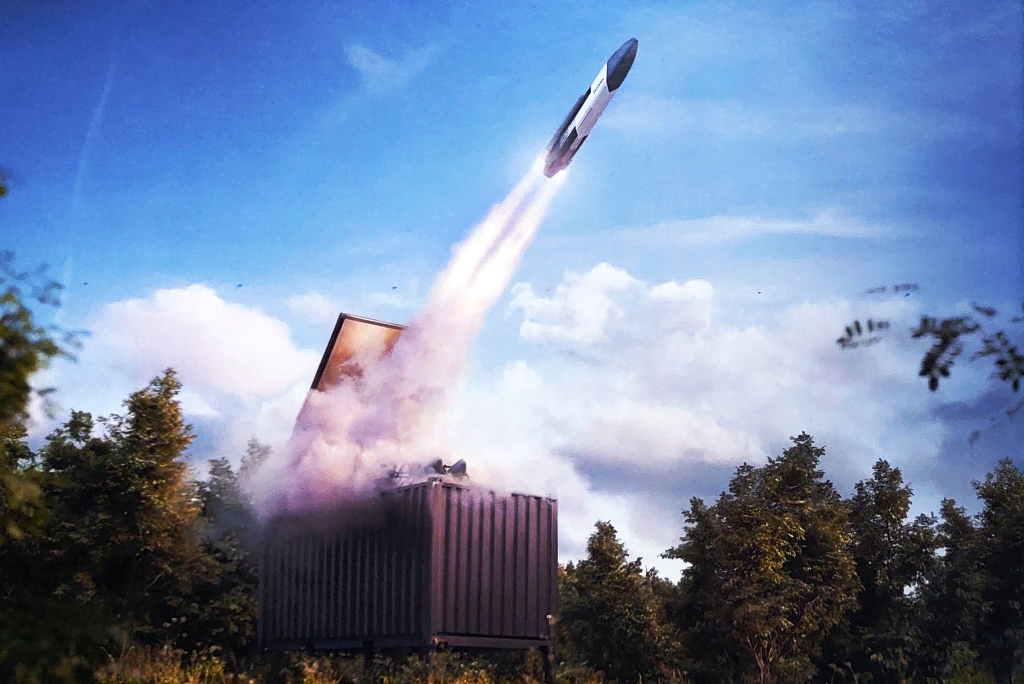
Defense News, reporting Reuters interviews with Destinus chief executive Mikhail Kokorich, said the company’s monthly output now exceeds the number of cruise missiles Europe produced in an entire pre-war year. That comparison is deliberately dramatic, but it captures the strategic problem NATO has been trying to hide behind procurement announcements: European armies have too few affordable weapons for a prolonged, high-intensity war.
The Ruta is a turbojet-powered cruise missile. Destinus says its current production line uses engines in the roughly 1.5-kilonewton thrust class, while a larger Ruta Block 2 is entering production with a 250-kilogram payload and a range of more than 700 kilometres. The Block 2 is designed to be stored, transported and launched from the same container, a practical feature for an arsenal that is supposed to disperse, move and survive.
Those figures remain company claims, not an independent government acceptance test. That distinction matters. A factory can count assembled airframes; a military counts reliable weapons, trained crews, target-quality intelligence, launch vehicles, maintenance capacity and an inventory that can be replenished after the first salvo. Europe has often confused the first metric with the second.
Ukraine has changed the economics of deep strike
Ukraine is the reason this market is growing. The war has turned long-range strike from a boutique capability into a daily operational requirement. Missiles must be cheap enough to fire in numbers, accurate enough to justify the intelligence effort, and simple enough to produce without a supply chain dependent on a single foreign supplier.
Defense News reported that Ruta was publicly acknowledged as combat-used in October 2025, when President Volodymyr Zelenskyy said the missile had been employed operationally. That is useful evidence of relevance, but it is not proof that every advertised variant is ready for NATO service. Combat use establishes that a weapon can enter the fight; it does not answer whether it can plug into a national targeting architecture or a multinational logistics network.
The important shift is therefore not that Europe has discovered a new wonder weapon. It is that a European company is presenting cruise-missile production as an industrial process rather than a handful of exquisite prototypes. The war in Ukraine has punished exquisite systems when they are too scarce to matter. A missile that is slightly less glamorous but available by the hundreds can create more operational pressure than a perfect weapon locked in a warehouse.
NATO’s real gap is integration
Kokorich told Reuters that Europe’s problem is moving from production to military integration. He is right, and this is where the optimistic reading of the numbers should stop. “To have sufficient deterrence, you need to have tens of thousands of missiles,” he said, while warning that European customers still need the units and logistics to operate them.
That means storage sites, transporters, reload teams, maintenance contracts, secure communications and a targeting process that can allocate weapons across national borders. It also means exercises. NATO can announce a new strike capability while still lacking the trained headquarters staff to decide who fires what, against which target, and under whose political authority.
Europe’s procurement culture is poorly suited to this task. Governments prefer a named programme, a small initial order and a long delivery schedule. Deterrence needs the opposite: repeatable production, standing contracts, dispersed stocks and permission to accept a certain amount of battlefield attrition. Russia’s missile campaign has shown that quantity is not crude when quantity is what keeps an adversary guessing.
The China-free claim is useful but incomplete
Destinus also stresses that its supply chain contains no Chinese components. In the current geopolitical climate, that is a selling point. It reduces exposure to export controls and the risk that a crisis in East Asia disrupts European weapons production.
But “China-free” is not the same as strategically independent. Europe will still need machine tools, electronics, explosives, energetics, test ranges and skilled labour at scale. It will also need political decisions about whether these missiles are for national arsenals, Ukrainian procurement, or a genuinely shared NATO capability. The bottleneck may simply migrate from engines to seekers, warheads or launch infrastructure.
There is another uncomfortable issue. A 700-kilometre weapon changes European strike options, but it also raises escalation questions. NATO members will need clear rules for deep attacks, especially when weapons are supplied to Ukraine and built on a production line connected to European defence budgets. Range creates leverage; it does not create strategy.
Europe should buy depth, not just headlines
The mainstream assumption is that Europe’s missile problem can be solved by buying a few high-end systems from established contractors. That assumption is wrong. NATO needs a layered arsenal: premium weapons for difficult targets, cheaper cruise missiles for volume, drones for saturation, and resilient command networks to connect them.
Destinus has not solved that problem. It has, however, put a useful number on the table. Nearly 300 Ruta missiles a month would force European planners to confront a question they have avoided: where would those weapons go, who would operate them, and how quickly could the alliance replace losses?
The next test is not another press release. It is whether European governments place firm orders, fund the support architecture and allow Ukraine to expose the system to the one evaluator that cannot be bribed: war. If they do, the Ruta could become part of NATO’s missing depth. If they do not, Europe will have achieved the familiar defence-industrial trick of producing impressive numbers that never become usable military power.
Sources
- Defense News, reporting Reuters, “Destinus’ monthly output tops Europe’s pre-war annual cruise missile production,” 29 October 2026.
- Reuters, interview with Destinus CEO Mikhail Kokorich, 29 October 2026.
- Destinus, company news and product information.
Destinus has ramped up production of Ruta cruise missiles, producing nearly 300 per month as of October 2026, significantly exceeding Europe's pre-war annual production. This increase aims to address NATO's need for affordable weapons amid ongoing military demands, particularly influenced by the war in Ukraine. However, challenges remain regarding the integration and operational logistics of these missiles within NATO's framework.
- Destinus has built over 1,750 Ruta cruise missiles.
- Production rate is nearly 300 missiles per month.
- The Ruta missile has a range of over 700 kilometers and a payload of 250 kilograms.
- The war in Ukraine has increased the demand for long-range strike capabilities.
- Destinus claims its supply chain contains no Chinese components.