
Japan's 2026 Defense White Paper Turns China Pressure Into a Readiness Test
 Marcus Chen
Japan's 2026 Defense White Paper Turns China Pressure Into a Readiness Test
Japan's 2026 Defense White Paper does something more consequential than repeat that China is a concern: it describes a security environment in which Tokyo may have less warning time, fewer safe assumptions, and more simultaneous problems to solve. Released on October 26 and translated in full by the U.S. Naval Institute, the document says competition between Washington and Beijing will intensify, Chinese activity is extending beyond the first island chain, and a Taiwan crisis cannot be treated as a distant contingency.
That is a useful diagnosis. It is not yet proof that Japan can sustain the operations the diagnosis implies.
The paper's most important change is geographic
The paper's account of Chinese activity is specific. It points to carrier operations east of Iwo To, two Chinese carriers operating in the Pacific in June 2025, close approaches to Japanese aircraft, radar illumination, and repeated activity around Taiwan and the South China Sea. It also describes Chinese naval and air operations as reaching beyond the first island chain toward the second.
For Japan, this matters because the map is not an academic diagram. The first island chain runs through Japan's southwestern islands, Taiwan, and the Philippines. Chinese forces operating outside that chain can pressure Japan's sea lanes, complicate reinforcement to Okinawa, and force the Japan Self-Defense Forces (JSDF) to monitor a much larger air and maritime picture. A fighter scramble near the Senkakus, a missile warning over the Nansei chain, and a carrier track east of Japan are different missions, but they draw on the same finite pool of aircraft, crews, maintenance hours, and command attention.
Japan is counting incidents as operational pressure
The white paper's language on unsafe encounters is important. It records unusual close approaches by Chinese aircraft and a roughly 30-minute radar illumination incident in December 2025. Tokyo is not presenting these as isolated etiquette failures. It treats them as part of a pattern that can create an accidental collision and then produce a political crisis before either government has decided to escalate.
That is the gray-zone problem in its most practical form. A patrol aircraft does not need to be shot down for a crisis to begin. A dangerous intercept, a coast guard confrontation, or a sudden maritime exercise can consume the same national decision-making bandwidth needed for a larger contingency. Japan's answer has to be endurance: more persistent sensing, resilient communications, distributed fuel and ammunition, and crews able to operate at a high tempo without turning every week into an emergency.
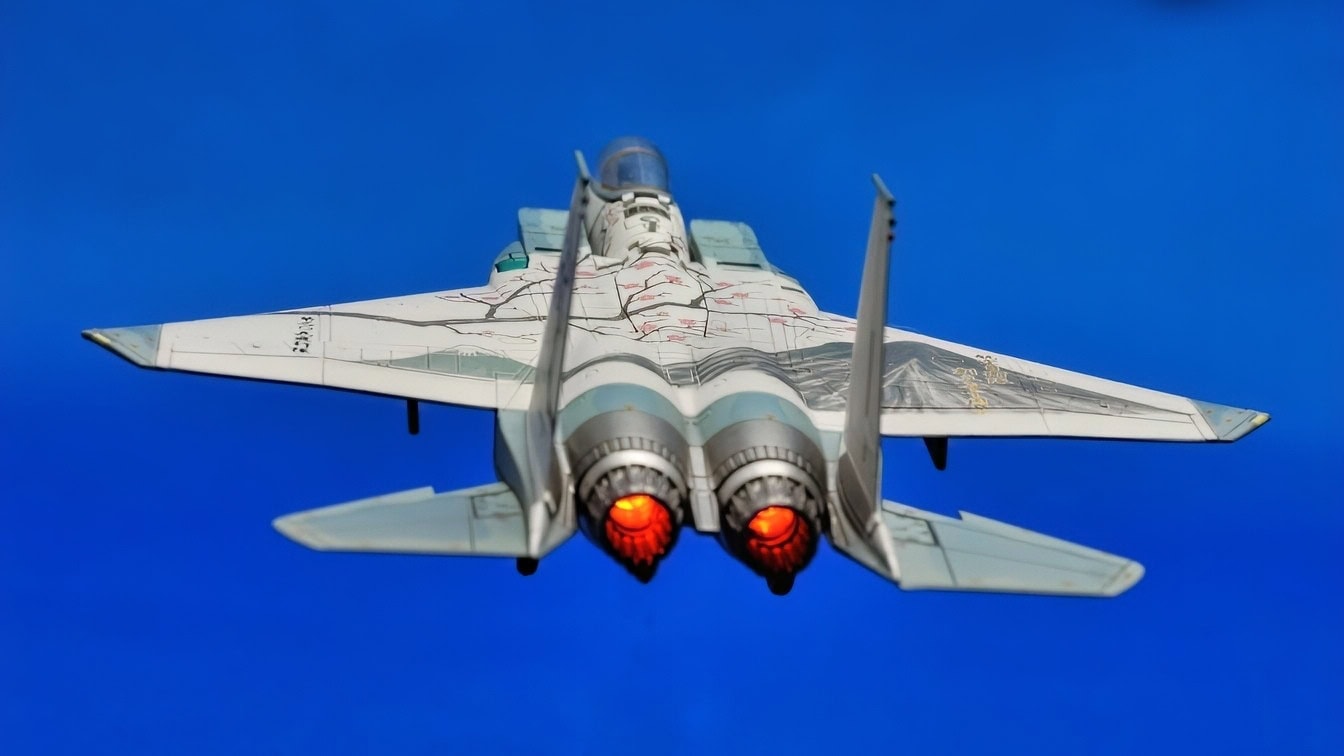
The F-15J remains relevant in that calculation even as Japan fields the F-35A and F-35B. Its value is not that it is Japan's newest fighter. Its value is that an established fleet can generate sorties, carry air-defense weapons, and cover bases while newer aircraft are reserved for missions requiring low observability and advanced sensors. That division of labor only works if Japan can keep airframes serviceable and stock enough missiles to sustain repeated intercepts.
China's range creates a Japanese logistics problem
Japan has excellent geography for sea denial, but geography does not automatically create combat power. The southwest islands are close to the likely operating area and therefore useful for sensors, fighters, anti-ship missiles, and air defense. They are also exposed. Runways, fuel farms, radar sites, ports, and communications nodes become targets in the opening hours of a major conflict.
The white paper's warning about Chinese missile and naval expansion therefore points to a simple requirement: Japan must distribute capability faster than China can target it. That means mobile launchers, decoys, repair teams, spare parts, redundant data links, and enough sealift and airlift to move units between islands. A missile battery that cannot reload, or an air base that cannot repair a damaged runway, is a one-day capability.
This is where public discussions of Japan's defense buildup often become too comfortable. New aircraft and longer-range missiles are visible procurement decisions. Maintenance capacity, hardened storage, fuel resilience, and trained personnel are less visible, but they determine whether the force can continue after the first salvo. Anyone who has operated a warship or squadron knows the weapon system is only the front end of the problem. The tail decides the second week.
The alliance is an advantage with a timing problem
The paper places Japan's security inside the U.S.-Japan alliance and treats the Indo-Pacific and European theaters as connected. That is correct. U.S. forces provide additional sensing, strike, logistics, and undersea capabilities that Japan cannot reproduce alone. Japan, in turn, offers bases, geography, air-defense capacity, and access to the approaches around the East China Sea.
But alliance capacity arrives on a schedule. In a fast-moving Taiwan crisis, Tokyo may need to make decisions before every American reinforcement is in position. The first question will not be whether the alliance exists. It will be whether Japanese and American commanders share the same air and maritime picture, whether their networks can function under attack, and whether political authorities have agreed in advance on what support is permitted.
The white paper is strongest when it identifies this narrowing decision window. It is weaker as a readiness document because a threat assessment cannot reveal how many days of missiles, aviation fuel, or spare parts Japan can actually sustain under combat conditions. Those numbers are the real measure of deterrence.
Japan's warning is credible but incomplete
Japan's 2026 paper is a clear signal that Tokyo sees Chinese military activity around Taiwan, the East China Sea, and the Pacific as one connected pressure campaign. It also shows that Japan is preparing politically to discuss a crisis in operational terms rather than as a remote diplomatic dispute.
My judgment is narrower: Japan is improving its ability to deny access, but its readiness will be tested by persistence, not by the first deployment announcement. If Tokyo can keep aircraft flying, missiles supplied, bases repaired, and alliance networks connected after the opening shock, its geography becomes a serious obstacle for Beijing. If it cannot, the paper will have accurately described the danger without solving it.
The next useful numbers are not another estimate of China's fleet size. They are Japan's sortie generation rate, reload stocks, runway-repair capacity, and the number of days its southwest posture can operate under fire. That is where deterrence becomes arithmetic.
Sources
- U.S. Naval Institute News, “Japan’s 2026 Defense White Paper,” October 27, 2026 — full English translation of Japan's October 26 white paper.
- Japan Ministry of Defense, Defense of Japan white papers — official publication portal.
- Japan Ministry of Defense, Defense of Japan 2025 — official reference framework for Japan's defense posture.
Japan's 2026 Defense White Paper identifies increasing military pressure from China, detailing specific activities such as carrier operations near Iwo To and close encounters with Japanese aircraft. The document emphasizes the need for Japan to enhance its defense readiness and logistics to address simultaneous threats in the region. It highlights the importance of maintaining operational capabilities amid potential crises, particularly concerning Taiwan and the East China Sea.
- Japan's 2026 Defense White Paper emphasizes the increasing military pressure from China.
- Chinese military activities are extending beyond the first island chain.
- Japan is enhancing its defense capabilities to address simultaneous threats.
- The report highlights the importance of logistics and maintenance for sustained military operations.
- Japan's readiness will be tested by its ability to maintain operations under pressure.