
Destroyer "Chokai" Acquires Tomahawk Launch Capability and Returns to Sasebo: A Starting Point for 400 Missiles Procurement and the Japan Maritime Self-Defense Force's Five-Ship System
 Tanaka Takashi
The Aegis Destroyer "Chokai," Equipped with Tomahawk Launch Capability, Returns to Sasebo: A Starting Point for the Acquisition of 400 Missiles and the JMSDF's Five-Ship System
On August 30, the Japan Maritime Self-Defense Force's Aegis destroyer "Chokai," which returned to Sasebo Port in Nagasaki Prefecture, is not just a ship that has completed a long-term deployment. As reported by Mainichi Shimbun, Asahi Shimbun, and KTN News on the same day, this ship has become the first in the JMSDF to be equipped with the capability to launch Tomahawk cruise missiles after undergoing modifications and training in the United States, as well as a live-fire test on July 29. While the silhouette of the ship entering the port is quiet, its significance brings about considerable changes to the deterrence structure in the southwestern region.
The Meaning of the Return is Not "Deployment Complete" but "The Entrance to Operationalization"
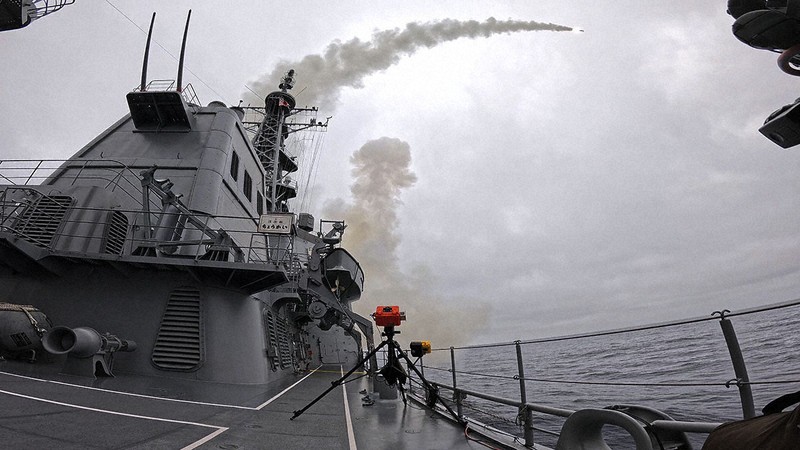
According to Naval News and USNI News, "Chokai" conducted its first live-fire test of the Tomahawk on July 29 in the Pacific Ocean, confirming that the ship and crew could execute a series of launch procedures. However, it is important to note that the acquisition of launch capability and the completion of readiness are not synonymous. The live-fire test merely confirmed the integration of the ship, launch system, combat system, and crew procedures, and ongoing operational missions will still require the management of ammunition loading, the receipt of target information, and the legal organization of engagement decisions.
In my view, it is premature to conclude that Japan can immediately operate long-range strikes freely with this return. Rather, it is closer to the reality that a ship capable of "firing" has finally returned.
The Procurement of 400 Missiles and the Modification of Five Ships Indicate a Focus on Sustained Combat Design Rather than Quantity
- Japan plans to acquire up to 400 Tomahawks through FMS.
- Block IV is scheduled for delivery from fiscal year 2025 to 2027, while Block V is expected to be delivered from fiscal year 2026 to 2027.
- There is a plan to equip five ships, including "Chokai," "Kirishima," "Haguro," "Myoko," and "Atago," with launch capability within the budget for fiscal year 2026.
- The estimated cost for the modifications of the five ships is approximately 113.6 billion yen.
At first glance, the numbers suggest that Japan is stepping into an era of long-range strikes all at once. However, from the perspective of naval power, what is crucial is not the total number of 400 missiles, but how many ships can maintain that capability in which maritime areas, and for how long, while balancing other missions. Aegis ships are primarily the core of ballistic missile defense and air defense, and the burden of air defense missions remains heavy. Adding long-range land strikes is both an enhancement of capability and a factor that complicates the distribution of the ship's missions.
The Practical Changes Brought by the Sasebo Deployment to the East China Sea and the Southwestern Islands
The fact that "Chokai" is homeported in Sasebo is symbolic. Sasebo is positioned to flexibly deploy ships in three directions: the East China Sea, the Korean Peninsula, and support for the southwestern islands in times of emergency. Therefore, this return signifies that the capability for counterattack has begun to enter the JMSDF, not as a policy discussion in the metropolitan area, but as a practical matter in the western maritime region.
However, the Tomahawk is not a weapon that can establish deterrence on its own. Due to its long range, what is needed even before the launch ship is the discovery, identification, tracking of targets, and information sharing between Japan and the United States. If Japan continues to depend on U.S. ISR assets within the Japan-U.S. alliance, Japan's counterattack capability, while formally belonging to domestic decision-making, will practically remain deeply tied to the alliance's information circuits.
The True Challenge is Not the Number of Launch Tubes but the Speed of Politics and Information
In light of this return, China and North Korea are likely to use it as propaganda regarding Japan's expansion of "offensive capabilities." However, what the adversaries are most calmly observing is not the ship itself, but when, under what conditions, and based on whose information Japan can actually decide to launch. Even with five ships, if targeting information and political decisions are delayed, the deterrent effect will be weak. Conversely, Japan's real homework is not the additional purchase of missiles, but how to balance the JMSDF's air defense missions with long-range strike missions, and to what extent it can convert the alliance's information superiority into its own readiness.
The return of "Chokai" to Sasebo is indeed evidence that the JMSDF has entered a new era. However, whether that era will truly function depends not on the number of ships with launch capability, but on the speed of information sharing and political decision-making. This is where the greatest blind spot, which has not yet been sufficiently discussed, lies.
The Japan Maritime Self-Defense Force's destroyer 'Chokai' returned to Sasebo on August 30 after acquiring Tomahawk missile capability, marking a significant enhancement in Japan's military capabilities. The ship successfully conducted its first live-fire test of the Tomahawk on July 29. Japan plans to procure up to 400 Tomahawk missiles and upgrade five Aegis destroyers to enhance its long-range strike capabilities.
- The destroyer 'Chokai' returned to Sasebo on August 30 after acquiring Tomahawk missile capability.
- The ship conducted its first live-fire test of the Tomahawk on July 29.
- Japan plans to acquire up to 400 Tomahawk missiles through FMS.
- Five Aegis destroyers will be upgraded to launch Tomahawks by 2026.
- The return of 'Chokai' signifies a shift in Japan's military capabilities.