
Disinformation follows latest Russia-linked drone incident in Poland
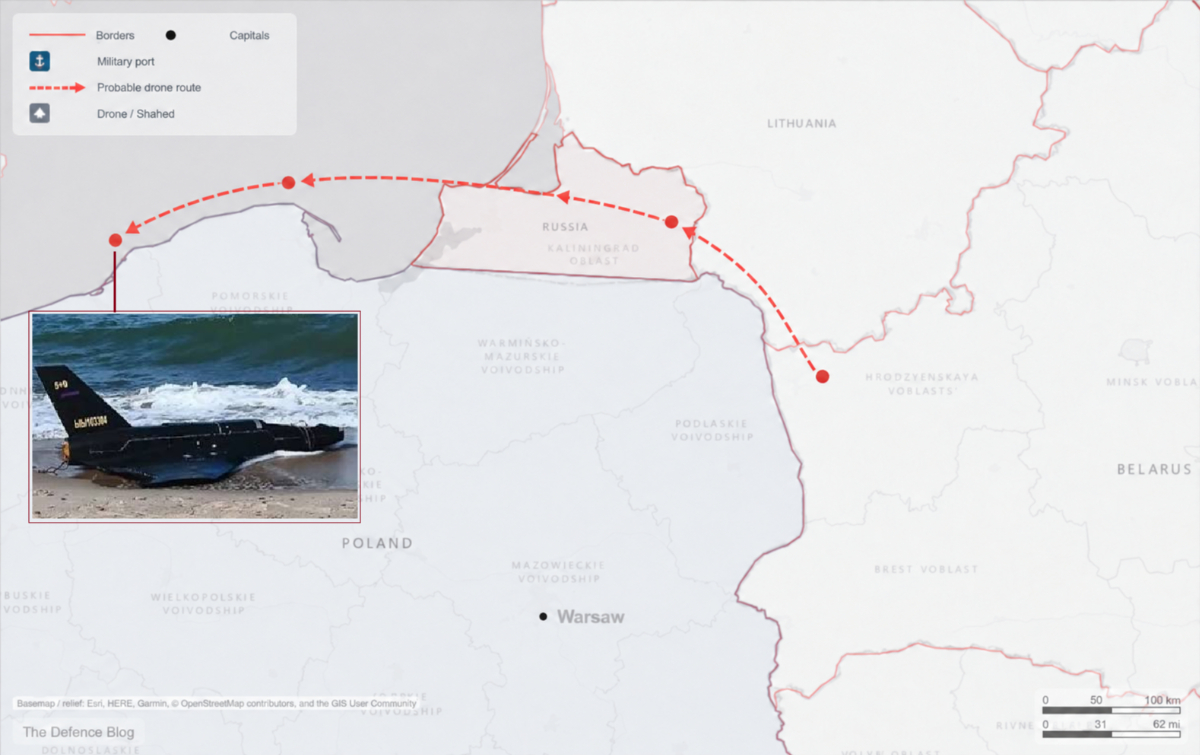
A suspected Russian drone crossed from Belarus into Lithuanian airspace this week before continuing into Russia’s Kaliningrad exclave, and a second drone following the same route the next night was shot down by an Italian fighter jet flying NATO’s Baltic Air Policing mission.
Retired Polish military pilot Michał Fiszer described the episode in a post this week, saying the route matched one Poland’s defense minister laid out publicly a day earlier. Lithuania and the Italian air unit involved both confirmed the details independently.
Polish radar tracked the first drone as it crossed the border, and wreckage recovered afterward carried a serial number beginning with the Cyrillic letters “ЫЫ,” a marking tied to Russia’s Alabuga drone plant in Tatarstan. The aircraft was a Gerbera, a cheap, plywood-and-foam drone that Ukrainian intelligence describes as a stripped-down relative of the more dangerous Shahed-136. Gerberas are built mainly to overwhelm and confuse air defenses or gather basic reconnaissance, though some carry a small explosive payload. Poland has run into this exact drone type before: in September 2025, close to 20 Gerberas turned up scattered across Polish farmland in a single overnight incursion that Warsaw called a deliberate act of Russian aggression.
An Italian Eurofighter scrambled from Šiauliai Air Base to intercept it but couldn’t reach the aircraft before it slipped into Kaliningrad. Šiauliai hosts a rotating detachment of allied jets flying NATO’s Baltic Air Policing mission, which keeps fighters on standby to respond to unidentified aircraft near the Baltic states. The unit on duty was a detachment from Italy’s 36th Fighter Wing, normally stationed at Gioia del Colle in southern Italy. The next night, the Italians were already airborne when a second drone made a similar run from Belarus. This time, they caught it and shot it down.
What followed the intercept was a deliberate disinformation push. Someone took a real photo of a Gerbera drone, one that had actually washed up on a Polish beach, and altered it before pushing it out online. The edited version swapped the drone’s genuine “ЫЫ” marking for a Polish-style “SP-” prefix, framing the aircraft as a secret Polish design under test rather than a Russian drone that had crossed the border. The claim doesn’t hold up: Poland doesn’t register drones with “SP-” codes at all. That prefix belongs to civilian aircraft. Drone operators get a code starting with “POL” instead, and individual drones aren’t registered the way manned aircraft are. The same doctored photo also changed a marking associated with newer Russian drone variants, swapping “5+0” for “540” to strip away anything that looked Russian.
The fake image spread quickly, and several mainstream Polish outlets published it before catching the discrepancy. Poland’s Ministry of National Defense and the Prime Minister’s Chancellery each posted their own corrections, setting the real photo side by side with the doctored one to make the manipulation clear to the public.
A retired Polish general, unnamed in Fiszer’s post but described as holding views sympathetic to Russia, then publicly backed the fake photo, insisting the drone really was a new Polish design in testing. The claim spread rapidly online anyway, resting entirely on a registration format Poland has never used for drones. Neither the Polish government nor NATO has issued a joint statement addressing the general’s remarks.
Content preview only. Full article available at source. View Full Article
A Russian drone crossed from Belarus into Lithuanian airspace and was tracked by Polish radar. An Italian Eurofighter shot down a second drone following the same route. Following the incident, a disinformation campaign emerged, altering images of the drone to falsely suggest it was a Polish design. Poland's Ministry of National Defense issued corrections to clarify the situation.
- A Russian drone crossed from Belarus into Lithuanian airspace and was tracked by Polish radar.
- An Italian fighter jet shot down a second drone following the same route.
- Disinformation was spread regarding the drone's origin, altering its markings to suggest it was Polish.
- The original drone was identified as a Gerbera, linked to Russian production.
- Poland's Ministry of National Defense issued corrections regarding the disinformation.