
Eastern View on Military Affairs | Why Does the U.S. Change Its Mind About Supplying Ukraine with "Patriots"?
On July 31, U.S. President Trump stated to the media during a cabinet meeting at Camp David in Maryland that he has not yet agreed to authorize Ukraine to produce "Patriot" air defense system interceptors.
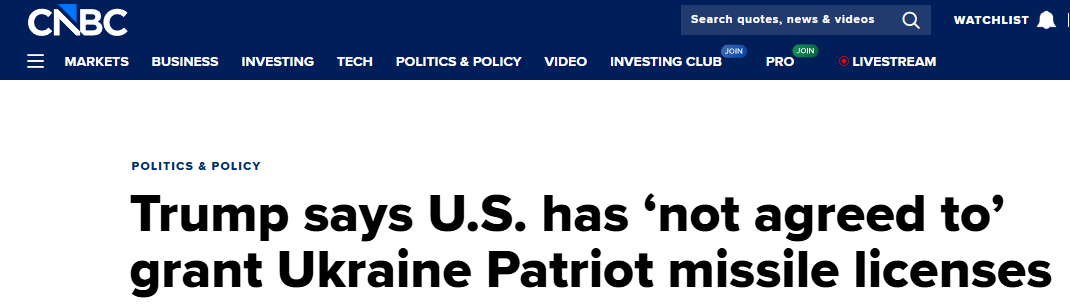
Screenshot from the U.S. Consumer News and Business Channel website
During a meeting between the presidents of the U.S. and Ukraine on July 8 at the NATO summit in Ankara, Turkey, Trump had indicated that he would authorize Ukraine to produce "Patriot" systems.
Why has the U.S. position on this matter changed repeatedly recently?
Why has Trump retracted the commitment to authorize "Patriot" production?
Less than a month after agreeing to authorize Ukraine to produce "Patriot" interceptors, President Trump changed his mind. On July 31, while discussing the Ukraine crisis, he stated that both Ukrainian and Russian leaders want to reach an agreement, but both sides must make some concessions.
He indicated that the U.S. has not yet agreed to grant Ukraine a license to produce "Patriot" interceptors, saying, "We are discussing it," and that transferring such technology "must be done very cautiously."
On July 28, after a closed-door meeting with Trump in the U.S., Zelensky stated that the two sides had a "good meeting" where they discussed Ukraine's production of "Patriot" interceptors and the need to revive diplomatic efforts to end the Russia-Ukraine conflict. At that time, Zelensky was optimistic about obtaining authorization for the production of "Patriot" interceptors.
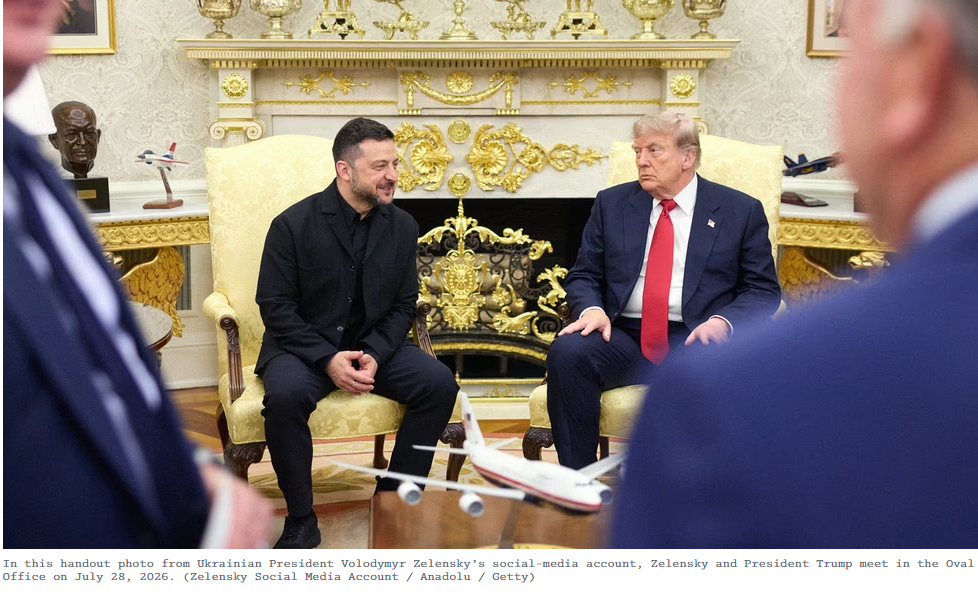
Screenshot from foreign media reports
Three considerations: U.S. military shortages, insufficient production capacity, and core technology protection
Why did Trump change his stance on authorizing Ukraine to produce "Patriot" interceptors?
Military commentator Wei Dongxu analyzes that there are three main reasons:
First, the U.S. military's "Patriot" systems are also in short supply. Currently, military conflicts between the U.S. and Iran are ongoing. The U.S. has repeatedly launched large-scale airstrikes against Iran, while Iran has retaliated against U.S. military bases in the Middle East, with ballistic missiles being the most important counterattack weapon. The defensive operations of U.S. forces in the Middle East have also continuously and significantly consumed "Patriot" interceptors, leading to a shortage of anti-missile munitions. If the "Patriot" systems in the Middle East become inoperable, the U.S. military will face a greater risk of casualties.
Second, U.S. arms manufacturers have insufficient production capacity and are unable to assist Ukraine in building a "Patriot" interceptor production line. Raytheon and Lockheed Martin are working overtime to produce "Patriot" interceptors for the U.S. military, even resuming production lines for older models of "Patriot" interceptors that had been discontinued at the request of the U.S. Army. Zelensky's proposal for Ukraine to jointly produce "Patriot" systems with Raytheon is likely to be difficult to realize.
Third, "Patriot" involves core U.S. missile defense technology, which will not be easily granted to Ukraine. If Ukraine gains the capability to produce "Patriot" interceptors with the help of European countries, U.S. arms manufacturers may face new competitors in the international defense market.
The U.S. "reversal" puts Ukraine in a passive position
What impact will the U.S. "reversal" have?
Wei Dongxu analyzes that, in the context of escalating long-range fire exchanges between Russia and Ukraine, where the Russian military is using cruise missiles, ballistic missiles, and hypersonic ballistic missiles to strike Ukrainian military airports, defense industries, military communications, and logistics centers, "Patriot" is the most effective weapon for the Ukrainian military to intercept advanced Russian missiles. If the shortage of interceptors cannot be resolved, the Ukrainian military will face a more passive situation.
Source|CCTV Global News
Commentator|Wei Dongxu
Editor|Fan Meng
Reviewed by|Yang Qiong Zhang Han
Produced by|Liu Yiyao
U.S. President Trump announced on July 31 that the U.S. will not authorize Ukraine to produce Patriot missile interceptors, reversing a prior commitment made during a NATO summit in Ankara on July 8. This decision is influenced by U.S. military shortages and concerns over technology transfer. The inability to provide Ukraine with these interceptors may leave them vulnerable amid escalating conflict with Russia.
- U.S. President Trump stated on July 31 that the U.S. has not agreed to authorize Ukraine to produce Patriot interceptors.
- Trump had previously indicated at a NATO summit on July 8 that he would authorize such production.
- The U.S. military is facing shortages of Patriot missiles due to ongoing conflicts in the Middle East.
- U.S. defense contractors are currently unable to assist Ukraine in establishing production lines for the Patriot system.
- The U.S. is concerned about sharing core missile defense technology with Ukraine.