
New Challenges for the Japan-U.S. Alliance in Advancing the Defense of the First Island Chain
 Tanaka Takashi
New Challenges for the Japan-U.S. Alliance in Advancing Denial Defense of the First Island Chain
On October 28, Defense Minister Shinjiro Koizumi and U.S. Secretary of Defense Lloyd Austin, who met in Cebu, Philippines, confirmed their policy to achieve "effective denial defense" in the First Island Chain. This line, connecting Japan, Taiwan, and the Philippines from the East China Sea to the South China Sea, represents a shift from a mere geographical concept to a space for joint operations.
Operational Concepts Highlighted by the Cebu Meeting
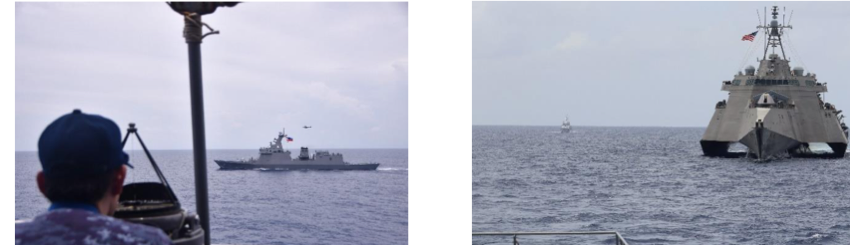
According to Mainichi Shimbun (Kyodo News), both ministers confirmed the expansion of defense investments and the maintenance of strategic alignment, with the Japanese side explaining that they would revise security-related documents by the end of the year. The Straits Times also reported that the focus of the discussions was not a political statement of "deterring China," but rather the denial capabilities that would actually make approaching the First Island Chain difficult.
From the perspective of the Japan Maritime Self-Defense Force, the core of denial defense is not a competition over the number of vessels. The question is whether the Type 12 surface-to-ship guided missile, escort ships, submarines, Air Self-Defense Force fighter jets, and U.S. ISR (Intelligence, Surveillance, and Reconnaissance) can be operated as a single firepower network from dispersed bases between the islands. Cooperation with the Philippines is significant in that it considers not only the Nansei Islands but also the SLOC (Sea Lines of Communication) that includes the Bashi Channel and the Luzon Strait.
The Gap Between Capability and Intent
However, the mere enhancement of capabilities does not automatically lead to deterrence. Japan's strengthening of defense capabilities is easily perceived by China as "containment," and it remains unclear how much the use of Philippine bases and joint surveillance will be permitted during peacetime. Furthermore, the ongoing discussions on preventing incidents involving U.S. Marines in Okinawa indicate that the integration of operational aspects and the trust of local communities are separate issues.
In my view, the weakness of the Japan-U.S. alliance lies not in the range of missiles but in whether the three countries can view the same maritime chart at the onset of a crisis. If denial defense is to be advocated, the next priority should not be the number of equipment but the speed of information sharing and political decision-making.
References
- Ministry of Defense of Japan "Japan-U.S. Defense Ministerial Meeting (Summary)"
https://www.mod.go.jp/en/article/2026/10/8dbc5c2ef47ef3843a13f3bb48dc6b00fff7ba03.html - Mainichi Shimbun (Kyodo News) "Japan, US defense chiefs meet in Philippines to boost security alliance"
https://mainichi.jp/english/articles/20261028/p2g/00m/0na/032000c - The Straits Times "Japan, US defence chiefs agree to boost deterrence amid China clout"
https://www.straitstimes.com/world/japan-us-defence-chiefs-agree-to-boost-deterrence-amid-china-clout
Japan and the U.S. confirmed plans for effective denial defense along the First Island Chain during a meeting in Cebu, Philippines on October 28. The defense ministers emphasized operational collaboration and the expansion of defense investments, with Japan set to revise security-related documents by year-end. The discussions highlighted the need for improved deterrence capabilities against China, while also addressing concerns about the perception of Japan's military enhancements.
- Japan and the U.S. confirmed plans for effective denial defense along the First Island Chain.
- The meeting took place in Cebu, Philippines on October 28.
- Japan will revise security-related documents by the end of the year.
- The focus is on operational collaboration and defense investment expansion.
- Concerns exist regarding the perception of Japan's defense enhancements as containment by China.