
EDGE and Brazil Sign Defense Memorandum in 2026 and Test Gulf Industrial Independence
 Ahmed Al-Rashid
UAE's EDGE and Brazil Sign Defense Memorandum in 2026 and Test Industrial Gulf Independence
[Abu Dhabi, October 13, 2026] The UAE's EDGE Group signed a memorandum of intent with the UAE Ministry of Defense, the Brazilian Army, and IMBEL in Abu Dhabi, in a move that at first glance appears to be a routine industrial cooperation announcement. However, it actually reveals a deeper trend in the Gulf arms market. Abu Dhabi does not want to be merely a buyer of foreign systems, and Brasília does not want to remain an importer of sensitive technologies. Both parties are trying to transform the partnership into a channel for production, modernization, and export, while the more challenging military question remains unanswered: can these arrangements produce an independent capability that is operational in war, or will it remain a beautiful political memorandum in the files of the opposition?
What the Memorandum Actually Means
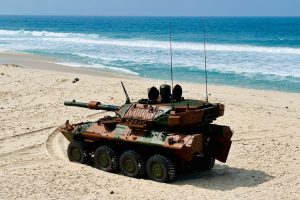
According to EDR Magazine, the memorandum aims to establish a framework for joint initiatives in defense, manufacturing, and modernization, building on previous understandings between the parties since 2014 and 2019. This wording is significant because it does not imply a final purchase contract and does not disclose a financial value or delivery schedule. Practically, we are looking at a political and industrial permission to explore projects that could include armored vehicles, munitions, unmanned systems, maintenance, and training.
The presence of IMBEL alongside the Brazilian Army gives the memorandum a substance that goes beyond government relations. The company is a well-known Brazilian industrial arm in weapons, communications, and vehicles, while EDGE is looking for markets and partners to expand its product base beyond the Gulf. The UAE Ministry of Defense provides the project with a potential customer, field testing, and institutional cover. This is a triangle different from a traditional purchase deal, but it does not become a military capability until it transforms into production lines, spare parts, maintenance teams, and training contracts.
Why Brazil Needs Abu Dhabi
Brazil has a considerable industrial base, but it faces a continuity problem. Developing a good platform is easier than maintaining its production for two decades, especially when the budget is volatile and the domestic market is limited. The Emirati partner can provide funding, export networks, and access to users in the Middle East, Africa, and Asia. Additionally, Abu Dhabi has experience in assembling companies and directing them towards export-oriented products, an expertise that technology alone cannot replace.
However, this does not mean that Brazil will relinquish its industry. The Brazilian Army wants to modernize its capabilities while retaining ownership of knowledge and freedom to use the platforms. Therefore, the most realistic cooperation will be in specific projects, such as developing 8x8 vehicles, integrating communications and sensing, or producing munitions and counter-drone systems. Transferring complete technology across all fields is not a near scenario. Countries do not hand over the keys to their sensitive industries due to a shared image in Abu Dhabi.
EDGE's Gain and Its Limits
For EDGE, the value of the agreement lies in diversifying partners away from reliance on the United States and Europe. The Emirati group has built a wide portfolio in missiles, vehicles, naval systems, and unmanned aircraft in recent years, but it still needs to prove that its products can integrate with armies that have different operational requirements. Brazil is a large market, and its military customer operates in a vast geographical environment, from the Amazon to the long land borders, imposing requirements that differ from coastal protection or facility security missions in the Gulf.
Here lies the real test. Will EDGE sell a ready-made Emirati product to Brazil, or will it participate in designing a Brazilian solution with local requirements? The second option is slower and more expensive, but it builds real industrial trust. The first option achieves a quick announcement but does not guarantee widespread use. Military experience suggests that a platform does not succeed because its manual states a longer range, but because the crew can repair it in a remote base, and because munitions, software, and communications are available when the battle begins.
The Gulf Dimension and the Political Message
The UAE wants to present itself as a defense hub capable of producing technology, not just as a wealthy buyer of Western systems. Cooperation with Brazil serves this narrative as it connects the Gulf with Latin America and opens a southern route for manufacturing and export. It also gives Abu Dhabi political leverage at a time when Turkey, South Korea, Israel, and the United States are competing for the Gulf defense market.
However, we should not confuse industrial independence with operational independence. Even the most advanced local industries need engines, chips, software, composite materials, and foreign funding sources. The UAE military, like the rest of the Gulf armies, relies on a vast Western network in areas of command, control, intelligence, and air defense. Therefore, the partnership with Brazil reduces some bottlenecks, but it does not eliminate dependency. It is a diversification of reliance, not an exit from it.
From Memorandum to Combat Capability
Four indicators should be monitored over the next twelve months. First, will a specific budget or contract emerge instead of general cooperation language? Second, will the two parties announce a pilot project, a production site, and clear ownership rights? Third, will Brazilian and Emirati military users participate in joint field trials? Fourth, is there a real plan for maintenance, training, and modernization after delivery?
In my view, the value of this memorandum is not in the number of systems that EDGE may sell to Brazil, but in testing a new industrial model for middle countries. If the model succeeds, Abu Dhabi could become a production partner rather than a permanent exhibition, and Brazil could gain funding and markets without losing its industrial identity. If it fails, the announcement will be added to a long list of defense memorandums that contained grand words but did not produce a single tank or missile.
The paradox is that the Gulf wants rapid industrial independence, while military capability requires years of training, discipline, and institutions. Equipment is one side of the capability triangle, alongside training and organization. The three countries may easily purchase the first side, but it is war that reveals whether the triangle truly stands.
Sources
EDGE Group signed a memorandum of understanding with the Brazilian Army and IMBEL in Abu Dhabi on October 13, 2026, to explore joint defense initiatives. This partnership aims to enhance local production capabilities and reduce reliance on foreign military systems. The agreement focuses on areas such as armored vehicles, munitions, and unmanned systems, indicating a shift towards industrial independence in the Gulf.
- EDGE Group signed a memorandum of understanding with the Brazilian Army and IMBEL in Abu Dhabi.
- The memorandum aims to establish a framework for joint initiatives in defense and manufacturing.
- The partnership seeks to reduce reliance on foreign military systems and enhance local production capabilities.
- Brazil aims to maintain knowledge ownership while upgrading its military capabilities through this partnership.
- The UAE is positioning itself as a defense technology producer rather than just a buyer of Western systems.