
Estonia's L-39 Gamble Exposes NATO's Russian Drone Gap
 Alexandra Reeves
Estonia's L-39 Gamble Exposes NATO's Russian Drone Gap
Estonia is considering buying light jet aircraft to shoot down Russian attack drones. That sounds like a clever local fix. It is actually a warning that NATO's Baltic air-defence model is being outpaced by the war in Ukraine.
The proposal is real, but it is not yet a procurement plan
Estonia's new defence minister, retired general Martin Herem, floated the idea after meeting President Volodymyr Zelenskyy in Kyiv, according to Defense News. He has not named an aircraft, set a budget or committed to a timetable. He is also examining computer-controlled cannon, heavy machine guns and fast interceptor drones.
That distinction matters. A minister asking officials to study a capability is not the same thing as Estonia ordering a squadron. But the underlying problem is concrete: the country has pilots and air-control expertise, yet no fighter fleet of its own. NATO allies police Baltic skies on rotation. Estonia currently leases two L-39 Albatros jets, primarily for training intercept controllers and joint terminal attack controllers, according to the Estonian Defence Forces.
Those L-39s are not an easy shortcut. They are leased civilian aircraft, and Estonia does not have the legal authority to arm them. The aircraft are useful trainers, not an instant air-defence force.
Why the drone threat is changing the calculation
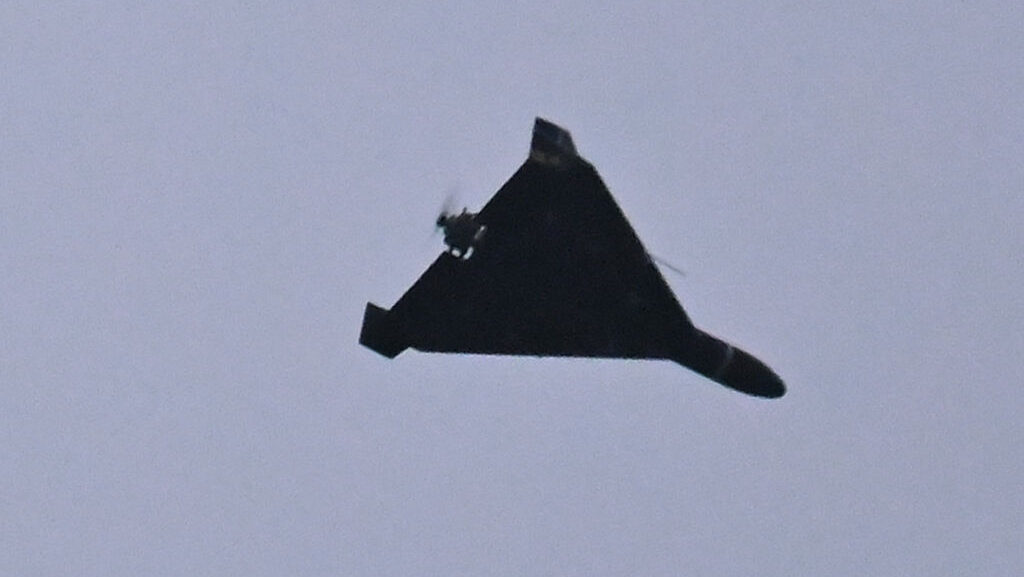
Russia's newer attack drones are not simply larger Shaheds with a new paint job. Ukrainian reporting describes the Geran-5 as capable of cruising at roughly 450 to 600 kilometres per hour, reaching up to six kilometres in altitude and travelling as far as 950 kilometres. That compresses the time available for detection, identification and engagement.
The scale is moving just as quickly. Ukraine's Air Force spokesman Yuriy Ihnat told Hromadske that Russia launched about 350 jet-powered drones in June, 1,500 in July, 2,800 in August and more than 3,500 in September. Ukrainian interception rates improved from about 40 percent in July to 60 percent in August, and reached as high as 85 percent on some days in October. That last figure is a daily result, not a stable average.
This is the central lesson for Estonia: a better interception percentage does not remove the saturation problem. A handful of drones getting through can still damage a power plant, an airfield or a port. And an expensive missile fired at every cheap airframe is a losing economic exchange.
The fighter solution has an obvious attraction
Light jets could give Estonia something it does not currently possess: a nationally controlled response option. They could launch quickly, operate under local rules and carry air-to-air weapons suited to a target moving faster than a conventional Shahed. They might also reduce the political and operational burden placed on NATO air-policing rotations.
Estonia's former air-force commander Jaak Tarien made the logic bluntly in ERR. Ground units may not reach a fast-moving drone in time, while keeping personnel deployed around the country every night would be costly. A light aircraft can cover distance quickly and return to base, which is exactly why the idea is appealing to a small state with long borders and limited manpower.
But speed alone is not a defence architecture. Aircraft need radar coverage, secure command-and-control, weapons stocks, trained maintainers, hardened bases and rules for operating in crowded peacetime airspace. Estonia would be buying a system, not just a plane.
NATO's cheaper answer is also the harder one
The more rational answer is a layered network: early-warning radar, acoustic and optical sensors, electronic warfare, interceptor drones, guns and selective use of aircraft. Ukraine's experience shows that detection can matter more than top speed. An interceptor does not have to chase a fast drone from behind if sensors identify its route early enough to place a cheaper weapon at the meeting point.
Latvia is building what it calls a “wall of drones” using radars, interceptor drones and command equipment. Lithuania has authorised accelerated purchases of interceptor drones and radars, favouring systems already tested in Ukraine. Those approaches fit NATO's broader economic reality better than using high-end fighters against every small target.
Still, Estonia's proposal exposes an uncomfortable gap. NATO planners can say heavy fighters are disproportionately expensive, but Estonia is not asking for a theoretical model. It is asking who will be there when a fast drone enters its airspace at night, during a training rotation, or while allied aircraft are committed elsewhere.
The real signal from Tallinn
Estonia is not about to become a miniature air force. The L-39 idea is a symptom of a larger alliance problem: NATO has built a system optimised for air sovereignty patrols and high-end Russian aircraft, while Russia is testing the seams with mass-produced, increasingly fast drones.
The next question is not whether Estonia buys light jets. It is whether NATO can field an affordable, common counter-drone architecture before every Baltic capital reaches the same conclusion independently. If the answer is no, the alliance will spend heavily on national improvisation while leaving the cheapest and most dangerous part of Russia's air campaign under-defended. That is a bad bargain for Europe—and an even worse one for the pilots NATO keeps sending to patch it.
Estonia is considering the purchase of light jet aircraft to counter the increasing threat of Russian attack drones. The proposal, discussed by Defense Minister Martin Herem after a meeting with President Zelenskyy in Kyiv, is not yet a formal procurement plan. Estonia currently relies on leased L-39 Albatros jets for training, highlighting a gap in its air defense capabilities. The report emphasizes the urgency of addressing the evolving drone threat as Russia escalates its drone operations.
- Estonia is considering buying light jet aircraft to counter Russian drones.
- The proposal is not yet a formal procurement plan.
- Estonia currently leases two L-39 Albatros jets for training purposes.
- Russia has significantly increased its drone launches in recent months.
- Estonia's defense minister is exploring various defense capabilities including interceptor drones.